

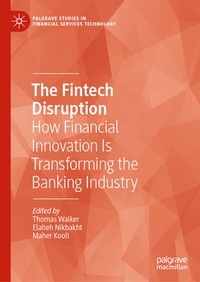
The Fintech Disruption
Description

This book provides both practice-oriented and academic insights into the disruptive power of fintech for the banking industry. It explores (1) whether and how the banking industry can use newly emerging technologies in the financial sphere to its advantage while managing any associated risks, (2) how these technologies affect traditional banking service formats as well as the pricing of these services, and (3) whether the emergence of fintech in the banking industry calls for a rethinking of existing banking regulations such as the Basel Accords as well as country-specific regulations.
Prior publications in this area typically examine both current applications of fintech in the banking industry, as well as its future prospects, by analyzing actual cases or exploring the impact of a single emerging technology on the banking industry. They often ignore the interdependence between emerging technologies and overlook the connection between fintech as a whole and the future of the banking industry. This book addresses this gap by providing a comprehensive overview of various fintech applications and by analyzing what they mean for the future of banking. Given the potentially disruptive power of fintech, the book will focus on the challenges banking supervisors are likely to encounter as a result of fintech's continual ascent. It will thus encourage readers to think about and explore how to find a balance between the beneficial aspects of fintech and the challenges it creates in terms of supervision, regulation, and risk management.More details
Other editions
Additional editions
Persons
Thomas Walker is Professor of Finance and Concordia University Research Chair in Emerging Risk Management at Concordia University, Montreal, Canada. Prior to academia, he worked for several years in the German consulting and industrial sector at Mercedes Benz, Utility Consultants International, Lahmeyer International, Telenet, and KPMG Peat Marwick.
Elaheh Nikbakht
currently serves as Data Management and Reporting Administrator in the Entity Services Department of Maples Group. In addition, she works as a Research Assistant for the Emerging Risks Information Centre and the Department of Finance at Concordia University. She holds an MBA and an MSc in Finance from Concordia University.
Maher Kooli is a Full Professor of Finance at the School of Management (ESG), Université du Québec à Montréal (UQAM) and head of the Finance Department. He is the Caisse de Depot et Placement de Québec (CDPQ) research chair-holder in portfolio management, founder of the trading room at ESG UQAM, and Autorite des marches financiers (AMF) and Finance Montreal research co-chair-holder in fintech at ESG UQAM.
Content
INTRODUCTION.- Chapter 1 Fintech and Banking: An Overview. SECTION I: FINANCIAL TECHNOLOGIES AND THEIR EFFECTS ON THE BANKING INDUSTRY.- Chapter 2 Centralized and Decentralized Finance: Coexistence or Convergence?.- Chapter 3 Fintech and the Digital Transformation of the Banking Landscape.- Chapter 4 Shifting paradigms in banking: How new service concepts and formats enhance the value of financial services.- Chapter 5 Competitors and Partners at the Same Time: On the Role of Fintech Companies in the Latvian Financial Market.- Chapter 6 Non-Fungible Tokens.- SECTION II: CHALLENGES, OPPORTUNITIES, AND REGULATIONS REGARDING FINTECH IN THE BANKING INDUSTRY.- Chapter 7 Open Banking: Opportunities and Risks.- Chapter 8 The Rise of Financial Services Ecosystems: Towards Open Banking Platforms.- Chapter 9 The Crypto-assets Market in the United Kingdom: Regulatory and Legal Challenges.- Chapter 10 A Preliminary Comparison of Two Ecosystems: Fintech Opportunities and Challenges for Financial Inclusion.- Chapter 11 Investigating Variables that Increase the Desire and Loyalty to Utilize Fintech After the COVID-19 Lockdown: A New Normal Habit.- SECTION III: EVIDENCE FROM AROUND THE WORLD.- Chapter 12 Fintech and Financial Inclusion in Developing Countries.- Chapter 13 The Cash Holdings of Fintechs and SMEs: Evidence from OECD Countries.- Chapter 14 Fintech Companies in Brazil: Assessing Their Effects on Competition in the Brazilian Financial System from 2018 to 2020.
