

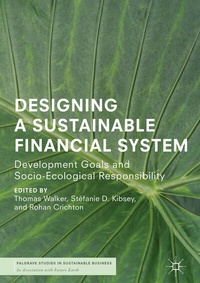
Designing a Sustainable Financial System
Description

More details
Other editions
Additional editions
Persons
Thomas Walker is Full Professor in the Department of Finance, Associate Dean, Research and Research Programs, and Co-Director of the David O'Brien Centre for Sustainable Enterprise at the John Molson School of Business at Concordia University, Canada. Prior to his academic career, he worked in the German consulting and industrial sector at firms such as Mercedes Benz, Utility Consultants International, and Telenet.
Stéfanie D. Kibsey coordinates the Sustainable Investment Professional Certification program at the John Molson School of Business at Concordia University, Canada, and she previously worked at the David O'Brien Centre for Sustainable Enterprise and La Caisse de dépôt et placement du Québec. She specializes in connecting sustainability with finance.
Rohan Crichton is a faculty member at McGill University, Canada. He is also completing his Ph.D. in management at Concordia University, Canada. Rohan brings to both roles almost twenty years of work and consulting experience garnered from such organizations as, the United Nations, the Public Service of Canada, VSO International, and Bell Canada.
Content
1. Introduction.- 2. An Alternative Finance Approach for a More Sustainable Financial System.- 3. Social and Environmental Responsibility in the Banking Industry: A Focus on Commercial Business.- 4. Seeking Greener Pastures: Exploring the Impact for Investors of ESG Integration in the Infrastructure Asset Class.- 5. Pricing Carbon: Integrating Promise, Practice, and Lessons Learned from the Chicago Climate Exchange (CCX).- 6. Designing Carbon: Neutral Investment Portfolios.- 7. Sustainability Stress Testing the Financial System: Challenges and Approaches.- 8. Responsible Investment Requires a Proxy Voting System Responsive to Retail Investors.- 9. The Creation of Social Impact Credits: Funding for Social Profit Organizations.- 10. Crowdfunding Sustainable Enterprises as a Form of Collective Action.- 11. Palm Oil: Mitigating Material Financial Risks via Sustainability.- 12. Towards a Theory of Sustainable Finance.- 13. MobilizingEarly-Stage Investments for an Innovation-Led Sustainability Transition.- 14. Financial Sector Sustainability Regulations and Voluntary Codes of Conduct: Do They Help to Create a More Sustainable Financial System?.- 15. Why Self-Commitment Is Not Enough: On a Regulated Minimum Standard for Ecologically and Socially Responsible Financial Products and Services.
