

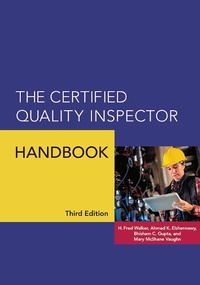
The Certified Quality Inspector Handbook
3rd Edition
Published on 9. March 2019
529 pages
978-1-951058-73-9 (ISBN)
Description

The quality inspector is the person perhaps most closely involved with day-to-day activities intended to ensure that products and services meet customer expectations. The quality inspector is required to understand and apply a variety of tools and techniques as codified in the American Society for Quality (ASQ) Certified Quality Inspector (CQI) Body of Knowledge (BoK). The tools and techniques identified in the ASQ CQI BoK include technical math, metrology, inspection and test techniques, and quality assurance. Quality inspectors frequently work with the quality function of organizations in the various measurement and inspection laboratories, as well as on the shop floor supporting and interacting with quality engineers and production/service delivery personnel.This handbook supports individuals preparing to perform, or those already performing, this type of work. It is intended to serve as a ready reference for quality inspectors and quality inspectors in training, as well as a comprehensive reference for those individuals preparing to take the ASQ CQI examination. Examples and problems used throughout the handbook are thoroughly explained, are algebra-based, and are drawn from real-world situations encountered in the quality profession.To assist readers in using this book as a ready reference or as a study aid, the book has been organized to conform explicitly to the ASQ CQI BoK. Each chapter title, all major topical divisions within the chapters, and every main point has been titled and then numbered exactly as they appear in the CQI BoK.
More details
Other editions
Additional editions
H. Fred Walker | Ahmad K. Elshennawy
The Certified Quality Inspector Handbook
Book
03/2019
3rd Edition
ASQ Quality Press
€144.40
Shipment within 10-20 days
Content
- Cover
- Title Page
- CIP Data
- Dedication
- Table of Contents
- List of Figures and Tables
- Preface
- Acknowledgments
- How to Use This Book
- Section I: Technical Mathematics
- Chapter 1: A. Basic Shop Math
- Properties of Real Numbers
- Positive and Negative Numbers
- Adding and Subtracting with Positive and Negative Numbers
- Multiplying and Dividing with Positive and Negative Numbers
- Fractions
- Equivalent Fractions
- Simplified Fractions
- Proper and Improper Fractions
- Adding and Subtracting Fractions with Like Denominators
- Adding and Subtracting Fractions with Unequal Denominators
- Adding or Subtracting Mixed Numbers
- Multiplying and Dividing Fractions
- Decimals
- Decimal and Fraction Equivalents
- Converting Fractions to Decimals
- Rational and Irrational Numbers
- Converting Decimals to Percentages
- Adding and Subtracting Decimals
- Multiplying and Dividing Decimals
- Squares and Square Roots
- Imaginary Numbers
- Exponents
- Order of Operations
- Factorials
- Truncating, Rounding, and Significant Digits
- Adding and Subtracting Measurements
- Multiplying and Dividing Using Significant Digits
- Bibliography
- Chapter 2: B. Basic Algebra
- Solving Algebraic Equations
- Properties of Real Numbers
- Inverse Operations
- Solving Equations Using One Inverse Operation
- Solving Equations Using Two or More Inverse Operations
- Solving Equations by Collecting Terms
- Solving Equations with Parentheses
- Solving Inequalities
- Solving Inequalities with Negatively Signed Values
- Bibliography
- Chapter 3: C. Basic Geometry
- Areas of Basic Geometric Shapes
- Examples of Area Calculations
- Perimeter and Circumference of Basic Geometric Shapes
- Examples of Perimeter and Circumference Calculations
- Volume of Basic Geometric Shapes
- Examples of Volume Calculations
- Surface Area of Basic Geometric Shapes
- Examples of Surface Area Calculations
- Complementary and Supplementary Angles
- Bibliography
- Chapter 4: D. Basic Trigonometry
- The Right Triangle
- Pythagorean Theorem
- Trigonometric Functions
- Values of Trigonometric Functions for Some Common Angles
- Trigonometric Identities
- Solving for Unknown Sides and Angles of a Right Triangle
- Finding the Unknown Angle
- Finding the Unknown Sides
- Inverse Trigonometric Functions
- Oblique Triangles
- Solving Oblique Triangles
- Law of Sines
- Law of Cosines
- Three Sides Known
- Two Sides and an Angle between Them Known
- One Side and Two Angles Known
- Bibliography
- Chapter 5: E. Measurement Systems
- Measurement Systems
- English System Measurements
- SI/Metric System Measurements
- English-to-SI/Metric Conversions
- Bibliography
- Chapter 6: F. Numeric Conversions
- Exponents
- Positive Exponents
- Negative Exponents
- Powers of 10
- Scientific Notation
- Procedure for Values Greater Than 1 or Less Than -1
- Procedure for Values between -1 and +1
- Converting Scientific Notation back to Original Form
- Decimals and Fractions
- Converting Fractions to Decimals
- Converting Decimals to Fractions
- Bibliography
- Section II: Metrology
- Chapter 7: A. Common Gauges and Measurement Instruments
- Introduction
- 1. Variable Gauges
- Steel Rules
- Verniers
- Micrometers
- Vernier Scales
- Digital Micrometers
- Micrometer Calipers
- Gauge Blocks
- Dial Indicators
- Borescopes
- Thermometers and Temperature Probes
- Coordinate Measuring Machines
- 2. Attribute Gauges
- Common Gauges
- 3. Transfer Gauges
- 4. Measurement Gauges
- Reference
- Bibliography
- Chapter 8: B. Special Gauges and Applications
- 1. Electronic Gauging Tools
- Advantages
- Oscilloscopes
- Multimeters
- Pyrometers
- 2. Automatic Gauging Components
- Interferometry
- Machine Vision
- X-Ray Inspection
- 3. Pneumatic Gauging Components
- 4. Force Gauging
- 5. Environmental Instrumentation
- Summary of Gauge Uses and Applications
- References
- Bibliography
- Chapter 9: C. Gauge Selection, Handling, and Use
- 1. The Rule of Ten (10:1 Rule)
- 2. Gauge Selection
- 3. Gauge Handling, Preservation, and Storage
- 4. Gauge Correlation
- Reference
- Bibliography
- Chapter 10: D. Surface Plate Tools and Techniques
- 1. Surface Plate Equipment
- Surface Plate
- Dial Indicators
- Vernier Height Gauge
- 2. Angle Measurement Instruments
- Sine Bar
- Angle Blocks
- Protractors
- Reference
- Bibliography
- Chapter 11: E. Specialized Inspection Equipment
- 1. Measuring Mass
- Weights, Balances, and Scales
- Measuring Weight and Mass
- Balances and Scales
- Surface Metrology
- 2. Measuring Finish
- 3. Measuring Shape and Profile
- Comparators
- Measurement of Roundness
- 4. Optical Equipment
- Optical Tooling
- 5. Software-Based Measurement Systems
- Machine Vision Systems
- Laser Trackers
- Other Digital Inspection Systems
- 6. Measuring Inclination
- References
- Bibliography
- Chapter 12: F. Calibration
- 1. Calibration Systems
- Calibration Interval Prompt
- Uncertainty
- Tracking and Identification Methods
- Calibration Documentation and History
- Calibration Equipment
- Calibration Procedures
- 2. Calibration Standards and Equipment Traceability
- Equipment Traceability
- 3. Gauge Calibration Environment
- 4. Out-of-Calibration Effects
- References
- Bibliography
- Chapter 13: G. Measurement System Analysis (MSA)
- 1. Process Variability
- Variability in the Measurement Process
- 2. Evaluating Measurement System Performance
- 3. The Range-Based Method
- 4. The ANOVA Method
- Gauge R&R Study-ANOVA Method
- Graphical Representation of Gauge R&R Study
- 5. Measurement Capability Indices
- MCI as a Percentage of Process Variation (MCIpv)
- MCI as a Percentage of Process Specification (MCIps)
- References
- Section III: Inspection and Test
- Chapter 14: A. Blueprints, Drawings, Geometric Dimensioning & Tolerancing (GD&T) and Model Based Definitions
- Introduction
- 1. Blueprints and Engineering Drawings, and Model Based Definitions
- Sections of Technical Drawings
- Model Based Definition
- 2. Terminology and Symbols
- 3. Position and Bonus Tolerances
- 4. Part Alignment and Datum Structure
- References
- Chapter 15: B. Sampling
- Introduction
- Advantages
- Sampling Concepts
- Random Sampling
- The Operating Characteristic Curve
- Acceptance Sampling by Attributes
- Acceptance Quality Limit
- Lot Tolerance Percent Defective
- Producer's and Consumer's Risks
- Average Outgoing Quality
- Average Outgoing Quality Limit
- Lot Size, Sample Size, and Acceptance Number
- Types of Attribute Sampling Plans
- Single Sampling Plans
- Double Sampling Plans
- Multiple Sampling Plans
- Sampling Standards and Plans
- ANSI/ASQ Z1.4-2008
- Levels of Inspection
- Types of Sampling
- Variables Sampling Plans
- ANSI/ASQ Z1.9-2008
- Sequential Sampling Plans
- Continuous Sampling Plans
- MIL-STD-1235B
- References
- Bibliography
- Chapter 16: C. Inspection Planning and Processes
- Introduction
- Inspection Planning
- 1. Inspection Types
- Incoming Material Inspection
- First-Piece Inspection
- In-Process Inspection
- Final Inspection
- 2. Inspection Errors
- Inspector Qualifications and Training
- The Characteristics of a Quality Inspector
- 3. Product Traceability
- Factors to Consider
- 4. Identification of Nonconforming Material
- Principles of Identification
- Mechanics
- 5. Levels of Severity
- Control of Nonconforming Materials
- Control of Nonconforming Product
- Corrective Action
- Preventive Action
- 6. Disposition of Nonconforming Material
- Material Segregation
- Material Review Board
- References
- Bibliography
- Chapter 17: D. Testing Methods
- 1. Nondestructive Testing
- Definition
- NDT Applications and Objectives
- Methods of NDT
- 2. Destructive Testing
- Definition
- Destructive Testing Applications and Objectives
- Methods of Destructive Testing
- 3. Functionality Testing
- Definition
- Functionality Testing Objectives
- Methods of Functionality Testing
- 4. Hardness Testing
- Brinell
- Rockwell
- Vickers
- Microhardness Test
- References
- Chapter 18: E. Software for Test Equipment
- Software Testing
- Testing versus Inspection
- Functional Testing in Software Development
- Software Testing Terminology
- Automated Software Testing
- Automated Testing Tools
- Basis Path Testing
- Basis Test Set
- Bebugging
- Benchmark Testing
- Benchmark Testing Methods
- Compatibility Testing
- Debugging
- Desk Checking
- Design-Based Testing
- Dynamic Testing
- Functional Decomposition
- Functional Requirements
- Manual Testing
- Metric
- Modified Condition/Decision Coverage
- Modified Condition/Decision Testing
- Monkey Testing
- Negative Testing
- Portability Testing
- Positive Testing
- Recovery Testing
- Security Testing
- Traceability
- Validation Testing
- References
- Bibliography
- Section IV: Quality Assurance
- Chapter 19: A. Basic Statistics and Applications
- 1. Graphical Methods
- Frequency Distribution Table
- Qualitative Data
- Quantitative Data
- Dot Plot
- Pie Chart
- Bar Chart
- Pareto Chart
- Scatter Plot
- Histograms
- Stem-and-Leaf Diagram
- 2. Numerical Methods
- Measures of Centrality
- Measures of Dispersion
- Measures of Percentages
- Box-and-Whisker Plot
- 3. Normal Distribution
- Standard Normal Distribution Table
- References
- Chapter 20: B. Statistical Process Control (SPC)
- 1. Basic Concepts of Quality and Its Benefits
- 2. Flowchart
- 3. What Is a Process?
- 4. Check Sheet
- 5. Cause-and-Effect (Fishbone or Ishikawa) Diagram
- 6. Defect Concentration Diagram
- 7. Run Chart
- 8. Control Charts
- Preparation for Use of Control Charts
- Benefits of Control Charts
- Rational Subgroups for a Control Chart
- 9. Average Run Length
- 10. Operating Characteristic Curve
- 11. Common Causes versus Special Causes
- Process Evaluation
- Action on Process
- Action on Output
- Variation
- Common Causes, or Random Causes
- Special Causes, or Assignable Causes
- 12. Control Limits versus Specification Limits
- 13. Control Charts for Variables
- Shewhart X-bar and R Control Chart
- Calculation of Sample Statistics
- Calculation of Control Limits
- Interpretation of Shewhart X-bar and R Control Charts
- Shewhart X-bar and R Control Chart When Process Mean µ and Process Standard Deviation s Are Known
- Shewhart X-bar and S Control Chart
- Calculation of Control Limits
- 14. Control Charts for Attributes
- The p Chart: Control Chart for Fraction of Nonconforming Units
- Control Limits for the p Chart
- Interpreting the Control Chart for Fraction Nonconforming
- The p Chart: Control Chart for Fraction Nonconforming with Variable Samples
- The np Chart: Control Chart for Number of Nonconforming Units
- Control Limits for np Control Chart
- The c Chart (Nonconformities versus Nonconforming Units)
- The u Chart
- 15. Process Capability Analysis
- Process Capability Index: Cp
- Process Capability Index: Cpk
- Process Capability Indices: Pp and Ppk
- References
- Chapter 21: C. Quality Improvement
- 1. Terms and Concepts
- Prevention versus Detection
- The Importance of Customer Satisfaction
- The Cost of Poor Quality
- 2. Products and Processes
- Product
- Process
- The Interrelatedness of Products and Processes
- References
- Bibliography
- Chapter 22: D. Quality Audits
- Terms and Definitions
- 1. Types of Audits
- Roles and Responsibilities in Audits
- 2. Audit Process
- 3. Audit Tools
- Checklists
- Log Sheets
- Sampling Plans
- 4. Communication Tools and Techniques
- 5. Corrective Action Requests (CARs)
- Audit Outcomes
- Audit Reporting and Follow-Up
- References
- Bibliography
- Chapter 23: E. Quality Tools and Techniques
- Seven Basic Quality Control Tools
- Bibliography
- Chapter 24: F. Problem-Solving Tools and Continuous Improvement Techniques
- 1. Plan-Do-Check-Act (PDCA) or Plan-Do-Study-Act (PDSA) Cycles
- Plan
- Do
- Check
- Act
- 2. Lean Tools for Eliminating Waste
- 5S
- Error-Proofing
- Value Stream Mapping
- Lean Concepts
- 3. Six Sigma Phases
- The Scientific Method
- Six Sigma
- Root Cause Analysis
- 4. Failure Mode and Effects Analysis (FMEA)
- Selecting a Standard for FMEA
- Planning for an FMEA
- Establishing a Single Point of Responsibility
- FMEA Team Members
- Inputs to an FMEA
- FMEA and Other Quality Tools
- Outputs from an FMEA
- Basic Steps in an FMEA
- Quantifying the Risk Associated with Each Potential Failure
- FMEAs Encountered by Quality Professionals
- Design and Process FMEA
- Heading Information and Documentation
- Analysis Content and Documentation
- A Final Word on Taking Corrective Action
- Assessing Criticality
- A Caution about Using FMEA
- Design and Process FMEA Examples
- FMEA Summary
- 5. 8D Methodology
- 6. 5 Whys
- 7. Fault Tree Analysis (FTA)
- References
- Bibliography
- Chapter 25: G. Resources
- 1. Environmental and Safety Support
- 2. Reference Documents
- 3. Employees as Resources
- Empowering Employees
- Employee Involvement
- Team Roles and Responsibilities
- Stages of Team Development
- Conflict Resolution
- Consensus
- Brainstorming
- Meeting Management
- 4. Quality Documentation
- ISO 9001
- First Article Inspection Report (FAI)
- Initial Sample Inspection Report (ISIR)
- Production Part Approval Process (PPAP)
- Basic Quality Documentation
- References
- Bibliography
- Section V: Appendices
- Appendix A: American Society for Quality Certified Quality Inspector (CQI) Body of Knowledge 2018
- Appendix B: Computer Resources to Support the CQI Handbook
- Appendix C: General Tables of Units of Measurement
- Appendix D: Standard Normal Distribution
- Appendix E: Factors Helpful in Constructing Control Charts for Variables
- Appendix F: Values of K1 for Computing Repeatability Using the Range Method
- Appendix G: Values of K2 for Computing Reproducibility Using the Range Method
- Appendix H: Sample Tables of ANSI/ASQ Z1.4-2008 and ANSI/ASQ Z1.9-2008 Standards
- Glossary of Inspection Terms
- Index
