

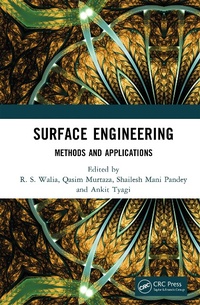
Surface Engineering
Methods and Applications
1st Edition
Published on 19. December 2022
324 pages
978-1-000-79866-1 (ISBN)
Description

Surface engineering is considered an important aspect in the reduction of friction and wear. This reference text discusses a wide range of surface engineering technologies along with applications in a comprehensive manner. The book describes various methods in surface engineering technology with a thorough explanation of various aspects of each process that comes under this domain. Apart from an enhanced explanation of the process and its attributes, this book also gives insight into the types of materials, applications, and optimization of surface engineering techniques. It discusses important topics including surface engineering of the functionality of graded materials, materials characterization, processing of biomaterials, design, surface modification technologies and process control, smart manufacturing, artificial intelligence, and machine learning applications.
The book:
discusses computational and simulation analyses for better selection of process parameters
covers optimizations of processes with state-of-the-art technologies
discusses applications of surface engineering in medical, agricultural, architecture engineering, and allied sectors
covers processing techniques of biomaterials in surface engineering
The text is useful for senior undergraduate, graduate students, and academic researchers working in diverse areas such as industrial and production engineering, mechanical engineering, materials science, and manufacturing science. It covers a hybrid process for surface modification, modeling techniques, and issues in surface engineering.
The book:
discusses computational and simulation analyses for better selection of process parameters
covers optimizations of processes with state-of-the-art technologies
discusses applications of surface engineering in medical, agricultural, architecture engineering, and allied sectors
covers processing techniques of biomaterials in surface engineering
The text is useful for senior undergraduate, graduate students, and academic researchers working in diverse areas such as industrial and production engineering, mechanical engineering, materials science, and manufacturing science. It covers a hybrid process for surface modification, modeling techniques, and issues in surface engineering.
More details
Edition
1. Auflage
Language
English
Place of publication
London
United Kingdom
Publishing group
Taylor & Francis Ltd
Target group
College/higher education
Professional and scholarly
Illustrations
32 Tables, black and white; 38 Line drawings, black and white; 62 Halftones, black and white; 80 Illustrations, color; 20 Illustrations, black and white
ISBN-13
978-1-000-79866-1 (9781000798661)
Copyright in bibliographic data and cover images is held by Nielsen Book Services Limited or by the publishers or by their respective licensors: all rights reserved.
Schweitzer Classification
Other editions
Additional editions
Book
10/2024
1st Edition
CRC Press
€75.00
Shipment within 10-20 days
Book
12/2022
1st Edition
CRC Press
€207.98
Shipment within 10-20 days
Persons
R. S. Walia is a Professor and Head of the Department of Production & Industrial Engineering, Punjab Engineering College, Chandigarh, India. He earned his Ph.D. (2006) in the area of Centrifugal Force Assisted Abrasive Flow Machining Process from IIT Roorkee, India. He has also worked as Professor at Delhi Technological University, Delhi, India. He has visited various academic institutions and industries in several countries for academic pursuits.
His research interests include Advanced Manufacturing Processes, Industrial Engineering, Work System Design and Ergonomics, Operation Research, Industrial Quality Control, Precision Manufacturing, and Advanced Manufacturing Processes such as metal coatings, free-standing metal coating components, hybrid stir casting & including tribological assessment, super-finishing processes, and re-manufacturing. He has guided 45 M.Tech theses and 14 Ph.D.s. He has published more than 100 research papers in reputed journals and conference proceedings and recieved best paper awards from Elsevier, Emerald, and Springer publication houses. He received the Commendable Research Award in recognition for his research during the year 2017, DTU, Delhi, and the Best Performance Award International Teams for NASA Moon Buggy Race at US Space and Rocket Centre, USA, April 2011. He was part of interview boards as expert member in public sector companies and government service commissions and also worked in the examination/research boards of various institutions and was involved in multiple institutional activities related to policy planning curriculum design, admission, evaluation & examination, and other academic processes.
Qasim Murtaza is a Professor in the Department of Mechanical Engineering, Delhi Technological University, (Erstwhile Delhi College of Engineering) Delhi, India. He earned his Ph.D. (2006) in the area of Manufacturing Process, Dublin City University, Ireland. He has also worked as Research Associate at Metropolitan Manchester University, Manchester, UK.
He has visited various academic institutions and industries in several countries for academic pursuits. His research interests include Precision Manufacturing and Advanced Manufacturing Processes such as metal coatings, free-standing metal coating components, hybrid stir casting & including tribological assessment, super-finishing processes, and re-manufacturing. He has guided 33 M.Tech theses and 7 Ph.D.s. He has published more than 97 research papers in reputed journals and conference proceedings and has received best paper awards from Elsevier, Emerald, and Springer publication houses. He was part of interview boards as expert member in public sector companies and government service commissions and also worked in the examination/research boards of various institutions and was involved in multiple institutional activities related to policy planning, curriculum design, admission, evaluation & examination, and other academic processes.
S. M. Pandey is an Assistant Professor in the Department of Mechanical Engineering, National Institute of Technology (NIT) Patna, Patna, India. He earned his Ph.D. (2017) in the area of Manufacturing Process in Advance Coating, Delhi Technological University, Delhi, India. He has also worked as Assistant Professor at Delhi Technological University. His areas of research include Surface Modification, Coating, Tribology, and Material Processing; Composite Materials; Metal Matrix Nanocomposites; Nano-Coatings; Wear; Deformation and Corrosion. He also has a good command over teaching subjects like Welding Technology, Casting, Wear Mechanics, Material Science, Non-Destructive Testing, Metrology, and Composite Materials. Dr. Pandey has over 2 years of Industry Experience at Shriram Pistons and Rings Limited (SPRL) Ghaziabad in the field of Production Planning and Control and 8.5 plus years of teaching and research in various reputed organizations such as Delhi Technological University and NIT Patna. During this period, he has published 35 research papers in peer-reviewed international journals having good impact factors and 28 research papers in reputed international and national conferences in India as well as in abroad. Apart from this, recently, he has also published 1 chapter in books published by Springer. Nine students have completed their B.Tech projects and 6 students have completed their M.Tech dissertations under his guidance.
Ankit Tyagi is an Assistant Professor in the Department of Mechanical Engineering, SGT University, Haryana, India. He is pursuing his Ph.D. in the area of Manufacturing Process in Advance Coating, Delhi Technological University, Delhi, India. He has visited various academic institutions and industries in several countries for academic pursuits. His areas of research include Surface Modification, Coating, Tribology, and Material Processing; Composite Materials; Metal Matrix Nanocomposites; Nano-Coatings; Wear; Deformation and Corrosion. He also has a good command over teaching subjects like Welding Technology, Casting, Wear Mechanics, Material Science, Non-Destructive Testing, Metrology, and Composite Materials. He has published more than 30 research papers in reputed journals and conference proceedings.
His research interests include Advanced Manufacturing Processes, Industrial Engineering, Work System Design and Ergonomics, Operation Research, Industrial Quality Control, Precision Manufacturing, and Advanced Manufacturing Processes such as metal coatings, free-standing metal coating components, hybrid stir casting & including tribological assessment, super-finishing processes, and re-manufacturing. He has guided 45 M.Tech theses and 14 Ph.D.s. He has published more than 100 research papers in reputed journals and conference proceedings and recieved best paper awards from Elsevier, Emerald, and Springer publication houses. He received the Commendable Research Award in recognition for his research during the year 2017, DTU, Delhi, and the Best Performance Award International Teams for NASA Moon Buggy Race at US Space and Rocket Centre, USA, April 2011. He was part of interview boards as expert member in public sector companies and government service commissions and also worked in the examination/research boards of various institutions and was involved in multiple institutional activities related to policy planning curriculum design, admission, evaluation & examination, and other academic processes.
Qasim Murtaza is a Professor in the Department of Mechanical Engineering, Delhi Technological University, (Erstwhile Delhi College of Engineering) Delhi, India. He earned his Ph.D. (2006) in the area of Manufacturing Process, Dublin City University, Ireland. He has also worked as Research Associate at Metropolitan Manchester University, Manchester, UK.
He has visited various academic institutions and industries in several countries for academic pursuits. His research interests include Precision Manufacturing and Advanced Manufacturing Processes such as metal coatings, free-standing metal coating components, hybrid stir casting & including tribological assessment, super-finishing processes, and re-manufacturing. He has guided 33 M.Tech theses and 7 Ph.D.s. He has published more than 97 research papers in reputed journals and conference proceedings and has received best paper awards from Elsevier, Emerald, and Springer publication houses. He was part of interview boards as expert member in public sector companies and government service commissions and also worked in the examination/research boards of various institutions and was involved in multiple institutional activities related to policy planning, curriculum design, admission, evaluation & examination, and other academic processes.
S. M. Pandey is an Assistant Professor in the Department of Mechanical Engineering, National Institute of Technology (NIT) Patna, Patna, India. He earned his Ph.D. (2017) in the area of Manufacturing Process in Advance Coating, Delhi Technological University, Delhi, India. He has also worked as Assistant Professor at Delhi Technological University. His areas of research include Surface Modification, Coating, Tribology, and Material Processing; Composite Materials; Metal Matrix Nanocomposites; Nano-Coatings; Wear; Deformation and Corrosion. He also has a good command over teaching subjects like Welding Technology, Casting, Wear Mechanics, Material Science, Non-Destructive Testing, Metrology, and Composite Materials. Dr. Pandey has over 2 years of Industry Experience at Shriram Pistons and Rings Limited (SPRL) Ghaziabad in the field of Production Planning and Control and 8.5 plus years of teaching and research in various reputed organizations such as Delhi Technological University and NIT Patna. During this period, he has published 35 research papers in peer-reviewed international journals having good impact factors and 28 research papers in reputed international and national conferences in India as well as in abroad. Apart from this, recently, he has also published 1 chapter in books published by Springer. Nine students have completed their B.Tech projects and 6 students have completed their M.Tech dissertations under his guidance.
Ankit Tyagi is an Assistant Professor in the Department of Mechanical Engineering, SGT University, Haryana, India. He is pursuing his Ph.D. in the area of Manufacturing Process in Advance Coating, Delhi Technological University, Delhi, India. He has visited various academic institutions and industries in several countries for academic pursuits. His areas of research include Surface Modification, Coating, Tribology, and Material Processing; Composite Materials; Metal Matrix Nanocomposites; Nano-Coatings; Wear; Deformation and Corrosion. He also has a good command over teaching subjects like Welding Technology, Casting, Wear Mechanics, Material Science, Non-Destructive Testing, Metrology, and Composite Materials. He has published more than 30 research papers in reputed journals and conference proceedings.
Content
Chapter 1
Surface Engineering: Redefining surface in global perspective
Shubhangi Chourasia, Ankit Tyagi, SM Pandey, Kalpana Gupta, Abdul Faheem, Qasim Murtaza, RS Walia
Chapter 2
Tribological Hybrid Materials
Aarti P. More, Pradnya D. Desai
Chapter 3
Nanotechnology and Surface Engineering
Pankaj Shrivastava, Arka Ghosh, Syed Nasimul Alam
Chapter 4
Surface engineering of nanomaterials: Processing and applications
Mainak Saha, Manab Mallik
Chapter 5
Laser surface modification of metal additive manufactured parts: A case study on ex-situ and in-situ methodology
Abhishek Kumar, Bijaya Bikram Samal, Ashish Kumar Nath, Cheruvu Siva Kumar
Chapter 6
Review of Materials and Methods in 3D Printing
Ganeshkumar S, Naveen prabhu V, Sathish K, Vivek R
Chapter 7
The Frame Work of Combining Artificial Intelligence in Additive Manufacturing
Ganeshkumar S, Deepika T, Sureshkumar R, Naveen prabhu V
Chapter 8
A review on metallic deposition in polymer substrate under cold spray additive manufacturing approach
Abdul Faheem, Faisal Hasan, Shubhangi Chourasia, Ankit Tyagi, SM Pandey, Qasim Murtaza
Chapter 9
Anodization of the Implantable Metal and Alloy Surfaces: Purpose and Scope,
Sikta Panda, Chandan Kumar Biswas, Subhankar Paul
Chapter 10
Effect of surface treatment of cenospheres on the mechanical properties of cenosphere/ recycled-PET composites
B. Krishna Prabhu, S. M. Kulkarni, Ajith G. Joshi
Chapter 11
Effect of performance parameters, surface failure and mitigation techniques of steam Turbine blades
Satyajeet Kumar, Shailesh Mani Pandey
Chapter 12
Performance Analysis of Tidal Turbine Blades for Different Composite Materials
R Deepak Suresh Kumar, Justin Joseph, K B Vigneshwara, K T Yugendheran, N Adithya
Chapter 13
Surface Texturing for Improved Sliding Friction and Wear under Dry and Lubricated Conditions
Peddakondigalla Venkateswara Babu, Syed Ismail, Vasavi Boggarapu
Chapter 14
Industry 5.0 for sustainable manufacturing: New product, services, organizational and social information
Shubhangi Chourasia, Ankit Tyagi, SM Pandey, Kalpana Gupta, Dinesh Deshwal, Qasim Murtaza2, RS Walia
Chapter 15
Surface Modification of Titanium for Drug-Eluting Stents
Monalisha Mohanta, A. Thirugnanam
Chapter 16
Dry Sliding Wear Behavior of HVOF Sprayed Cermet (CrC-NiCr, WC-Co & WC-Co-Cr) Coatings using Statistical Analysis and ANN Model
R Suresh, Ajith G. Joshi, M. Manjaiah
Surface Engineering: Redefining surface in global perspective
Shubhangi Chourasia, Ankit Tyagi, SM Pandey, Kalpana Gupta, Abdul Faheem, Qasim Murtaza, RS Walia
Chapter 2
Tribological Hybrid Materials
Aarti P. More, Pradnya D. Desai
Chapter 3
Nanotechnology and Surface Engineering
Pankaj Shrivastava, Arka Ghosh, Syed Nasimul Alam
Chapter 4
Surface engineering of nanomaterials: Processing and applications
Mainak Saha, Manab Mallik
Chapter 5
Laser surface modification of metal additive manufactured parts: A case study on ex-situ and in-situ methodology
Abhishek Kumar, Bijaya Bikram Samal, Ashish Kumar Nath, Cheruvu Siva Kumar
Chapter 6
Review of Materials and Methods in 3D Printing
Ganeshkumar S, Naveen prabhu V, Sathish K, Vivek R
Chapter 7
The Frame Work of Combining Artificial Intelligence in Additive Manufacturing
Ganeshkumar S, Deepika T, Sureshkumar R, Naveen prabhu V
Chapter 8
A review on metallic deposition in polymer substrate under cold spray additive manufacturing approach
Abdul Faheem, Faisal Hasan, Shubhangi Chourasia, Ankit Tyagi, SM Pandey, Qasim Murtaza
Chapter 9
Anodization of the Implantable Metal and Alloy Surfaces: Purpose and Scope,
Sikta Panda, Chandan Kumar Biswas, Subhankar Paul
Chapter 10
Effect of surface treatment of cenospheres on the mechanical properties of cenosphere/ recycled-PET composites
B. Krishna Prabhu, S. M. Kulkarni, Ajith G. Joshi
Chapter 11
Effect of performance parameters, surface failure and mitigation techniques of steam Turbine blades
Satyajeet Kumar, Shailesh Mani Pandey
Chapter 12
Performance Analysis of Tidal Turbine Blades for Different Composite Materials
R Deepak Suresh Kumar, Justin Joseph, K B Vigneshwara, K T Yugendheran, N Adithya
Chapter 13
Surface Texturing for Improved Sliding Friction and Wear under Dry and Lubricated Conditions
Peddakondigalla Venkateswara Babu, Syed Ismail, Vasavi Boggarapu
Chapter 14
Industry 5.0 for sustainable manufacturing: New product, services, organizational and social information
Shubhangi Chourasia, Ankit Tyagi, SM Pandey, Kalpana Gupta, Dinesh Deshwal, Qasim Murtaza2, RS Walia
Chapter 15
Surface Modification of Titanium for Drug-Eluting Stents
Monalisha Mohanta, A. Thirugnanam
Chapter 16
Dry Sliding Wear Behavior of HVOF Sprayed Cermet (CrC-NiCr, WC-Co & WC-Co-Cr) Coatings using Statistical Analysis and ANN Model
R Suresh, Ajith G. Joshi, M. Manjaiah
