

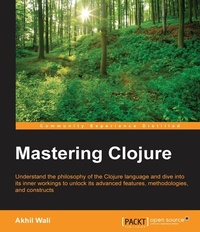
Mastering Clojure
Understand the philosophy of the Clojure language and dive into its inner workings to unlock its advanced features, methodologies, and constructs
Published on 13. January 2025
266 pages
978-1-78588-205-0 (ISBN)
Description

Understand the philosophy of the Clojure language and dive into its inner workings to unlock its advanced features, methodologies, and constructs
Key Features
[*] Learn to handle data using sequences, reducers, and transducers in Clojure
[*] Explore the lesser known and more advanced features, constructs, and methodologies of the Clojure language and its ecosystem, such as asynchronous channels, actors, logic programming, and reactive programming
[*] Sharpen your Clojure skills through illustrative and comprehensive examples
Book DescriptionClojure is a general-purpose language from the Lisp family with an emphasis on functional programming. It has some interesting concepts and features such as immutability, gradual typing, thread-safe concurrency primitives, and macro-based metaprogramming, which makes it a great choice to create modern, performant, and scalable applications. Mastering Clojure gives you an insight into the nitty-gritty details and more advanced features of the Clojure programming language to create more scalable, maintainable, and elegant applications. You'll start off by learning the details of sequences, concurrency primitives, and macros. Packed with a lot of examples, you'll get a walkthrough on orchestrating concurrency and parallelism, which will help you understand Clojure reducers, and we'll walk through composing transducers so you know about functional composition and process transformation inside out. We also explain how reducers and transducers can be used to handle data in a more performant manner. Later on, we describe how Clojure also supports other programming paradigms such as pure functional programming and logic programming. Furthermore, you'll level up your skills by taking advantage of Clojure's powerful macro system. Parallel, asynchronous, and reactive programming techniques are also described in detail. Lastly, we'll show you how to test and troubleshoot your code to speed up your development cycles and allow you to deploy the code faster. What you will learn
[*] Maximize the impact of parallelization, functional composition, and process transformation by composing reducers and transducers
[*] Process and manipulate data using sequences, reducers, and transducers in Clojure
[*] Modify and add features to the Clojure language using macros
[*] Explore the features of category theory and custom data sources for logic programming in Clojure
[*] Orchestrate parallelism and concurrency using built-in primitives as well as community libraries in Clojure
[*] Handle data with asynchronous and reactive programming methodologies and leverage it using the core.async library
[*] Test your code with unit tests, specs, and type checks to write testable code
[*] Troubleshoot and style your Clojure code to make it more maintainable
Who this book is forIf you're looking to learn more about the core libraries and dive deep into the Clojure language, then this book is ideal for you. Prior knowledge of the Clojure language is required.
Key Features
[*] Learn to handle data using sequences, reducers, and transducers in Clojure
[*] Explore the lesser known and more advanced features, constructs, and methodologies of the Clojure language and its ecosystem, such as asynchronous channels, actors, logic programming, and reactive programming
[*] Sharpen your Clojure skills through illustrative and comprehensive examples
Book DescriptionClojure is a general-purpose language from the Lisp family with an emphasis on functional programming. It has some interesting concepts and features such as immutability, gradual typing, thread-safe concurrency primitives, and macro-based metaprogramming, which makes it a great choice to create modern, performant, and scalable applications. Mastering Clojure gives you an insight into the nitty-gritty details and more advanced features of the Clojure programming language to create more scalable, maintainable, and elegant applications. You'll start off by learning the details of sequences, concurrency primitives, and macros. Packed with a lot of examples, you'll get a walkthrough on orchestrating concurrency and parallelism, which will help you understand Clojure reducers, and we'll walk through composing transducers so you know about functional composition and process transformation inside out. We also explain how reducers and transducers can be used to handle data in a more performant manner. Later on, we describe how Clojure also supports other programming paradigms such as pure functional programming and logic programming. Furthermore, you'll level up your skills by taking advantage of Clojure's powerful macro system. Parallel, asynchronous, and reactive programming techniques are also described in detail. Lastly, we'll show you how to test and troubleshoot your code to speed up your development cycles and allow you to deploy the code faster. What you will learn
[*] Maximize the impact of parallelization, functional composition, and process transformation by composing reducers and transducers
[*] Process and manipulate data using sequences, reducers, and transducers in Clojure
[*] Modify and add features to the Clojure language using macros
[*] Explore the features of category theory and custom data sources for logic programming in Clojure
[*] Orchestrate parallelism and concurrency using built-in primitives as well as community libraries in Clojure
[*] Handle data with asynchronous and reactive programming methodologies and leverage it using the core.async library
[*] Test your code with unit tests, specs, and type checks to write testable code
[*] Troubleshoot and style your Clojure code to make it more maintainable
Who this book is forIf you're looking to learn more about the core libraries and dive deep into the Clojure language, then this book is ideal for you. Prior knowledge of the Clojure language is required.
All prices
More details
Edition
Digital original
Language
English
Place of publication
Birmingham
United Kingdom
Target group
US School Grade: College Graduate Student
Edition type
Digital original
File size
1,69 MB
ISBN-13
978-1-78588-205-0 (9781785882050)
Copyright in bibliographic data and cover images is held by Nielsen Book Services Limited or by the publishers or by their respective licensors: all rights reserved.
Schweitzer Classification
Other editions
Additional editions
Person
Wali Akhil :
Akhil Wali is a software developer. He has been writing code as a hobbyist since 1997 and professionally since 2010. He completed his post graduation from Santa Clara University in 2010, and he graduated from Visvesvaraya Technological University in 2008. His areas of work include business intelligence systems, ERP systems, search engines, and document collaboration tools. He mostly works with Clojure, JavaScript, and C#. Apart from computers, his interests include soccer, guitar solos, and finding out more about the universe.
Akhil Wali is a software developer. He has been writing code as a hobbyist since 1997 and professionally since 2010. He completed his post graduation from Santa Clara University in 2010, and he graduated from Visvesvaraya Technological University in 2008. His areas of work include business intelligence systems, ERP systems, search engines, and document collaboration tools. He mostly works with Clojure, JavaScript, and C#. Apart from computers, his interests include soccer, guitar solos, and finding out more about the universe.
Content
Table of Contents
Working with Sequences and Types
Orchestrating Concurrency and Parallelism
Parallelization using Reducers
Writing Macros
Composing Transducers
Using Functors and Monads
Programming with Logic
Leveraging Asynchronous Tasks
Reactive Programming
Working with Tests
Troubleshooting and Best Practices
Working with Sequences and Types
Orchestrating Concurrency and Parallelism
Parallelization using Reducers
Writing Macros
Composing Transducers
Using Functors and Monads
Programming with Logic
Leveraging Asynchronous Tasks
Reactive Programming
Working with Tests
Troubleshooting and Best Practices

