

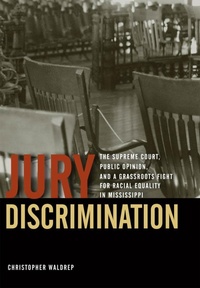
Jury Discrimination
Description

In 1906 a white lawyer named Dabney Marshall argued a case before the Mississippi Supreme Court demanding the racial integration of juries. He carried out a plan devised by Mississippi's foremost black lawyer of the time: Willis Mollison. Against staggering odds, and with the help of a friendly newspaper editor, he won. How Marshall and his allies were able to force the court to overturn state law and precedent, if only for a brief period, at the behest of the U.S. Supreme Court is the subject of Jury Discrimination, a book that explores the impact of the Civil War and Reconstruction on America's civil rights history.
Christopher Waldrep traces the origins of Americans' ideas about trial by jury and provides the first detailed analysis of jury discrimination. Southerners' determination to keep their juries entirely white played a crucial role in segregation, emboldening lynchers and vigilantes like the Ku Klux Klan. As the postbellum Congress articulated ideals of national citizenship in civil rights legislation, most importantly the Fourteenth Amendment, factions within the U.S. Supreme Court battled over how to read the amendment: expansively, protecting a variety of rights against a host of enemies, or narrowly, guarding only against rare violations by state governments. The latter view prevailed, entombing the amendment in a narrow interpretation that persists to this day.
Although the high court clearly denounced the overt discrimination enacted by state legislatures, it set evidentiary rules that made discrimination by state officers and agents extremely difficult to prove. Had these rules been less onerous, Waldrep argues, countless black jurors could have been seated throughout the nation at precisely the moment when white legislators and jurists were making and enforcing segregation laws. Marshall and Mollison's success in breaking through Mississippi law to get blacks admitted to juries suggests that legal reasoning plausibly founded on constitutional principle, as articulated by the Supreme Court, could trump even the most stubbornly prejudiced public opinion.
More details
Other editions
Additional editions
Person
Content
- Cover
- Contents
- Acknowledgments
- Introduction
- ONE: Making the Fairy Tale
- TWO: The Discovery That Race Politicizes Due Process
- THREE: How Revolutionary Was the Civil War?
- FOUR: Privileges and Immunities in the Supreme Court
- FIVE: The Jury Cases
- SIX: Getting Blacks on Mississippi Juries
- Conclusion
- APPENDIX 1 States Discriminating by Property and Race in Their Statutes
- APPENDIX 2 States Linking Jury Service to Constitutional Suffrage Requirements
- APPENDIX 3 States Relying on Local Discrimination
- APPENDIX 4 Members of the House of Representatives for and against the Fourteenth Amendment, Thirty-ninth Congress, First Session
- Notes
- Bibliography
- Index
- A
- B
- C
- D
- E
- F
- G
- H
- I
- J
- K
- L
- M
- N
- O
- P
- Q
- R
- S
- T
- U
- V
- W
- Y
- Z
