

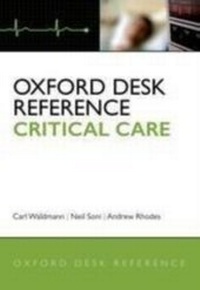
Oxford Desk Reference
Critical Care
1st Edition
Published on 27. November 2008
629 pages
978-0-19-155199-4 (ISBN)
Description

Critical care medicine is an evolving speciality in which the amount of available information is growing daily and spread across a myriad of books, journals and websites. This essential guide brings together this information in an easy-to-use format. Up-to-date, relevant, and evidence-based information on the management of the critically ill is combined in one resource, ideal for the use of Intensive Care Units, High Dependency Units, acute medical or surgical wards, Accident and Emergency departments and operating theatres. The book is designed such that each subject will form a self-contained topic in its own right, laid out across two or four pages to facilitate the key aim of rapid and easy access to information. This makes the information included simple to find, read and absorb, so that the book can be consulted in the clinic or ward setting for information on the optimum management of a particular condition. With chapters written by internationally renowned critical care specialists and edited by the three of the leading figures in UK Critical Care, this book should be an essential resource for all critical care physicians.
More details
Other editions
Additional editions
Carl Waldmann | Neil Soni | Andrew Rhodes
Oxford Desk Reference: Critical Care
Book
11/2008
Oxford University Press
€118.85
Article exhausted; check different version
Content
- Intro
- Contents
- Abbreviations
- Contributors
- 1 Respiratory therapy techniques
- Oxygen therapy
- Ventilatory support: indications
- IPPV-description of ventilators
- IPPV-modes of ventilation
- IPPV-adjusting the ventilator
- IPPV-barotrauma
- IPPV-weaning techniques
- High-frequency ventilation
- Positive end-respiratory pressure
- Continuous positive airway pressure ventilation (CPAP)
- Recruitment manoeuvres
- Prone position ventilation
- Non-invasive positive pressure ventilation (NIPPV)
- Extracorporeal membrane oxygenation (ECMO) for adults in respiratory failure
- Tracheostomy
- Aftercare of the patient with a tracheostomy
- Chest drain insertion
- Pleural aspiration
- Flexible bronchoscopy
- Chest physiotherapy
- Humidification
- Heart-lung interactions
- 2 Cardiovascular therapy techniques
- Defibrillation
- Temporary cardiac pacing
- Intra-aortic balloon counterpulsation pump
- Cardiac assist devices
- Therapeutic cooling
- 3 Renal therapy techniques
- Haemodialysis
- Haemo(dia)filtration
- Peritoneal dialysis (PD)
- 4 Gastrointestinal therapy techniques
- Insertion of a Sengstaken-Blakemore tube in critical care
- Upper gastrointestinal endoscopy
- Nasojejunal feeding in critical care patients
- 5 Nutrition
- Enteral nutrition
- Parenteral nutrition
- Immune-enhancing nutrition
- 6 Respiratory monitoring
- Pulmonary function tests in critical illness
- End-tidal CO2 monitoring
- Pulse oximetry
- 7 Cardiovascular monitoring
- ECG monitoring
- Arterial pressure monitoring
- Insertion of central venous catheters
- Common problems with central venous access
- Pulmonary artery catheter: indications and use
- Pulmonary artery catheter: insertion
- Echocardiography
- Clinical application of echocardiography in the ICU
- Doppler
- Pulse pressure algorithms
- Non-invasive methods
- Measurement of preload status
- Detection of fluid responsiveness
- 8 Neurological monitoring
- Intracranial pressure monitoring
- Intracranial perfusion
- EEG and CFAM monitoring
- Other forms of neurological monitoring
- 9 Fluids
- Crystalloids
- Colloids
- Sodium bicarbonate
- Blood
- 10 Respiratory drugs
- Bronchodilators
- Nitric oxide
- Mucolytics
- Surfactant
- Helium-oxygen gas mixtures
- 11 Cardiovascular drugs
- ß-Adrenergic agonists
- Phosphodiesterase inhibitors
- Vasodilators
- Vasopressors
- Antiarrhythmic agents
- Chronotropes
- Antianginal agents
- Antiplatelet agents
- Diuretics and the critically ill
- Levosimendan
- 12 Gastrointestinal drugs
- H2 blockers and proton pump inhibitors
- Antiemetics
- Gut motility agents
- Antidiarrhoeals
- Constipation in critical care
- 13 Neurological drugs
- Opioid and non-opioid analgesics in the ICU
- Sedation management in ICU
- Muscle relaxants
- Anticonvulsant drugs
- Cerebroprotective agents
- Mannitol and hypertonic saline
- 14 Haematological drugs
- Anticoagulants and heparin-induced thrombocytopenia
- Thrombolysis
- Antifibrinolytics
- 15 Miscellaneous drugs
- Antibiotics
- Antifungals
- Antiviral agents
- N-Acetylcysteine
- Activated protein C
- 16 Resuscitation
- Basic and advanced resuscitation
- Post-cardiac arrest management
- Fluid challenge
- 17 Respiratory disorders
- Upper airway obstruction
- Respiratory failure
- Pulmonary collapse and atelectasis
- Chronic obstructive pulmonary disease (COPD)
- ARDS: diagnosis
- ARDS: general management
- ARDS: ventilatory management
- Asthma
- Asthma: ventilatory management
- Pneumothorax
- Empyema
- Haemoptysis
- Inhalation injury
- Pulmonary embolism
- Community-acquired pneumonia
- Hospital-acquired pneumonia
- Pulmonary hypertension
- 18 Cardiovascular disorders
- Hypertension
- Tachyarrhythmias
- Bradyarrhythmias
- Myocardial infarction: diagnosis
- NSTEMI
- STEMI
- Acute heart failure: assessment
- Acute heart failure: management
- Bacterial endocarditis
- 19 Renal disorders
- Prevention of acute renal failure
- Diagnosis of acute renal failure
- 20 Gastrointestinal disorders
- Vomiting and gastric stasis/gastroparesis
- Gastric erosions
- Diarrhoea
- Upper gastrointestinal haemorrhage (non-variceal)
- Bleeding varices
- Intestinal perforation
- Intestinal obstruction
- Lower gastrointestinal bleeding
- Colitis
- Intra-abdominal sepsis
- Pancreatitis
- Acute acalculous cholecystitis
- Splanchnic ischaemia
- Abdominal hypertension (IAH) and abdominal compartment syndrome
- 21 Hepatic disorders
- Jaundice
- Acute liver failure
- Hepatic encephalopathy
- Chronic liver failure
- Abnormal liver function tests
- 22 Neurological disorders
- Agitation and confusion
- Status epilepticus
- Meningitis
- Intracerebral haemorrhage
- Subarachnoid haemorrhage
- Ischaemic stroke
- Guillain-Barre syndrome
- Myasthenia gravis
- ICU neuromuscular disorders
- Tetanus
- Botulism
- Neurorehabilitation
- Hyperthermias
- 23 Haematological disorders
- Bleeding disorders
- Anaemia in critical care
- Sickle cell anaemia
- Haemolysis
- Disseminated intravascular coagulation
- Neutropenic sepsis
- Haematological malignancies in the ICU
- Coagulation monitoring
- 24 Metabolic disorders
- Electrolyte disorders
- Hyponatraemia
- Hypernatraemia
- Categorizing metabolic acidoses
- Metabolic acidosis aetiology
- Metabolic alkalosis
- Glycaemic control in the critically ill
- Diabetic ketoacidosis
- Hyperosmolar diabetic emergencies
- Thyroid emergencies: thyroid crisis/thyrotoxic storm
- Thyroid emergencies: myxoedema coma
- Hypoadrenal crisis
- 25 Poisoning
- Management of acute poisoning
- 26 Shock
- Shock: definition and diagnosis
- Hypovolaemic shock
- Cardiogenic shock
- Anaphylactic shock
- Septic shock: pathogenesis
- 27 Infection and inflammation
- Pathophysiology of sepsis and multi-organ failure
- Infection control-general principles
- HIV
- Severe falciparum malaria
- Vasculitides in the ICU
- Source control
- Selective decontamination of the digestive tract (SDD)
- Markers of infection
- Adrenal insufficiency and sepsis
- 28 Trauma and burns
- Initial management of major trauma
- Head injury
- Spinal trauma
- Chest trauma
- Pelvic trauma
- Burns-fluid management
- Burns-general management
- 29 Physical disorders
- Hypothermia
- Drowning and near-drowning
- Rhabdomyolysis
- Pressure sores
- 30 Pain and post-operative intensive care
- Pain management in ICU
- Intensive care for the high risk surgical patient
- The acute surgical abdomen in the ITU
- The medical patient with surgical problems
- 31 Obstetric emergencies
- Pre-eclampsia
- Eclampsia
- HELLP syndrome
- Postpartum haemorrhage
- Amniotic fluid embolism
- 32 Death and dying
- Confirming death using neurological criteria (brainstem death)
- Withdrawing and withholding treatment
- The potential heart-beating organ donor
- Non-heart-beating organ donation
- 33 ICU organization and management
- Consent on the ICU
- Rationing in critical care
- ICU layout
- Medical staffing in critical care
- ICU staffing: nursing
- ICU staffing: supporting professions
- Fire safety
- Legal issues and the Coroner
- Patient safety
- Severity of illness scoring systems
- Comparison of ICUs
- Critical care disaster planning
- Health technology assessment
- Transfer of the critically ill patient
- Aeromedical evacuation
- Outreach
- Medical emergency teams
- Critical care follow-up
- Managing antibiotic resistance
- Appendix
- Respiratory physiology
- Index
- A
- B
- C
- D
- E
- F
- G
- H
- I
- J
- K
- L
- M
- N
- O
- P
- Q
- R
- S
- T
- U
- V
- W
- X
