
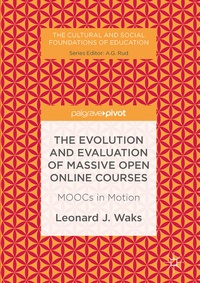
The Evolution and Evaluation of Massive Open Online Courses
Description
Alles über E-Books | Antworten auf Fragen rund um E-Books, Kopierschutz und Dateiformate finden Sie in unserem Info- & Hilfebereich.
Winner of the Outstanding Book Award (Society for Professors of Education)
This book offers a re-assessment of the educational and occupational value of MOOCs based on developments since 2013. When MOOCs appeared--amidst great fanfare in 2012, leaders proclaimed an educational "revolution." By 2013, however, dramatic failures, negative research findings, and sharp critiques ended the MOOC hype. This book examines both MOOCs and prior distance learning innovations, and offers a broad overview of their educational, economic and social effects. Chapters explore ties between MOOCs and emerging pedagogical models as well as exponentially rising tuition rates, student debt, and chronic underemployment of university graduates worldwide. It offers readers a comprehensive, up-to-the-moment guide to the MOOC phenomenon.
More details
Other editions
Additional editions
Person
Leonard J. Waks is Professor Emeritus of Educational Leadership at Temple University, USA.

Content
System requirements
File format: PDF
Copy protection: Watermark-DRM (Digital Rights Management)
System requirements:
- Computer (Windows; MacOS X; Linux): Use the free software Adobe Reader, Adobe Digital Editions, or any other PDF viewer of your choice (see eBook Help).
- Tablet/Smartphone (Android; iOS): Install the free app Adobe Digital Editions or another reading app for eBooks, e.g., PocketBook (see eBook Help).
- E-reader: Bookeen, Kobo, Pocketbook, Sony, Tolino and many more (only limited: Kindle).
The file format PDF always displays a book page identically on any hardware. This makes PDF suitable for complex layouts such as those used in textbooks and reference books (images, tables, columns, footnotes). Unfortunately, on the small screens of e-readers or smartphones, PDFs are rather annoying, requiring too much scrolling.
This eBook uses Watermark-DRM, a „soft” copy protection. This means that there are no technical restrictions to prevent illegal distribution. However, there is a personalised watermark embedded in the eBook that can be used to identify the purchaser of the eBook in the event of misuse and to provide evidence for legal purposes.
For more information, see our eBook Help page.