

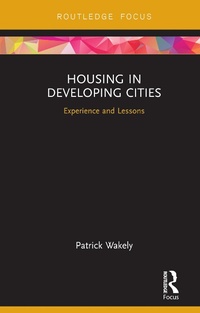
Housing in Developing Cities
Experience and Lessons
1st Edition
Published on 9. January 2018
176 pages
978-1-351-21238-0 (ISBN)
Description

Universally, the production, maintenance and management of housing have been, and continue to be, market-based activities. Nevertheless, since the mid-twentieth century virtually all governments, socialist and liberal alike, have perceived the need to intervene in urban housing markets in support of low-income households who are denied access to the established (private sector) housing market by their lack of financial resources.
Housing in Developing Cities examines the range of strategic policy alternatives that have been employed by state housing agencies to this end. They range from public sector entry into the urban housing market through the direct construction of ('conventional') 'public housing' that is let or transferred to low-income beneficiaries at sub-market rates, to the provision of financial supports (subsidies) and non-financial incentives to private sector producers and consumers of urban housing, and to the administration of ('non-conventional') programmes of social, technical and legislative supports that enable the production, maintenance and management of socially acceptable housing at prices and costs that are affordable to low-income urban households and communities. It concludes with a brief review of the direction that public housing policies have been taking at the start of the 21st century and reflects on 'where next', making a distinction between 'public housing' and 'social housing' strategies and how they can be combined in a 'partnership' paradigm for the 21st century.
Housing in Developing Cities examines the range of strategic policy alternatives that have been employed by state housing agencies to this end. They range from public sector entry into the urban housing market through the direct construction of ('conventional') 'public housing' that is let or transferred to low-income beneficiaries at sub-market rates, to the provision of financial supports (subsidies) and non-financial incentives to private sector producers and consumers of urban housing, and to the administration of ('non-conventional') programmes of social, technical and legislative supports that enable the production, maintenance and management of socially acceptable housing at prices and costs that are affordable to low-income urban households and communities. It concludes with a brief review of the direction that public housing policies have been taking at the start of the 21st century and reflects on 'where next', making a distinction between 'public housing' and 'social housing' strategies and how they can be combined in a 'partnership' paradigm for the 21st century.
Reviews / Votes
"Patrick Wakely draws on 40 years of experience to examine the range of policy alternatives used by States to intervene in urban housing markets in support of low-income households. This is much needed."Emma Wragg, International Journal of Urban Sustainable Development
"Wakely uses his unique understanding and vast experience to bring clear and practical solutions to the vexed challenge of housing in developing countries. Whereas most written policies typically benefit a small minority - the middle class and civil servants - Wakely's approaches empowers the urban poor, both as users and producers of housing. This should be required reading for practitioners and policy makers alike."
William Cobbett, Director, Cities Alliance
"Patrick Wakely's new book is nothing short of the book that we all need in order to understand both how the huge growth in cities in the developing world is being managed, and how communities on extremely low incomes are getting by; providing their own housing with some public support and progressing their life chances. It is an invaluable guide to both the experience of housing in developing cities and the importance of recognising the potential of informal and semi-formal urban development, combined with a guiding public hand. I hope this book will help many people understand this dynamic process, as it will certainly help me."
Anne Power, Professor of Social Policy and Head of LSE Housing and Communities, London School of Economics
"This book is an excellent synopsis of fifty year's of practice in the provision of housing in developing countries. Patrick Wakely brings wide and thoughtful experience to this subject. The book focuses on 'the how' housing has actually been created and for whom. It is a needed counterpoint to the declaration of global goals which focus on the 'what'."
Michael Cohen, Professor of International Affairs, The New School, New York
More details
Edition
1. Auflage
Language
English
Place of publication
London
United Kingdom
Publishing group
Taylor & Francis Ltd
Target group
College/higher education
Professional and scholarly
Illustrations
2 s/w Tabellen, 44 s/w Photographien bzw. Rasterbilder
2 Tables, black and white; 44 Halftones, black and white
File size
13,91 MB
ISBN-13
978-1-351-21238-0 (9781351212380)
Copyright in bibliographic data and cover images is held by Nielsen Book Services Limited or by the publishers or by their respective licensors: all rights reserved.
Schweitzer Classification
Other editions
Additional editions
Book
11/2019
1st Edition
Routledge
€37.10
Shipment within 15-20 days
Book
01/2018
1st Edition
Routledge
€84.10
Shipment within 10-20 days
Person
Patrick Wakely is an independent consultant and Professor Emeritus of Urban Development in London University and former Director of the Development Planning Unit (DPU), University College London (UCL). An architect (AA Dipl, London), he has 40 years of experience of research, consultancy and teaching in housing, planning and urban development, on which he has worked in more than 20 developing countries.
Content
Foreword. Preface. Chapter 1. Informal housing procurement processes Chapter 2. Public sector intervention in low-income group housing Chapter 3. Enabling supports & 'non-conventional' housing strategies Chapter 4. Three case studies of enabling support strategies Chapter 5. The return to 'conventional' public housing production & incentives to private sector developers Chapter 6. Where Next Chapter 7. Partnership paradigm for the 21st Century Chapter 8. Components of support to incremental development Chapter 9. Some conclusions, capacity building & the way forward
