

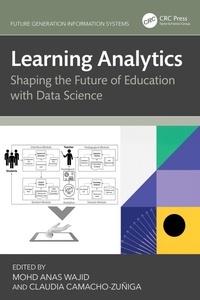
Learning Analytics
Shaping the Future of Education with Data Science
1st Edition
Published on 5. June 2026
298 pages
978-1-040-88213-9 (ISBN)
Description

This book explores how data science, which involves preparing, analyzing, visualizing, and interpreting data, can revolutionize the field of education. The authors delve into how schools and universities can analyze data to improve teaching methods, enhance student learning, and design effective evaluations.
Learning Analytics: Shaping the Future of Education with Data Science examines how machine learning algorithms can analyze individual student performance data to tailor personalized adaptive learning paths, ensuring the best educational experience. Through real-world examples, this book discusses how valuable insights and opportunities can be gained through the application of data science in educational environments. The authors discuss the application of natural language processing (NLP) to analyze educational content, providing insights into language usage, comprehension levels, and improving the effectiveness of instructional materials and examines computer vision in classroom dynamics to measure student engagement. The book also exposes the reader to the crucial role of cybersecurity in safeguarding sensitive student and institutional information, ensuring a secure learning environment, and protecting against cyber threats. It also addresses the ethical considerations and privacy concerns associated with collecting, analyzing, and making decisions from educational data. Finally, it emphasizes the importance of responsible practices to protect the rights and well-being of students and educators.
The book is intended for engineers from computer science, government policymakers, institutions, and educational stakeholders. It shows how computer science, statistics, and data can personalize learning, improve educational tools, enhance classroom dynamics, secure academic records with blockchain, and ensure online safety.
Learning Analytics: Shaping the Future of Education with Data Science examines how machine learning algorithms can analyze individual student performance data to tailor personalized adaptive learning paths, ensuring the best educational experience. Through real-world examples, this book discusses how valuable insights and opportunities can be gained through the application of data science in educational environments. The authors discuss the application of natural language processing (NLP) to analyze educational content, providing insights into language usage, comprehension levels, and improving the effectiveness of instructional materials and examines computer vision in classroom dynamics to measure student engagement. The book also exposes the reader to the crucial role of cybersecurity in safeguarding sensitive student and institutional information, ensuring a secure learning environment, and protecting against cyber threats. It also addresses the ethical considerations and privacy concerns associated with collecting, analyzing, and making decisions from educational data. Finally, it emphasizes the importance of responsible practices to protect the rights and well-being of students and educators.
The book is intended for engineers from computer science, government policymakers, institutions, and educational stakeholders. It shows how computer science, statistics, and data can personalize learning, improve educational tools, enhance classroom dynamics, secure academic records with blockchain, and ensure online safety.
More details
Series
Edition
1. Auflage
Language
English
Place of publication
London
United Kingdom
Publishing group
Taylor & Francis Ltd
Target group
College/higher education
Professional and scholarly
Illustrations
38 Tables, black and white; 51 Line drawings, black and white; 14 Halftones, black and white; 65 Illustrations, black and white
File size
6,84 MB
ISBN-13
978-1-040-88213-9 (9781040882139)
Copyright in bibliographic data and cover images is held by Nielsen Book Services Limited or by the publishers or by their respective licensors: all rights reserved.
Schweitzer Classification
Other editions
Additional editions
Mohd Anas Wajid | Claudia Camacho-Zuniga
Learning Analytics
Shaping the Future of Education with Data Science
Book
approx. 06/2026
1st Edition
CRC Press
€129.50
Not yet published
Persons
Dr. Mohd Anas Wajid is a Post Doctoral Research Associate in Data Science at TEC de Monterrey, Mexico. He received his PhD degree in Computer Science from Aligarh Muslim University, India. He was awarded with the MITACS-SICI Globalink Research Award by Mitacs in collaboration with HRD ministry, Government of India to do a project at the University of Athabasca, Edmonton, Alberta, Canada. The ACM India Council named him an ACM India Anveshan Setu Fellow, and he received a fellowship to conduct a part of his research at IIIT-Delhi. His contribution to Neutrosophic research earned him a Diploma from the Neutrosophic Science International Association (NSIA), University of New Mexico, United States (USA). He has keen interest in Soft Computing, Machine Learning, Data Science, Information Retrieval, and Neutrosophy. He has academic as well as industrial experience.
Prof. Claudia Camacho-Zuniga is a researcher at the Institute for the Future of Education and a professor at the School of Engineering at Tecnologico de Monterrey, Mexico. She is a leader in research, innovation, and transformation in higher education with over 29 years of experience in the field. Since 2014, Professor Camacho-Zuniga has been a driving force in educational innovation and research in Mexico and Latin America; she has leveraged her expertise in teaching and data science tools to foster a passion for science, ethical and civic engagement, and appreciation for diversity of knowledge and people among undergraduate students and academia.
Prof. Claudia Camacho-Zuniga is a researcher at the Institute for the Future of Education and a professor at the School of Engineering at Tecnologico de Monterrey, Mexico. She is a leader in research, innovation, and transformation in higher education with over 29 years of experience in the field. Since 2014, Professor Camacho-Zuniga has been a driving force in educational innovation and research in Mexico and Latin America; she has leveraged her expertise in teaching and data science tools to foster a passion for science, ethical and civic engagement, and appreciation for diversity of knowledge and people among undergraduate students and academia.
Content
Chapter 1 Use of virtual reality in learning environments and its impact on mental health Chapter 2 AI-Driven Adaptive Learning: Architecture, Governance, and a Roadmap for Scalable Personalization Chapter 3 Enhancing AI Model Reliability: Mitigating Synthetic Data Risks with Hybrid Data and Explainable AI Chapter 4 Intelligent Educators: From Personalization to Educational Autonomy Chapter 5 An Augmented Reality-Enhanced Ecosystem for Literacy and Learning in Primary Education Chapter 6 Semantic Web and Complex Thinking: The Usefulness of Computational Tools for Achieving Professional Competencies in Health Chapter 7 Beyond GPA: Learning Analytics Reveals Plural Pathways to Academic Success Among Scholarship Recipients Chapter 8 Accessible Human Computer Interaction (HCI) for Inclusive Education: Designing Educational Tools for Diverse Learners Chapter 9 Emerging Technologies and Regenerative Pedagogies in the Era of Education 6.0 Chapter 10 Measuring Educational Initiatives through Student Engagement: A Data-Driven Evaluation Framework in Engineering Education Chapter 11 Teacher-in-the-loop Learning Analytics for LLM-Enhanced Intelligent Tutoring Systems Chapter 12 Multimodal Learning Analytics in Practice: Lessons from the 1st IFE Experiential Classroom Call Chapter 13 Algorithmic Bias and Human Computer Interaction in Educational Platforms: A Qualitative Approach from Substantive Equity Chapter 14 Digital Microcredentials in Latin America and the Caribbean: Ecosystem Maturity, Regulatory Frameworks, Blockchain Infrastructure, and Credential Analytics for Regional Governance
