

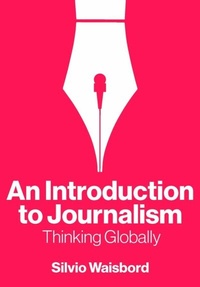
An Introduction to Journalism
Description

An Introduction to Journalism is the new go-to textbook for journalism studies. Organized around three thematic sections - structures, practices, and change and continuity - this textbook covers a broad range of issues central to the study of journalism. These include the nature of news as a socio-cultural construct; the impact of social forces (political, economic, technology, cultural) on journalistic practices and news content; the origin and the impact of journalistic norms, values, and ideologies; patterns of news access and consumption; the relation between journalism and public life; and the role of the press in democracy and authoritarianism. Taking a global perspective throughout, the textbook is grounded in the conviction that we need to examine developments across countries and regions, and understand how global forces shape news, journalism, and the news industry.
Supported by extensive examples and clear case studies throughout, this accessible textbook, written by a leading scholar in the field, provides a comprehensive and analytical survey of the key themes that shape journalism. It is essential reading for undergraduate students of journalism studies.
More details
Other editions
Additional editions
Person
Content
Introduction
Purpose
1. News and Journalism
2. Journalism and Democracy
3. Press Freedom
Structures
4. The Press and Political Power
5. The Press and Economic Power
6. Journalism and Ideological Power
Practices
7. The Organization of News Production
8. Work Conditions
9. Violence Against the Press
10. News Diversity
11. Professional Ethics and Trust
12. News Audiences/Publics
Changes and Continuities
13. Global Journalism
14. Journalism and its Futures
15. Why Journalism is still Relevant
Bibliography
Index
Introduction
Keywords
- Data journalism
- De-westernizing
- Investigative journalism
- News deserts
- Social forces
This book offers an introduction to journalism studies for undergraduate students. It understands journalism studies as the study of the structures and the practices of journalism and the news industry. It covers questions such as the nature of news as a sociocultural construct; the impact of social forces (political, economic, technological, cultural) on journalistic practices and news content; the origin and the impact of journalistic norms, values, and ideologies; patterns of news access and consumption; the relation between journalism and public life; and the role of the press in democracy and authoritarianism.
An Introduction to Journalism offers a global perspective on journalism studies - a field of research primarily grounded in scholarship concerned with a relatively small number of western countries. Taking a global perspective means approaching news, journalism, and news industries in their multiple dimensions, shaped by their local, national, regional, and international contexts. A global perspective probes topics, questions, and answers by examining developments across countries and regions, and understanding the role of global forces.
The book examines fifteen key topics in journalism studies and is organized in four thematic sections: purpose; structures; practices; and change and continuity. Each chapter is built around key questions for each topic and presents a focused perspective and set of arguments, drawing analytical insights and examples from original and secondary sources.
What is journalism studies?
Colombian literature giant Gabriel García Márquez observed that "journalism is the most wonderful craft in the world." This book is driven by the same conviction about journalism studies - a sprawling, unwieldy, vibrant, interdisciplinary field of research, education, and practice.
Journalism studies addresses the impact of social forces on journalistic practices, news content, news economics, and other issues - that is, external structures and dynamics that may be political, economic, technological, cultural - that affect the news industry and journalism. It provides foundational knowledge for undergraduate education and careers in news media. In a world of news abundance and communication chaos, it offers essential analytical skills and knowledge for understanding basic aspects of contemporary society. The discipline is a pillar of news/media/digital literacy, examining the competencies and skills that citizens need to live in the digital society surrounded by myriad forms of communication, media, (dis)information, and content. It also provides fundamental insights for students interested in careers in journalism and media, as well as other fields that demand creative thinking and abilities.
Why write this book? At a moment of economic troubles in news industries globally, it is timely to consider why the study of news is important, and why journalism remains a vital, irreplaceable institution in the public sphere. Understandably, educators and researchers often focus on troubling, current trends to raise awareness about problems. This is necessary for understanding fundamental aspects in the current context. Yet we also need to remind ourselves, students, and the public why journalism is worth pursuing and studying in the first place. Younger generations, accustomed to worrisome news, may not be aware of or know the ways in which journalism continues to make singular contributions to society and democracy.
Paeans to journalism remind us that it offers a "window on the world," punctures social illusions, tells us engaging stories that otherwise we would not know, and probes the inner workings of power. These arguments are valid and worth remembering, even though journalism comprises the good, the bad, and the ugly. Indeed, plenty of bad journalism exists - the kind of reporting that is a stenographer to power, spreads lies and partial truths, and validates and exploits social prejudices and fears about economic profit and political gain. Sloppy journalism exists, too, the kind of reporting that provides imperfect representations and superficial explanations of the world and distorts social perceptions and beliefs.
However, in its best moments, journalism does what no other social institution can do - it connects us regularly to people, places, stories, and events beyond the confines of our private lives, and sparks our curiosity about interesting and important developments.
This book is written primarily for students interested in journalism studies and/or convinced that they want to pursue a career in journalism or adjacent fields. My hope is that it helps them to understand key research themes, concepts, debates, and arguments. With that in mind, I intend to offer a case as to why we should care to read, watch, listen, and study news and journalism.
A time of deep transformation
Contemporary journalism sits at the intersection of multiple information and communication transformations around the world. It is connected to changing economics and politics, organizational decisions, technological innovations, and public agendas and priorities. Although journalism has experienced unprecedented change in recent decades, it is important to recognize that this has always been its defining feature. It is not preserved in amber.
Why? Journalism has historically been sensitive to a range of social changes - political transitions, economic downturns and upturns, social upheavals, cultural trends, and technological mutations. In turn, journalism has affected multiple aspects of social change - the way we access news and information and come to understand what is happening in our communities, countries, and the world; how political forces communicate with citizens, elites, and other groups; how advertisers try to influence markets and consumers.
Historically, communication and information technologies have transformed the press, too. Over the past two centuries, technological innovations have deeply affected the way news is produced, transmitted, and consumed. From the telegraph to artificial intelligence, technologies have made some practices obsolete and offered other opportunities. Time and time again, the news industry has adapted. But even by the historical standards of an industry extremely sensitive to change, the recent pace and scale of change has been remarkable. Everything has been shaken up. Occasional flashes of optimism, brought about by promising business models and exciting reporting innovations, are inevitably followed by pessimistic forecasts.
News economics
The digital revolution unleashed economic havoc in the news industry by dismantling the old funding model. Advertising continues to migrate away from traditional news companies to digital corporations. The economic crisis is evident: the old model is broken, and there are no proven, viable replacements that are valid for all news companies. The news industry faces bad economic headwinds. Global advertising revenue for print news continues to collapse. According to a 2023 report by the World Advertising Research Center, global advertising revenue for total print will experience a 7.7% reduction from 2022 (with US$47.2 billion in total for 2023). Considering the persistent failures of the commercial model, many scholars and policymakers have called for revamping news economics in support of public funding. As long as news is primarily left to commercial forces, they argue, there will be significant market failures, with troubling consequences for democracy and public life.
Financial losses are followed by cutbacks and massive layoffs. A shrinking workforce and widespread shutdown of newspapers, particularly at the local and regional level, chip away at one of the foundations of original reporting and employment. In the United States, the closing of local newspapers has continued apace for several decades. In France, sales of national dailies were down 8.6% in 2023 compared to the previous year. It is estimated that two-thirds of newspaper jobs (43,000 positions) were eliminated between 2005 and 2023. The growth of jobs in digital news organizations has not compensated for significant losses, mostly in the newspaper industry. Layoffs have been common across the national and regional press amid the reduction of news outlets from 28,579 in 2011 to 20,232 in 2022. According to a 2021 report by the Center for Monitoring Indian Economy, almost 78% of jobs were lost in the media and publishing industry in five years. It is estimated that 20-25% of journalism jobs have been lost in Sweden over the past decade. The Australian news media industry has also experienced a dramatic contraction that has resulted in the loss of an estimated 3,000 journalism positions since 2011.
Given current economic difficulties, the news industry in several countries is not as profitable as it used to be. Yet some companies continue to expect to extract profit from news in ways that basically decimate the capacity of newsrooms to produce original content. Notably, hedge fund companies in the United States insist on squeezing gains by continuing to downsize newsrooms and prioritize low-cost reporting before selling off remaining assets. This is not an insignificant matter, considering that hedge funds and financial companies control half of US daily newspapers and large newspaper groups, such as McClatchy, Media News Group, and...
