

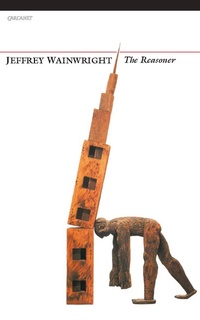
The Reasoner
Published on 1. September 2012
80 pages
978-1-84777-678-5 (ISBN)
Description

In a series of ninety-five poems we listen to 'the Reasoner', a voice that is by turns ardent, despairing and comic. Petty obsessions rub against attempts at philosophical seriousness; vernacular expression vies with an intent deliberation. Above all, the Reasoner is worried. He has cherished the notion that, with thought and study, the world may be understood. But the world remains recalcitrant, elusive even in simple things like the trickeries of light on a spider's web. Language plays tricks, although it may be as complete as we can manage. History proposes and disposes of its patterns. Behind all this there may be a 'hidden order' - and that is both a hope and a fear.
Does God help us to understand any of this? Does Art? Is the 'soul' a sanctuary? The Reasoner, the reader, 'smiles ruefully and soldiers on', 'for this is not a wicked but a hard world, / and people struggle, without a scheme of things, / and deserve release.'
Does God help us to understand any of this? Does Art? Is the 'soul' a sanctuary? The Reasoner, the reader, 'smiles ruefully and soldiers on', 'for this is not a wicked but a hard world, / and people struggle, without a scheme of things, / and deserve release.'
Reviews / Votes
Sean O'Brien admires a richly suggestive but austere collection.Jeffrey Wainwright, born in 1944, has made an important contribution to the phase of political and historical poetry that connects him with Tony Harrison, Ken Smith and Douglas Dunn. With 'Thomas Muntzer' he offered the condensed autobiography of a reformation revolutionary, while '1815' remains the definitive contemporary poem of the industrial revolution. Wainwright juxtaposes Wellington riding among the 'deep-chested rosy ploughboys' killed at Waterloo, while an anonymous mill-girl is drowned in a canal, and a mill-owner is amazed to discover that his wealth cannot prevent a fatal seizure. All these are parts of 'the English miracle' that thrives 'on coal and iron and wool', killing as it creates a new England as pitiless as any of which George Osborne could dream.
These poems are richly suggestive and yet intimidatingly austere: Wainwright makes his own space between the packed allusiveness of early Geoffrey Hill and the fierce, stammering energy of Tony Harrison. He offers, sparingly, a powerful clarity, as in 'The Dead Come Back': 'Unable as we are to die, / The dead come back to us in dreams - / As we are told they do, so they come.' This is something different from style or manner.
The austerity extends to the bibliography: Wainwright has not published a great deal, and what he does publish makes no effort to ingratiate itself with the reader - which brings us to The Reasoner, a book that at times seems hardly to care whether or not it's a collection of poems or a series of lightly versified ruminations, a commonplace book of unanswerable inquiries. The Reasoner himself is a speaker continually in search of understanding through the application of reason to experience and observation. Yet he is always also at the mercy of the imagination's impulse to digress and to bridge gaps in sense as an inescapable consequence of being what it is.
In poem 20 (there are 95), the Reasoner hears a percussive noise in the distance - a bird-scarer, perhaps, or fireworks. 'The mind can associate anything with anything / and casts about: will sounds go with sights / or movements, this wisp of thistledown going quickly by?' Eliot is somewhere in the offing here, and at the close: 'Today, and maybe for all time, I will insist / that the percussions must also be met elsewhere / in a space that is more than this mind.'
It seems as though Wainwright is resisting the temptation to make the cadences more memorable, perhaps to expose the starkness of the need to be convinced that language belongs to the world and does not merely decorate it. The poet is going to considerable trouble not to write the kind of lyrics where such anxiety might be assuaged by submergence in the general music - the kind of thing Nietzsche condemned as 'sickly-sweet whimsy and tinkle-tinkle'. Whether this is a good idea, only time will tell, since The Reasoner feels like a prelude to something else, perhaps to the grand conversion of notes and queries into a complete work (though of a kind the notes and queries may seem to forbid).
In poem 18, while ironically sounding rather Brechtian, the Reasoner is found exposing in the baldest terms the sense of disconnection from the history of his own political formation: 'In the reading rooms for working men, / it was written: "Get Knowledge, Get Understanding." / But what I keep thinking is / I don't know what the mind is.' This seems both a luxury and a necessity, given the cultural and political climate. Returning to the theme from another direction in poem 64, Wainwright allows himself greater rhetorical latitude. Nature 'has a tendency towards / concealment, a disinclination to show its hand, / and the skeins of its web are thought all the stronger / half-disclosed, and its whole harmony - / could it but be sprung to view - / therefore shapelier and more certain sure.'
He enacts this beautiful casuistry as a preface not to the unified picture of nature we might have expected, a garden perhaps, but to an atomised view of discrete bits and pieces - banksia, a rose, a spider and, through closed eyes, "a squarish red shadow shimmering in a shirt cuff". The last item sounds like a Rothko. There we end.
It takes considerable stubbornness not to betray doubt and incompleteness into consolation before due time. The Reasoner calls himself a 'lucky fuck', with a rich life and room for manoeuvre, room to advance the claim in poem 94 (with a strange echo of King Lear) that 'this is not a wicked but a hard world, / and people struggle, without a scheme of things, / and deserve release. That's it, willing it so.' There is a compelling tenderness in poem 73, 'at Kranji war cemetery, Singapore', where the Reasoner recalls the grief of Uncle Percy's mother at the loss of her son: 'sectioned for her grief, / locked in all that countryside / until she could say what he is now: / this photo, a frame of ordinary medals, / a stripe of wall, unvisitable, / where he is incised by race, /service-arm, rank, number, and alphabet, / in column 437, everything about him attended to daily / in this needful dream, this phantasm of order.' This is worth the wait. Wainwright keeps his powder dry for the apt occasion, which then ushers the reader back into the maze - itself a 'phantasm of order' - of this most uncommonplace book.
More details
Language
English
Place of publication
United Kingdom
Publishing group
Carcanet Press Ltd
File size
0,48 MB
ISBN-13
978-1-84777-678-5 (9781847776785)
Copyright in bibliographic data and cover images is held by Nielsen Book Services Limited or by the publishers or by their respective licensors: all rights reserved.
Schweitzer Classification
Other editions
Additional editions
Jeffrey Wainwright
Reasoner
Book
09/2012
Carcanet Press Ltd
€17.50
Article exhausted; check different version
Person
Jeffrey Wainwright was born in Stoke-on-Trent in 1944 and was educated locally and at the University of Leeds. He has taught at the University of Wales, Long Island University in Brooklyn and for many years at the Manchester Metropolitan University where he was Professor in the Department of English and its Writing School until 2008.
His first poetry collection was published by Northern House in 1971 and first full book, Heart's Desire, by Carcanet in 1978.Carcanet Press also publish his Selected Poems (1985), The Red-Headed Pupil (1994), Out of the Air (1999) and Clarity or Death! (2008), The Reasoner (2012), What Must Happen (2016) and most recently As Best We Can (2020). He has translated plays by Peguy, Claudel and Corneille for BBC Radio 3 and his version of Bernard-Marie Koltes' In the Silence of Cotton Fields was broadcast in March 1999 and among other stage productions is the one by the Actors Touring Company in London and tour September-November 2001. The text is available in Koltes: Plays 2 (Methuen 2004).
For eleven years, 1989-99, he was northern theatre critic of The Independent contributing twenty or more reviews per year. Radio work has included reviews for Kaleidoscope, Night Waves and On Air. His book, Poetry the Basics, was published by Routledge in April 2004, third edition 2016, and his book on the poetry of Geoffrey Hill, Acceptable Words, in 2005. He has also published many articles on modern and contemporary poetry. He lives in Manchester and for part of the year in Umbria.
His first poetry collection was published by Northern House in 1971 and first full book, Heart's Desire, by Carcanet in 1978.Carcanet Press also publish his Selected Poems (1985), The Red-Headed Pupil (1994), Out of the Air (1999) and Clarity or Death! (2008), The Reasoner (2012), What Must Happen (2016) and most recently As Best We Can (2020). He has translated plays by Peguy, Claudel and Corneille for BBC Radio 3 and his version of Bernard-Marie Koltes' In the Silence of Cotton Fields was broadcast in March 1999 and among other stage productions is the one by the Actors Touring Company in London and tour September-November 2001. The text is available in Koltes: Plays 2 (Methuen 2004).
For eleven years, 1989-99, he was northern theatre critic of The Independent contributing twenty or more reviews per year. Radio work has included reviews for Kaleidoscope, Night Waves and On Air. His book, Poetry the Basics, was published by Routledge in April 2004, third edition 2016, and his book on the poetry of Geoffrey Hill, Acceptable Words, in 2005. He has also published many articles on modern and contemporary poetry. He lives in Manchester and for part of the year in Umbria.
