

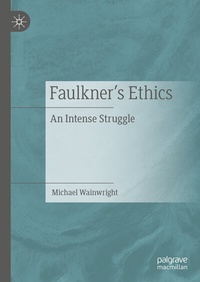
Faulkner's Ethics
Description

This book offers the first comprehensive investigation of ethics in the canon of William Faulkner. As the fundamental framework for its analysis of Faulkner's fiction, this study draws on The Methods of Ethics , the magnum opus of the utilitarian philosopher Henry Sidgwick. While Faulkner's Ethics does not claim that Faulkner read Sidgwick's work, this book traces Faulkner's moral sensitivity. It argues that Faulkner's language is a moral medium that captures the ways in which people negotiate the ethical demands that life places on them. Tracing the contours of this evolving medium across six of the author's major novels, it explores the basic precepts set out in The Methods of Ethics with the application of more recent contributions to moral philosophy, especially those of Jacques Derrida and Derek Parfit.
Reviews / Votes
'Michael Wainwright's reassessment of William Faulkner's major works in relation to the ethics of Henry Sidgwick and Jacques Derrida - with support from game theory and psychoanalysis - is original, perceptive, and timely. Wainwright provocatively refigures Faulkner's corpus in the light of these hitherto disparate philosophical trajectories, and in doing so acquaints the philosophers with one another in ways which are lucid and suggestive. Faulkner's Ethics represents a serious challenge to extant Faulkner scholarship.'- Niall Gildea, author of Jacques Derrida's Cambridge Affair: Deconstruction, Philosophy and Institutionality (2019).
'Early Faulkner criticism often followed the trajectory of Faulkner's life, sometimes simply assuming that life had a moral compass. Later schools, for example historical materialism, sought the 'substratum' of material reality that underpinned the narrative, again only assuming that issues, such as the nature and economics of labor, had moral implications. Psychology, anthropology, mythology-all have had their day, often very useful days, often touching on ethical issues-but what has been lacking is ethics itself. Michael Wainwright's Faulkner's Ethics: An Intense Struggle will end that neglect and, I believe, spur a new interest in moral struggle, moral direction as it can be found in Faulkner's life and literature.'
- Charles A. Peek, Professor Emeritus, Department of English, University of Nebraska Kearney, USA
More details
Other editions
Additional editions
Person
Content
Introduction.- 1 Authorial Irresponsibility: Hemingway's "The Battler" and Faulkner's "Barn Burning".- 2 The Benevolence of Self-Sacrifice: Kenosis in William Faulkner's Light in August.- 3 William Faulkner, John Bowlby and Strains of Familial Attachment in Pylon.- 4 Egoistic Hedonism: Thomas Sutpen's Dubious Guide to an Ignoble End in Absalom, Absalom!.- 5 The Moral Mathematics of Strategic Games in The Unvanquished.- 6 The Gifted Presence of Intruder in the Dust.- 7 A Fable: Buchwald's Disfiguring of Faulkner's Modernisms.- Conclusion: The Levine Shadow.
