

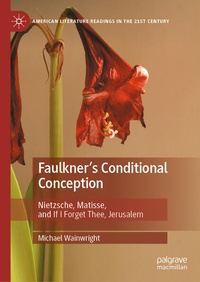
Faulkner's Conditional Conception
Description

This book reexamines William Faulkner's If I Forget Thee, Jerusalem (1939), a novel of increasing sociohistorical importance despite being one of Faulkner's lesser known and studied works. Wainwright traces Faulkner's 1925 visit to Paris, where he frequented major and minor art galleries and exhibitions and gained a formative appreciation of color and form, color as form, and form as color. Fauvism, the art movement of "wild beasts" led at the time by Henri Matisse and inspired by Nietzsche, offered Faulkner this depth. Wainwright argues that the chain of recognition from Nietzsche to Matisse to Faulkner, while fundamental to Faulkner's canon, comes startlingly to the fore in If I Forget Thee, Jerusalem , a book that measures the sociopolitical as well as the cultural situation of an epoch, a period of episodic violence on a global scale, a time of individual bloodshed and collective loss. In surveying the Fauvist bedrock to Faulkner's career as a writer, this book draws together philosophy, art, and literature before analyzing their influence on him. This process harnesses the thoughts of Faulkner's contemporaries, both relevant authors and relevant critics, voices that often go unheard in Faulkner studies. The result is a profound meditation on the secular eschatology of If I Forget Thee, Jerusalem , a doctrine comprising conception, abortion, birth, and death.
More details
Other editions
Additional editions
Person
Michael Wainwright is Honorary Research Associate at the University of London, UK. He is the author of numerous books, including most recently Kantian Dignity and Trolley Problems in the Literature of Richard Wright (2024), Faulkner's Ethics: An Intense Struggle (2021), The Rational Shakespeare: Peter Ramus, Edward de Vere, and the Question of Authorship (2018), and Game Theory and Postwar American Literature (2016), all published by Palgrave.
Content
Chapter 1: Introduction.- Chapter 2 : Friedrich Nietzsche and Henri Matisse.- Chapter 3 : William Faulkner and Henri Matisse.- Chapter 4 : Friedrich Nietzsche, Henri Matisse, and If I Forget Thee, Jerusalem.- Chapter 5 : If I Forget Thee, Jerusalem.- Chapter 6 : If I Forget Thee, Jerusalem and Abortion.- Chapter 7 : If I Forget Thee, Jerusalem, Abortion, and Morality .-Chapter 8 : Conclusion.
