

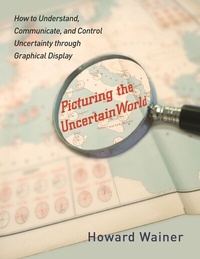
Picturing the Uncertain World
How to Understand, Communicate, and Control Uncertainty through Graphical Display
1st Edition
Published on 7. June 2021
264 pages
978-1-4008-3289-7 (ISBN)
Description

In his entertaining and informative book Graphic Discovery, Howard Wainer unlocked the power of graphical display to make complex problems clear. Now he's back with Picturing the Uncertain World, a book that explores how graphs can serve as maps to guide us when the information we have is ambiguous or incomplete. Using a visually diverse sampling of graphical display, from heartrending autobiographical displays of genocide in the Kovno ghetto to the "Pie Chart of Mystery" in a New Yorker cartoon, Wainer illustrates the many ways graphs can be used--and misused--as we try to make sense of an uncertain world.
Picturing the Uncertain World takes readers on an extraordinary graphical adventure, revealing how the visual communication of data offers answers to vexing questions yet also highlights the measure of uncertainty in almost everything we do. Are cancer rates higher or lower in rural communities? How can you know how much money to sock away for retirement when you don't know when you'll die? And where exactly did nineteenth-century novelists get their ideas? These are some of the fascinating questions Wainer invites readers to consider. Along the way he traces the origins and development of graphical display, from William Playfair, who pioneered the use of graphs in the eighteenth century, to instances today where the public has been misled through poorly designed graphs.
We live in a world full of uncertainty, yet it is within our grasp to take its measure. Read Picturing the Uncertain World and learn how.
Picturing the Uncertain World takes readers on an extraordinary graphical adventure, revealing how the visual communication of data offers answers to vexing questions yet also highlights the measure of uncertainty in almost everything we do. Are cancer rates higher or lower in rural communities? How can you know how much money to sock away for retirement when you don't know when you'll die? And where exactly did nineteenth-century novelists get their ideas? These are some of the fascinating questions Wainer invites readers to consider. Along the way he traces the origins and development of graphical display, from William Playfair, who pioneered the use of graphs in the eighteenth century, to instances today where the public has been misled through poorly designed graphs.
We live in a world full of uncertainty, yet it is within our grasp to take its measure. Read Picturing the Uncertain World and learn how.
More details
Language
English
Place of publication
Princeton, NJ
United States
Publishing group
De Gruyter
Target group
Professional and scholarly
Edition type
Digital original
Product notice
Reflowable
Illustrations
11 color illus. 14 halftones. 81 line illus. 12 tables.
ISBN-13
978-1-4008-3289-7 (9781400832897)
Schweitzer Classification
Other editions
Additional editions
Howard Wainer
Picturing the Uncertain World
How to Understand, Communicate, and Control Uncertainty through Graphical Display
Book
10/2011
Princeton University Press
€28.50
Shipment within 10-20 days
Howard Wainer
Picturing the Uncertain World
How to Understand, Communicate, and Control Uncertainty through Graphical Display
Book
04/2009
Princeton University Press
€30.95
Article exhausted; check different version
Person
Howard Wainer is distinguished research scientist at the National Board of Medical Examiners and adjunct professor of statistics at the Wharton School of the University of Pennsylvania. His many books include Graphic Discovery (Princeton).
Content
- Cover Page
- Half-title Page
- Title Page
- Copyright Page
- Dedication Page
- Contents
- Preface and Acknowledgments
- I. Introduction and Overview
- Chapter 1. The Most Dangerous Equation
- II. Political Issues
- Chapter 2. Curbstoning IQ and the 2000 Presidential Election
- Chapter 3. Stum bling on the Path toward the Visual Commu nication of Comp lexity
- Chapter 4. Using Graph s to Simp lify the Comp lex: The Medicare Drug Plan as an Example
- Chapter 5. A Political Statistic
- Chapter 6. A Catch-22 in Assigning Primary Delegates
- III. Educational Testing
- Chapter 7. Testing the Disabled: Using Statistics to Navigate between the Scylla of Standards and the Charybdis of Court Decisions
- Chapter 8. Ethnic Bias or Statistical Artifact? Freedle's Folly
- Chapter 9. Insignificant Is Not Zero: Musing on the College Board's Understanding of Uncertainty
- IV. Mostly Methodological
- Chapter 10. How Long Is Sh ort?
- Chapter 11. Imp roving Data Displays
- Chapter 12. Old Mother Hubbard and the United Nations
- Chapter 13. Depicting Error
- Chapter 14. The Mendel Effect
- V. History
- Chapter 15. Truth Is Slower than Fiction
- Chapter 16. Galton's Normal
- Chapter 17. Nobody's Perfect
- Chapter 18. When Form Violates Function
- Chapter 19. A Graph ical Legacy of Charles Joseph Minard: Two Jewels from The Past
- Chapter 20. La Diffusion de Qu elques Idées: A Master's Voice
- Chapter 21. Num bers and the Remembrance of Th ings Past
- VI. Epilogue
- Notes
- References
- Source Material
- Index
