

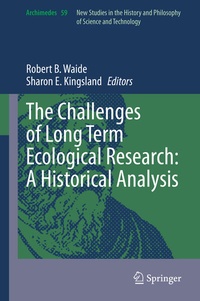
The Challenges of Long Term Ecological Research: A Historical Analysis
Description

This volume explores the challenges of sustaining long-term ecological research through a historical analysis of the Long Term Ecological Research Program created by the U.S. National Science Foundation in 1980. The book examines reasons for the creation of the Program, an overview of its 40-year history, and in-depth historical analysis of selected sites. Themes explored include the broader impact of this program on society, including its relevance to environmental policy and understanding global climate change, the challenge of extending ecosystem ecology into urban environments, and links to creative arts and humanities projects. A major theme is the evolution of a new type of network science, involving comparative studies, innovation in information management, creation of socio-ecological frameworks, development of governance structures, and formation of an International Long Term Ecological Research Network with worldwide reach. The book's themes will interest historians, philosophers and social scientists interested in ecological and environmental sciences, as well as researchers across many disciplines who are involved in long-term ecological research.
More details
Other editions
Additional editions
Persons
Robert B. Waide is Professor Emeritus in the Department of Biology at the University of New Mexico. As Senior Scientist at the Center for Energy and Environment Research (University of Puerto Rico), he was one of the founding Lead Principal Investigators (with Ariel Lugo) of the Luquillo Long Term Ecological Research (LTER) project from 1988-1997. He was Executive Director of the LTER Network Office in Albuquerque, New Mexico, from 1997-2016 and in this role, he was a member of the LTER Executive Board, Science Council, and most of the LTER standing committees. He continues his association with the LTER Network as a scientist with the Luquillo LTER and as a member of the Environmental Data Initiative. Books that he has published include: Ecological Gradient Analyses in a Tropical Landscape (2013); A Caribbean Forest Tapestry: The Multidimensional Nature of Disturbance and Response (2012); and The Food Web of a Tropical Rain Forest (1996).
Sharon E. Kingsland
is Professor Emeritus in the Department of History of Science and Technology at the Johns Hopkins University in Baltimore, Maryland. She has been writing about the history of ecology and related sciences for over forty years and has published two books on the history of ecology:
Modeling Nature: Episodes in the History of Population Ecology
(2
nd
ed., 1995), and
The Evolution of American Ecology, 1890
-
2000
(2005). She continues her interests in the history of ecological science and is currently writing a book on the history of physiological ecology.
