

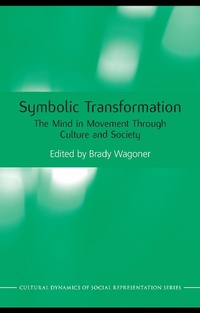
Symbolic Transformation
The Mind in Movement Through Culture and Society
Published on 4. December 2009
360 pages
978-1-135-15090-7 (ISBN)
Description

This book brings together scholars from around the world to address the question of how culture and mind are related through symbols: it is through the mediation of symbols that we think, act, imagine, feel, dream and remember. Thus, to understand the structure, function and development of symbols is to understand what it means to be human.
Part I of the book constructs a theoretical foundation in semiotics for thinking about symbols, and analyzes their place in speech, images, affect and evolution. Part II explores how our experience is transformed through symbols: why we are moved by a movie or political speech, how bread and wine can taste like Christ's body and blood, and why our memories are forever changing. Part III focuses on symbols in the human life-course, particularly in connection with play, language and art. And lastly, Part IV explores how identities, such as being a sex-worker or HIV-positive, are constituted in social relationships through society's symbols.
This broad interdisciplinary synthesis on the problem of symbols is an essential resource for anyone studying culture in mind, including advanced students in psychology, semiotics, anthropology, communications and philosophy.
Part I of the book constructs a theoretical foundation in semiotics for thinking about symbols, and analyzes their place in speech, images, affect and evolution. Part II explores how our experience is transformed through symbols: why we are moved by a movie or political speech, how bread and wine can taste like Christ's body and blood, and why our memories are forever changing. Part III focuses on symbols in the human life-course, particularly in connection with play, language and art. And lastly, Part IV explores how identities, such as being a sex-worker or HIV-positive, are constituted in social relationships through society's symbols.
This broad interdisciplinary synthesis on the problem of symbols is an essential resource for anyone studying culture in mind, including advanced students in psychology, semiotics, anthropology, communications and philosophy.
Reviews / Votes
"This is a timely and important collection of work discussing various aspects of symbolic transformation. It brings together a variety of authors from different disciplines, including social, cultural and developmental psychology, semiotics and anthropology. As a result of this, readers will find a depth and diversity in the chapters that both challenges and enriches their existing ideas about symbols and their importance and functions in our lives, our development and our identities." - Juliet Foster, Corpus Christi College, University of Cambridge, UK"Contributors to this book present original and scholarly perspectives inviting readers to engage their thoughts with symbols and their manifold transformations throughout life, in daily experience and identities. Fascinating and provocative in discussing complex topics, this volume offers a wide-ranging and integrative set of interdisciplinary approaches to the study of the dynamics of mind and culture through symbols and their vicissitudes." - Ivana Markova, University of Stirling, UK "This is a timely and important collection of work discussing various aspects of symbolic transformation. It brings together a variety of authors from different disciplines, including social, cultural and developmental psychology, semiotics and anthropology. As a result of this, readers will find a depth and diversity in the chapters that both challenges and enriches their existing ideas about symbols and their importance and functions in our lives, our development and our identities." - Juliet Foster, Corpus Christi College, University of Cambridge, UK
"Contributors to this book present original and scholarly perspectives inviting readers to engage their thoughts with symbols and their manifold transformations throughout life, in daily experience and identities. Fascinating and provocative in discussing complex topics, this volume offers a wide-ranging and integrative set of interdisciplinary approaches to the study of the dynamics of mind and culture through symbols and their vicissitudes." - Ivana Markova, University of Stirling, UK
More details
Series
Language
English
Place of publication
London
United Kingdom
Publishing group
Taylor & Francis Ltd
Target group
College/higher education
Illustrations
29 s/w Abbildungen, 3 s/w Tabellen
3 Tables, black and white; 29 Illustrations, black and white
File size
10,57 MB
ISBN-13
978-1-135-15090-7 (9781135150907)
Copyright in bibliographic data and cover images is held by Nielsen Book Services Limited or by the publishers or by their respective licensors: all rights reserved.
Schweitzer Classification
Other editions
Additional editions
Book
04/2015
1st Edition
Routledge
€84.30
Shipment within 10-20 days
Book
11/2009
1st Edition
Routledge
€232.50
Shipment within 15-20 days
Person
Brady Wagoner is a cultural psychologist interested in constructive memory, communication, existentialism, pragmatism and the history and philosophy of psychology. He is on the editorial board of Culture and Psychology, Integrative Psychological and Behavioral Science and the International Journal of Dialogical Science. In addition, he is the co-founding editor of Psychology and Society and co-creator of the F. C. Bartlett Internet Archive.
Content
J. Valsiner, Series Editor's Introduction. B. Wagoner, Introduction: What is a Symbol? Part 1. Semiotic Foundations. A. Gillespie, The Intersubjective Nature of Symbols. G. Sonesson, Here Comes the Semiotic Species: Reflections on the Semiotic Turn in the Cognitive Sciences. S. Salvatore, C. Venuleo, The Unconscious as Symbol Generator: A Psychodynamic-Semiotic Approach to Meaning Making. A. Rosa, Commentary on Part 1: Are We Connected to the Matrix Machine? Cognition and Experience Figuring out What Reality is. Part 2. Transformations of Experience. B. Bradley, Experiencing Symbols. G. Obeyesekere, Deep Motivation and the Work of Culture in Christian Penitential Ecstasy. N. Mori, Remembering with Others: The Veracity of an Experience in the Symbol Formation Process. E. Abbey, Commentary on Part 2: Imagination and the Movement of Meaning. Part 3. Transformations through the Life Course. T. Zittoun, How Does an Object Become Symbolic? Rooting Semiotic Artifacts in Dynamic Shared Experiences. L. McCune, Developing Symbolic Abilities. J. Matthews, Scribble: The Development of Children's Mark Making. U. Mueller, J. Carpendale, Commentary on Part 3: Some Reflections on the Development of Symbolic Abilities. Part 4. Transformations of Identity. D. Winther-Lindqvist, Symbolic Group Play and Social Identity. D. Holland, Symbolic Worlds in Time/Spaces of Practice: Identities and Transformations. S. Arrigg Koh, From Stigma and Coping to Social Repositioning: A New Perspective on HIV/AIDS, Identity and Human Rights. E. Aveling, F. Cornish, J. Oldmeadow, Diversity in Sex Workers' Strategies for the Protection of Social Identity: Content, Context and Contradiction. I. Kadianaki, H. Mahmoud, Commentary on Part 4: Identity and Social Reality: Formations and Transformations. B. Wagoner, Conclusion: Opening and Closing Symbolic Transformation.
