

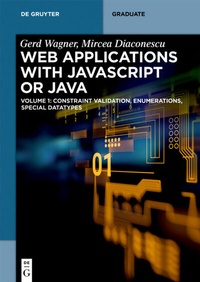
Web Applications with Javascript or Java
Description

Today, web applications are the most important type of software applications. This textbook shows how to design and implement them, using a model-based engineering approach that covers general information management concepts and techniques and the two most relevant technology platforms: JavaScript and Java. The book provides an in-depth tutorial for theory-underpinned and example-based learning by doing it yourself, supported by quiz questions and practice projects. Volume 1 provides an introduction to web technologies and model-based web application engineering, discussing the information management concepts of constraint-based data validation, enumerations and special datatypes. Volume 2 discusses the advanced information management concepts of associations and inheritance in class hierarchies.
Web apps are designed using UML class diagrams and implemented with two technologies: JavaScript for front-end (and distributed NodeJS) apps, and Java (with JPA and JSF) for back-end apps. The six example apps discussed in the book can be run, and their source code downloaded, from the book's website.
Gerd Wagner
is Professor of Internet Technology at Brandenburg University of Technology, Germany, and Adjunct Associate Professor at Old Dominion University, Norfolk, VA, USA. He works in the areas of web engineering and modeling and simulation.
Mircea Diaconescu
is a Software Architect and Technical Team Leader at Entri GmbH, Berlin. He enjoys to work with the newest web technologies and to build Web of Things projects. Java, JavaScript/NodeJS and C# are his favorite programming languages.
More details
Other editions
Additional editions
Persons
Prof. Gerd Wagner, Leiter des Fachgebiets Internet-Technologie der TU Brandenburg in Cottbus
Mircea Diaconescu, Wissenschaftlicher Mitarbeiter am Institut
Author reads at University of Brandenburg with 20 students per semester
Subject within all courses on Web-Engineering, Media Sciences (e.g. Lübeck, Diusburg, Munich)
Author also runs a webpage on the topic where he provides a living document of some chapters (not printable). This page attracts hits from all over the world.
Content
- Intro
- Contents
- Foreword
- List of Figures
- List of Tables
- Part I. Getting Started
- 1. A Quick Tour of the Foundations of Web Apps
- 2. More on JavaScript
- 3. Building a Minimal Web App with Plain JS in Seven Steps
- 4. Building a Minimal Web App with Java EE in Seven Steps
- 5. Information Modeling
- 6. Application Architecture
- Part II. Constraint Validation
- 7. Integrity Constraints and Data Validation
- 8. Implementing Constraint Validation in a Plain JS Web App
- 9. Implementing Constraint Validation in a Java EE Web App
- Part III. Enumerations
- 10. Enumerations and Enumeration Attributes
- 11. Implementing Enumeration Attributes in a Plain JS Web App
- 12. Implementing Enumeration Attributes in a Java EE Web App
- Part IV. Special Datatypes and Derived Properties
- 13. Special Datatypes
- 14. Derived Properties
- Glossary
- Index
