

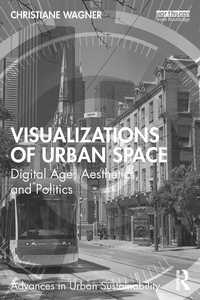
Visualizations of Urban Space
Digital Age, Aesthetics, and Politics
1st Edition
Published on 30. December 2022
224 pages
978-1-000-82858-0 (ISBN)
Description

This book explores environments where art, imagination, and creative practice meet urban spaces at the point where they connect to the digital world. It investigates relationships between urban visualizations, aesthetics, and politics in the context of new technologies, and social and urban challenges toward the Sustainable Development Goals.
Responding to questions stemming from critical theory, the book focuses on an interdisciplinary actualization of technological developments and social challenges. It demonstrates how art, architecture, and design can transform culture, society, and nature through artistic and cultural achievements, integration, and new developments. The book begins with the theoretical framework of social aesthetics theories before discussing global contemporary visual culture and technological evolution. Across the 12 chapters, it looks at how architecture and design play significant roles in causing and solving complex environmental transformations in the digital turn. By fostering transdisciplinary encounters between architecture, design, visual arts, and cinematography, this book presents different theoretical approaches to how the arts' interplay with the environment responds to the logic of the constructions of reality.
This book will appeal to scholars, researchers, and upper-level students in aesthetics, philosophy, visual cultural studies, communication studies, and media studies with a particular interest in sociopolitical and environmental discussions.
Responding to questions stemming from critical theory, the book focuses on an interdisciplinary actualization of technological developments and social challenges. It demonstrates how art, architecture, and design can transform culture, society, and nature through artistic and cultural achievements, integration, and new developments. The book begins with the theoretical framework of social aesthetics theories before discussing global contemporary visual culture and technological evolution. Across the 12 chapters, it looks at how architecture and design play significant roles in causing and solving complex environmental transformations in the digital turn. By fostering transdisciplinary encounters between architecture, design, visual arts, and cinematography, this book presents different theoretical approaches to how the arts' interplay with the environment responds to the logic of the constructions of reality.
This book will appeal to scholars, researchers, and upper-level students in aesthetics, philosophy, visual cultural studies, communication studies, and media studies with a particular interest in sociopolitical and environmental discussions.
Reviews / Votes
"Designing an urban environment aimed at a smart city between physical and virtual spaces means visualizing the future. Christiane Wagner's book, Visualizations of Urban Space, discusses the digital resources and the limits of human perception in the face of artificial intelligence applications and the Internet of Things, regarding automating various processes, simulations, and realities involved in the function of an urban city. Furthermore, it is an aesthetic-social approach to the effects of the fourth industrial revolution, focusing on sustainable development."Lars Christian Grabbe, Dean, Professor Theory of Perception, Communication and Media, Muenster School of Design, University of Applied Sciences Muenster, Germany
"Christiane Wagner's sensible and powerful book Visualizations of Urban Spaces provides a welcome new consideration of the use of art and technology in designing inclusive urban spaces. Beyond being a brilliant read, this think-piece is a compelling guide through which cities can connect with their citizens in order to advance the global public good."
Frank-Juergen Richter, Chairman, Horasis: The Global Visions Community, Switzerland
"Visualizing the city is part of the everyday aesthetic experience in which past, present, and future converge. In Visualizations of Urban Space, Christiane Wagner addresses the urban transformation related to the arts and architectural spaces as part of cities' material and immaterial heritage. Overall, this is a valuable contribution to the challenges of a more inclusive society, considering education, culture, and new technologies."
Edson Leite, Professor and President of the Research Commission at the Museum of Contemporary Art, University of Sao Paulo (MAC USP), Brazil
"Visualizations of Urban Space by Christiane Wagner is a timely contribution to the expanding literature on the dual role art and technology can play as positive forces in the way we see and experience urban space."
Gary Bratchford, President of the Visual Sociology Research Committee, Editor of Visual Studies Journal (Routledge), Senior Lecturer at the University of Central Lancashire, United Kingdom
"One of the most significant characteristics of modernity is urbanization, enormous and high-tech cities where people exchange not only economic goods and services but also culture. Visualizations of Urban Space by Christiane Wagner contains a deep analysis of how twenty-first-century cities become new environments that allow the speechless to have a voice, the invisible to have a presence and the oppressed to state their commands. This could be possible thanks to the intersection of technology, education, art and culture, resources that approach each other, to let societies become more democratic in these new urban spaces."
Omar Cerrillo Garnica, Director of the School of Humanities, Education, Architecture, Art and Design, at Tecnologico de Monterrey, Campus Cuernavaca, Mexico
More details
Series
Edition
1. Auflage
Language
English
Place of publication
London
United Kingdom
Publishing group
Taylor & Francis Ltd
Target group
College/higher education
Professional and scholarly
Illustrations
10 Halftones, black and white; 10 Illustrations, black and white
ISBN-13
978-1-000-82858-0 (9781000828580)
Copyright in bibliographic data and cover images is held by Nielsen Book Services Limited or by the publishers or by their respective licensors: all rights reserved.
Schweitzer Classification
Other editions
Additional editions
Book
12/2022
1st Edition
Routledge
€58.10
Shipment within 10-20 days
Book
12/2022
1st Edition
Routledge
€207.98
Shipment within 10-20 days
Person
Christiane Wagner is a visiting research professor at the Contemporary Art Museum of the University of Sao Paulo (MAC USP), Brazil. Her research focuses on culture, media, education, image studies, and the interface of architecture, art, design, and digital technology concerning cultural heritage, politics, postcolonial aesthetics, and urbanization. She is a member of the Scientific Committee of the Society for Interdisciplinary Image Science in Germany. Wagner is also a member of the International Committee and chair of the International Publications Subcommittee of the College Art Association of America (CAA) New York.
Content
1. Cultural Images: Real and Imagined Experiences 2. Urban Space and Collective Consciousness 3. The Arts and Traces of the Ideal City 4. Democratization of Art and Culture 5. Visual Media Effects 6. Urban Resilience: Toward Postcolonial Aesthetics 7. Sociopolitical Facts, Art, and Technology 8. Technicization and Aestheticization of Social and Urban Structures 9. The Urban Image in Motion and Connection 10. The Arts' Function: Social Inclusion and Sustainability 11. Designing for Sustainability 12. Aesthetic, Social, and Urban Solutions for a New World View
