

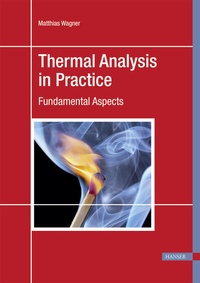
Thermal Analysis in Practice
Fundamental Aspects
1st Edition
Published on 11. December 2017
352 pages
978-1-56990-644-6 (ISBN)
Description

Thermal analysis comprises a group of techniques used to determine the physical or chemical properties of a substance as it is heated, cooled, or held at constant temperature. It is particularly important for polymer characterization, but also has major application in analysis of pharmaceuticals and foodstuffs.
This comprehensive handbook presents practical and theoretical aspects of the key techniques of DSC, TGA, TMA, DMA, and related methods. It also includes separate chapters on the glass transition, polymers, polymorphism, purity determination, and method development. The large number of practical examples included should inspire readers toward new ideas for applications in their own fields of work. The chapters are independent of one another and can be read individually in any desired order.
Based on years of experience in thermal analysis of users, application specialists, consultants, and course instructors, this book provides practical help to newcomers, inexperienced users, and anyone else interested in the practical aspects of thermal analysis.
More details
Other editions
Additional editions

Book
12/2017
1st Edition
Hanser Publications
€129.99
Shipment within 3-4 weeks
Content
- Intro
- Preface
- Contents
- 1 Introduction to Thermal Analysis
- 1.1 Definitions
- 1.2 A Brief Explanation of Important Thermal Analysis Techniques
- 1.3 Application Overview
- 1.4 The Temperature Program
- References and Further Reading
- 2 A Brief History of Thermal Analysis
- 2.1 Thermal Analysis at METTLER TOLEDO
- References and Further Reading
- 3 Polymers
- 3.1 Introduction
- 3.2 Synthesis of Polymers
- 3.3 Thermoplastics
- 3.5 Elastomers
- 3.6 Polymer Additives
- 3.7 Use of Thermal Analysis to Characterize Polymers
- References and Further Reading
- 4 Basic Measurement Technology
- 4.1 Definition
- 4.2 Sensitivity
- 4.3 Noise
- 4.4 Detection Limit
- 4.5 Drift
- 4.6 Time Constant, Limiting Frequency
- 4.7 Digital Resolution and Sampling Interval
- 4.8 Calibration and Adjustment of Sensors
- 4.9 The Most Important Electrical Temperature Sensors
- 4.10 Temperatures in Thermal Analysis
- 5 General Thermal Analysis Evaluations
- 5.1 The Optimum Coordinate System
- 5.2 Editing Diagrams
- 5.3 Displaying Information from the Database
- 5.4 Optimizing the Presentation of a Diagram
- 5.5 Normalizing Measurement Curves to Sample Mass
- 5.6 Displaying Curves with Respect to Time, Reference Temperature or SampleTemperature
- 5.7 Sample Temperature as a Function of Time
- 5.8 Curve Correction Using a Baseline Segment
- 5.9 Mathematical Evaluations
- 5.10 Curve Comparison
- 5.11 Numerical Evaluations
- 6 General Measurement Methodology
- 6.1 Usual Coordinate Systems of Diagrams
- 6.2 The Atmosphere in the Measuring Cell
- 6.3 Crucibles in Thermal Analysis
- 6.4 Overview of Thermal Effects
- 6.5 Calibration and Adjustment
- References and Further Reading
- 7 Differential Scanning Calorimetry
- 7.1 Introduction
- 7.2 Design and DSC Measurement Principle
- 7.3 Sample Preparation
- 7.4 Performing Measurements
- 7.5 Interpretation of DSC Curves
- 7.6 DSC Evaluations
- 7.7 Some Special DSC Measurements
- 7.8 DSC Application Overview
- 7.9 Calibration and Adjustment
- 7.10 Appendix: Assessing the Performance of a DSC Measuring Cell Using Simple Measurements
- References and Further Reading
- 8 Fast Scanning Calorimetry
- 8.1 Introduction
- 8.2 Design and Measurement Principle
- 8.3 Sample Preparation
- 8.4 Performing Measurements
- 8.5 A Typical Application
- 8.6 Application Overview
- 8.7 Temperature Calibration
- References and Further Reading
- 9 Differential Thermal Analysis
- 9.1 The DTA Measurement Principle
- 9.2 Typical DTA Curves
- 9.3 The Calculation of the DSC Curve from SDTA
- 9.4 The SDTA Evaluations in the STARe Software
- References and Further Reading
- 10 Thermogravimetric Analysis
- 10.1 Introduction
- 10.2 Design and Measuring Principle
- 10.3 Sample Preparation
- 10.4 Performing Measurements
- 10.5 Interpreting TGA Curves
- 10.6 TGA Evaluations
- 10.7 Typical Application: Rubber Analysis
- 10.8 Application Overview
- 10.9 Stoichiometric Considerations
- 10.10 Calibration and Adjustment
- References and Further Reading
- 11 Thermomechanical Analysis
- 11.1 Introduction
- 11.2 The Design and Measurement Principles of a TMA
- 11.3 Sample Preparation
- 11.4 Temperature Program
- 11.5 Interpretation of TMA Curves
- 11.6 TMA Evaluations
- 11.7 Application overview for TMA
- 11.8 Calibration and Adjustment of a TMA/SDTA
- References and Further Reading
- 12 Dynamic Mechanical Analysis
- 12.1 Introduction
- 12.2 Measurement Principle and Design
- 12.3 Sample Preparation
- 12.4 Performing Measurements
- 12.5 Interpretation of DMA Curves
- 12.6 DMA Evaluations
- 12.7 DMA Application Overview
- 12.8 Calibration of the DMA/SDTA
- References and Further Reading
- 13 The Glass Transition
- 13.1 Glasses and the Glass Transition
- 13.2 Measurement of the Glass Transition by DSC
- 13.3 Determination of the DSC Glass Transition Temperature
- 13.4 Physical Aging and Enthalpy Relaxation
- 13.5 The Glass Transition for Materials Characterization
- 13.6 Other Thermal Analysis Techniques for Measuring the Glass Transition
- References and Further Reading
- 14 Binary Phase Diagrams and Purity Determination
- 14.1 Introduction
- 14.2 The Most Important Binary Phase Diagrams
- 14.3 The Use of the Tie-Line to Predict DSC Curves
- 14.4 Constructing Phase Diagrams from DSC Measurements
- 14.5 DSC Purity Determination
- References and Further Reading
- 15 Polymorphism
- 15.1 Introduction and Terms
- 15.2 Detection of Polymorphism
- 15.3 The DSC Investigation of the Polymorphism of Sulfapyridine
- References and Further Reading
- 16 Temperature-Modulated DSC
- 16.1 Introduction
- 16.2 IsoStep®
- 16.3 Alternating DSC
- 16.4 TOPEM®
- References and Further Reading
- 17 Evolved Gas Analysis
- 17.1 Brief Introduction to Mass Spectrometry
- 17.2 Brief Introduction to Fourier Transform Infrared Spectrometry
- 17.3 Brief Introduction to Gas Chromatography
- 17.4 Coupling the TGA to a Gas Analyzer
- 17.5 Examples
- References and Further Reading
- 18 TGA Sorption Analysis
- 18.1 Brief Introduction to TGA Sorption Analysis
- 18.2 Examples
- 18.3 Calibration
- 18.4 Typical Application Areas
- References and Further Reading
- 19 Thermoptometry
- 19.1 Introduction
- 19.2 Thermomicroscopy
- 19.3 Chemiluminescence in Thermal Analysis
- 19.4 Conclusions
- References and Further Reading
- 20 Method Development
- 20.1 Introduction
- 20.2 Step 1: Choosing the Right Measurement Technique
- 20.3 Step 2: Sampling and Preparation of the Test Specimen
- 20.4 Step 3: Choosing the Crucible (DSC and TGA)
- 20.5 Step 4: Choosing the Temperature Program
- 20.6 Step 5: Choosing the Atmosphere
- 20.7 Step 6: Examining the Test Specimen after Measurement
- 20.8 Step 7: Evaluation
- 20.9 Step 8: Validation
- 20.10 Conclusions
- References and Further Reading
- 21 Overview of Standard Methods for Thermal Analysis
- 22 Index
