

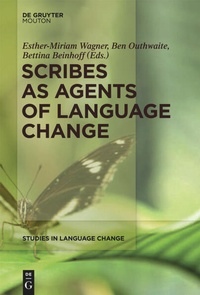
Scribes as Agents of Language Change
1st Edition
Published on 22. March 2013
VIII, 328 pages
978-1-61451-054-3 (ISBN)
Description

The majority of our evidence for language change in pre-modern times comes from the written output of scribes. The present volume deals with a variety of aspects of language change and focuses on the role of scribes. The individual articles, which treat different theoretical and empirical issues, reflect a broad cross-linguistic and cross-cultural diversity. The languages that are represented cover a broad spectrum, and the empirical data come from a wide range of sources. This book provides a wealth of new data and new perspectives on old problems, and it raises new questions about the actual mechanisms of language change.
More details
Series
Language
English
Place of publication
Boston
United States
Publishing group
De Gruyter
Target group
Professional and scholarly
US School Grade: College Graduate Student
Illustrations
Num. figs. and tabs., 33 s/w Tabellen
33 b/w tbl.Num. figs. and tabs.
File size
1,75 MB
ISBN-13
978-1-61451-054-3 (9781614510543)
Schweitzer Classification
Other editions
Additional editions
Esther-Miriam Wagner | Ben Outhwaite | Bettina Beinhoff
Scribes as Agents of Language Change
Book
03/2013
De Gruyter
€149.95
Article exhausted; check different version
Esther-Miriam Wagner | Ben Outhwaite | Bettina Beinhoff
Scribes as Agents of Language Change
Book
03/2013
1st Edition
De Gruyter Mouton
€149.95
Article not available at the moment
Persons
Esther-Miriam Wagner, Cambridge University, UK; Ben Outhwaite, Cambridge University, UK; Bettina Beinhoff, Anglia Ruskin University, UK
Content
1 - Acknowledgements [Seite 5]
2 - Part I: Introduction [Seite 9]
2.1 - 1 Scribes and Language Change [Seite 11]
3 - Part II: From spoken vernacular to written form [Seite 27]
3.1 - 2 Biblical Register and a Counsel of Despair: two Late Cornish versions of Genesis 1 [Seite 29]
3.2 - 3 Medieval Glossators as Agents of Language Change [Seite 47]
3.3 - 4 How scribes wrote Ibero-Romance before written Romance was invented [Seite 79]
3.4 - 5 Hittite scribal habits: Sumerograms and phonetic complements in Hittite cuneiform [Seite 93]
4 - Part III: Standardisation versus regionalisation and de-standardisation [Seite 105]
4.1 - 6 Words of kings and counsellors: register variation and language change in early English courtly correspondence [Seite 107]
4.2 - 7 Quantifying gender change in Medieval English [Seite 129]
4.3 - 8 Identity and intelligibility in Late Middle English scribal transmission: local dialect as an active choice in fifteenth-century texts [Seite 167]
4.4 - 9 Lines of communication: Medieval Hebrew letters of the eleventh century [Seite 191]
4.5 - 10 The historical development of early Arabic documentary formulae [Seite 207]
4.6 - 11 Individualism in "Osco-Greek" orthography [Seite 225]
4.7 - 12 How a Jewish scribe in early modern Poland attempted to alter a Hebrew linguistic register [Seite 235]
5 - Part IV: Idiosyncracy, scribal standards and registers [Seite 247]
5.1 - 13 Writing, reading, language change - a sociohistorical perspective on scribes, readers, and networks in medieval Britain [Seite 249]
5.2 - 14 Challenges of multiglossia: scribes and the emergence of substandard Judaeo-Arabic registers [Seite 269]
5.3 - 15 Variation in a Norwegian sixteenth-century scribal community [Seite 285]
5.4 - 16 Language change induced by written codes: a case of Old Kanembu and Kanuri dialects [Seite 299]
6 - Index [Seite 333]
2 - Part I: Introduction [Seite 9]
2.1 - 1 Scribes and Language Change [Seite 11]
3 - Part II: From spoken vernacular to written form [Seite 27]
3.1 - 2 Biblical Register and a Counsel of Despair: two Late Cornish versions of Genesis 1 [Seite 29]
3.2 - 3 Medieval Glossators as Agents of Language Change [Seite 47]
3.3 - 4 How scribes wrote Ibero-Romance before written Romance was invented [Seite 79]
3.4 - 5 Hittite scribal habits: Sumerograms and phonetic complements in Hittite cuneiform [Seite 93]
4 - Part III: Standardisation versus regionalisation and de-standardisation [Seite 105]
4.1 - 6 Words of kings and counsellors: register variation and language change in early English courtly correspondence [Seite 107]
4.2 - 7 Quantifying gender change in Medieval English [Seite 129]
4.3 - 8 Identity and intelligibility in Late Middle English scribal transmission: local dialect as an active choice in fifteenth-century texts [Seite 167]
4.4 - 9 Lines of communication: Medieval Hebrew letters of the eleventh century [Seite 191]
4.5 - 10 The historical development of early Arabic documentary formulae [Seite 207]
4.6 - 11 Individualism in "Osco-Greek" orthography [Seite 225]
4.7 - 12 How a Jewish scribe in early modern Poland attempted to alter a Hebrew linguistic register [Seite 235]
5 - Part IV: Idiosyncracy, scribal standards and registers [Seite 247]
5.1 - 13 Writing, reading, language change - a sociohistorical perspective on scribes, readers, and networks in medieval Britain [Seite 249]
5.2 - 14 Challenges of multiglossia: scribes and the emergence of substandard Judaeo-Arabic registers [Seite 269]
5.3 - 15 Variation in a Norwegian sixteenth-century scribal community [Seite 285]
5.4 - 16 Language change induced by written codes: a case of Old Kanembu and Kanuri dialects [Seite 299]
6 - Index [Seite 333]
