

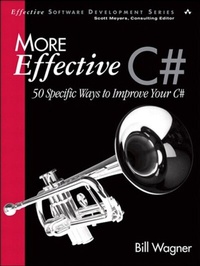
More Effective C
Description

In More Effective C#, Microsoft C# MVP and Regional Director Bill Wagner introduces fifty brand-new ways to write more efficient and more robust software. This all-new book follows the same format as Wagner's best-selling Effective C# (Addison-Wesley, 2005), providing clear, practical explanations, expert tips, and plenty of realistic code examples.
Wagner shows how to make the most of powerful innovations built into Microsoft's new C# 3.0 and .NET Framework 3.5, as well as advanced C# language capabilities not covered in his previous book. Drawing on his unsurpassed C# experience, the author reveals new best practices for working with LINQ, generics, metaprogramming, and many other features. He also uncovers practices that compromise performance or reliability and shows exactly how to avoid them.
More Effective C# shows how to
- Use generics to express your design intent more effectively
- Master advanced generics techniques, such as constraints, method constraints, and generic specialization
- Use the multithreaded techniques you'll need to work with the .NET framework every day
- Express modern design idioms using the rich palette of C# language features
- Successfully mix object oriented and functional programming constructs
- Create composable interfaces and avoid confusion in public interfaces
- Use extension methods to separate contracts from implementation
- Program successfully with C# closures and anonymous types
- Write more effective LINQ queries
- Make the most of LINQ Lazy Evaluation Queries and Lambda Expressions
- Distinguish and convert between delegates and expression trees
- Efficiently utilize nullable types and partial classes
- Use implicit properties for mutable, nonserializable data
You're already a successful C# programmer-this book can help you become an outstanding one.
All prices
More details
Other editions
New editions
Additional editions
Person
Bill Wagner, cofounder of SRT Solutions, has developed commercial software for more than twenty years and led design for many successful engineering and enterprise Microsoft Windows products. He has been a Microsoft Regional Director since 2003 and a Microsoft MVP for C# since 2005. Wagner consults routinely with the C# team on new features for forthcoming versions of C#. He has a regular column in Visual Studio Magazine and speaks frequently at conferences and user groups. His tutorials and advanced essays have appeared in MSDN Magazine, MSDN Online, .NET Insight, .NET DJ, and the MSDN C# Team Developer Center. Wagner is also the author of the best-selling Effective C# (Addison-Wesley, 2005).
Content
Introduction xiii
Chapter 1: Working with Generics 1
Item 1: Use Generic Replacements of 1.x Framework API Classes 4
Item 2: Define Constraints That Are Minimal and Sufficient 14
Item 3: Specialize Generic Algorithms Using Runtime Type Checking 19
Item 4: Use Generics to Force Compile-Time Type Inference 26
Item 5: Ensure That Your Generic Classes Support Disposable Type Parameters 32
Item 6: Use Delegates to Define Method Constraints on Type Parameters 36
Item 7: Do Not Create Generic Specialization on Base Classes or Interfaces 42
Item 8: Prefer Generic Methods Unless Type Parameters Are Instance Fields 46
Item 9: Prefer Generic Tuples to Output and Ref Parameters 50
Item 10: Implement Classic Interfaces in Addition to Generic Interfaces 56
Chapter 2: Multithreading in C# 63
Item 11: Use the Thread Pool Instead of Creating Threads 67
Item 12: Use BackgroundWorker for Cross-Thread Communication 74
Item 13: Use lock() as Your First Choice for Synchronization 78
Item 14: Use the Smallest Possible Scope for Lock Handles 86
Item 15: Avoid Calling Unknown Code in Locked Sections 90
Item 16: Understand Cross-Thread Calls in Windows Forms and WPF 93
Chapter 3: C# Design Practices 105
Item 17: Create Composable APIs for Sequences 105
Item 18: Decouple Iterations from Actions, Predicates, and Functions 112
Item 19: Generate Sequence Items as Requested 117
Item 20: Loosen Coupling by Using Function Parameters 120
Item 21: Create Method Groups That Are Clear, Minimal, and Complete 127
Item 22: Prefer Defining Methods to Overloading Operators 134
Item 23: Understand How Events Increase Runtime Coupling Among Objects 137
Item 24: Declare Only Nonvirtual Events 139
Item 25: Use Exceptions to Report Method Contract Failures 146
Item 26: Ensure That Properties Behave Like Data 150
Item 27: Distinguish Between Inheritance and Composition 156
Chapter 4: C# 3.0 Language Enhancements 163
Item 28: Augment Minimal Interface Contracts with Extension Methods 163
Item 29: Enhance Constructed Types with Extension Methods 167
Item 30: Prefer Implicitly Typed Local Variables 169
Item 31: Limit Type Scope by Using Anonymous Types 176
Item 32: Create Composable APIs for External Components 180
Item 33: Avoid Modifying Bound Variables 185
Item 34: Define Local Functions on Anonymous Types 191
Item 35: Never Overload Extension Methods 196
Chapter 5: Working with LINQ 201
Item 36: Understand How Query Expressions Map to Method Calls 201
Item 37: Prefer Lazy Evaluation Queries 213
Item 38: Prefer Lambda Expressions to Methods 218
Item 39: Avoid Throwing Exceptions in Functions and Actions 222
Item 40: Distinguish Early from Deferred Execution 225
Item 41: Avoid Capturing Expensive Resources 229
Item 42: Distinguish Between IEnumerable and IQueryable Data Sources 242
Item 43: Use Single() and First() to Enforce Semantic Expectations on Queries 247
Item 44: Prefer Storing Expression<> to Func<> 249
Chapter 6: Miscellaneous 255
Item 45: Minimize the Visibility of Nullable Values 255
Item 46: Give Partial Classes Partial Methods for Constructors, Mutators, and Event Handlers 261
Item 47: Limit Array Parameters to Params Arrays 266
Item 48: Avoid Calling Virtual Functions in Constructors 271
Item 49: Consider Weak References for Large Objects 274
Item 50: Prefer Implicit Properties for Mutable, Nonserializable Data 277
Index 283
