

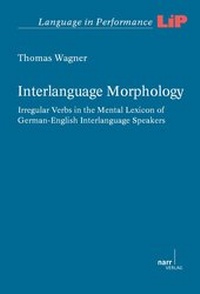
InterLanguage Morphology
Irregular Verbs in the Mental Lexicon of German-English InterLanguage Speakers
1st Edition
Published on 28. April 2010
194 pages
978-3-8233-7547-0 (ISBN)
Description

Das Buch bietet erstmals eine extensive und empirische fundierte Untersuchung dreier prävalenter Theorien und Modelle zur irregulären Verbmorphologie in englischen Muttersprachlern, deutschen Muttersprachlern und deutschen Lernern des Englischen. Die Ergebnisse multivariater L1 und L2 Datenauswertungen lassen profunde Rückschlüsse auf die Aussagekraft und Anwendungsmöglichkeiten der diskutierten Modelle zu. Darüber hinaus bietet das Theoriekapitel eine umfangreiche und detaillierte Aufarbeitung der Theorie irregulärer Verbmorphologie im Englischen und Deutschen.
More details
Other editions
Additional editions
Thomas Wagner
Interlanguage Morphology
Irregular Verbs in the Mental Lexicon of German-English Interlanguage Speakers
Book
04/2010
1st Edition
Narr Francke Attempto
€58.00
Shipment within 5-7 days
Content
- Intro
- Table of contents
- Figures and Tables
- Acknowledgements
- Preface
- 1 Introduction
- 2 Irregular verbs - a linguistic challenge
- 2.1 Introduction
- 2.2 Irregular verbs in English and German -a classic chestnut
- 2.3 One or two routes - irregular verbsand the dual mechanism
- 2.4 Good verbs, better verbs, best verbs - irregular verbsand prototype theory
- 2.5 Nodes, connections, and weights - irregular verbs andconnectionism
- 2.6 Exemplars, nothing but exemplars - irregular verbsand analogical models
- 2.7 Rules, ever more general rules -irregular verbs and 'islands of reliability'
- 2.8 frinked or frank - irregular verbsand the role of semantics
- 2.9 sing - sang - sung - vowel change classes or universalapophony
- 2.10 Irregular verbs and L2 acquisition
- 2.11 Desiderata and hypotheses
- 3 Experiment 1
- 3.1 Experimental design
- 3.2 Results
- 3.2.1 Experiment 1_G_L1 (Native speakers of German)
- 3.2.2 Experiment 1_E_L1 (Native speakers of English)
- 3.2.3 Experiment 1_E_L2 (German-English interlanguage speakers)
- 3.3 Summary and discussion
- 4 Experiment 2
- 4.1 Experimental design
- 4.2 Results
- 4.2.1 Experiment 2_G_L1a (Native speakers of German)
- 4.2.2 Experiment 2_G_L1b (Native speakers of German)
- 4.2.3 Experiment 2_E_L1a (Native speakers of English)
- 4.2.4 Experiment 2_E_L1b (Native speakers of English)
- 4.2.5 Experiment 2_E_L2a (German-English interlanguage speakers)
- 4.2.6 Experiment 2_E_L2b(German-English interlanguage speakers)
- 4.3 Summary and discussion
- 5 Experiment 3
- 5.1 Experimental design
- 5.2 Results
- 5.2.1 Experiment 3_G_L1_oral (Native speakers of German)
- 5.2.2 Experiment 3_E_ L2_oral (German-English interlanguagespeakers)
- 5.2.3 Experiment 3_E_L2_written (German-English interlanguagespeakers)
- 5.3 Summary and discussion
- 6 Discussion and conclusion
- References
- Appendix
- 1 Questionnaires
- 1.1 English questionnaire for experiment 1
- 1.2 English questionnaire for experiment 2
- 1.3 English questionnaire for experiment 3
- 2 Test items
