

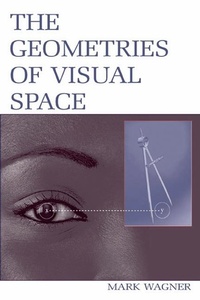
The Geometries of Visual Space
1st Edition
Published on 12. November 2012
280 pages
978-1-136-87186-3 (ISBN)
Description

When most people think of space, they think of physical space. However, visual space concerns space as consciously experienced, and it is studied through subjective measures, such as asking people to use numbers to estimate perceived distances, areas, angles, or volumes. This book explores the mismatch between perception and physical reality, and describes the many factors that influence the perception of space including the meaning assigned to geometric concepts like distance, the judgment methods used to report the experience, the presence or absence of cues to depth, and the orientation of a stimulus with respect to point of view. The main theme of the text is that no single geometry describes visual space, but that the geometry of visual space depends upon the stimulus conditions and mental shifts in the subjective meaning of size and distance.
In addition, The Geometries of Visual Space:
*contains philosophical, mathematical, and psychophysical background material;
*looks at synthetic approaches to space perception including work on hyperbolic, spherical, and Euclidean geometries;
*presents a meta-analysis of studies that ask observers to directly estimate size, distance, area, angle, and volume;
*looks at the size constancy literature in which observers are asked to adjust a comparison stimulus to match a variety of standards at different distances away;
*discusses research that takes a multi-dimensional approach toward studying visual space; and
*discusses how spatial experience is influenced by memory.
While this book is primarily intended for scholars in perception, mathematical psychology, and psychophysics, it will also be accessible to a wider audience since it is written at a readable level. It will make a good graduate-level textbook on space perception.
In addition, The Geometries of Visual Space:
*contains philosophical, mathematical, and psychophysical background material;
*looks at synthetic approaches to space perception including work on hyperbolic, spherical, and Euclidean geometries;
*presents a meta-analysis of studies that ask observers to directly estimate size, distance, area, angle, and volume;
*looks at the size constancy literature in which observers are asked to adjust a comparison stimulus to match a variety of standards at different distances away;
*discusses research that takes a multi-dimensional approach toward studying visual space; and
*discusses how spatial experience is influenced by memory.
While this book is primarily intended for scholars in perception, mathematical psychology, and psychophysics, it will also be accessible to a wider audience since it is written at a readable level. It will make a good graduate-level textbook on space perception.
Reviews / Votes
"In his fine book....Wagner's goal is to show how the 'literature of spatial experience paints a rich, multidimensional picture that dynamically changes as a function of contextual variables'. In this he very largely succeeds. Wagner expresses the hope that his book would not be only for scholars but would 'also make for a good graduate level textbook on space perception'....Any graduate student who is serious about understanding the foundations of psychology should try to read at least the first four chapters of this book."-PsycCRITIQUES "In his fine book....Wagner's goal is show how the 'literature of spatial experience paints a rich, multidimensional picture that dynamically changes as a function of contextual variables'. In this he very largely succeeds. Wagner expresses the hope that his book would not be only for scholars but would 'also make for a good graduate level textbook on space perception'....any graduate student who is serious about understanding the foundations of psychology should try to read at least the first four chapters of this book."-PsycCRITIQUES
More details
Language
English
Place of publication
London
United Kingdom
Publishing group
Taylor & Francis Ltd
Target group
Professional and scholarly
File size
4,65 MB
ISBN-13
978-1-136-87186-3 (9781136871863)
Copyright in bibliographic data and cover images is held by Nielsen Book Services Limited or by the publishers or by their respective licensors: all rights reserved.
Schweitzer Classification
Other editions
Additional editions
Mark Wagner
The Geometries of Visual Space
Book
01/2006
1st Edition
Psychology Press
€206.70
Article not available at the moment
Mark Wagner
The Geometries of Visual Space
Book
01/2006
1st Edition
Psychology Press
€78.80
Shipment within 10-20 days
Person
Wagner, Mark
Content
Contents: Preface. Introduction: Contrasting Visual, Experiential, and Physical Space. Traditional Views of Geometry and Vision. Synthetic Approaches to Visual Space Perception. An Analytic Approach to Space and Vision. Effects of Context on Judgments of Distance, Area, Volume, and Angle. Factors Affecting Size Constancy. The Metrics of Visual Space: Multidimensional Approaches to Space Perception. Cognitive Maps, Memory, and Space Perception. The Geometries of Visual Space: Conclusion.
