

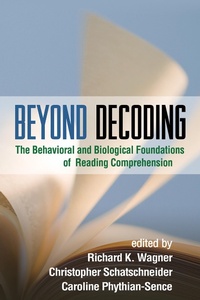
Beyond Decoding
Description

Reading researchers; teacher educators; literacy specialists; educational psychologists. May serve as a text in graduate-level courses such as Issues in Literacy Development, Advanced Study in Reading Comprehension, and Psychology of Reading.
More details
Other editions
Additional editions
Persons
Richard K. Wagner, PhD, is Robert O. Lawton Distinguished Professor of Psychology at Florida State University and Associate Director of the Florida Center for Reading Research. His major area of research interest is the acquisition of complex cognitive knowledge and skills. In the domain of reading, Dr. Wagner's research has focused on the role of reading-related phonological processing abilities in the normal and abnormal development of reading skills; the prediction, prevention, and remediation of dyslexia; and understanding the origins of individual and developmental differences in reading comprehension.
Christopher Schatschneider, PhD, is Professor of Psychology at Florida State University and Associate Director of the Florida Center for Reading Research. His research focuses on early reading development and reading disabilities. Dr. Schatschneider is also a trained methodologist who frequently provides assistance to investigators around design and analysis issues that arise when designing experiments and analyzing data from studies of early reading development. He is the Editor of Annals of Dyslexia and serves on the editorial boards of numerous journals.
Caroline Phythian-Sence, PhD, engages in research and pilot development for Reading Is Fundamental, UK, at the National Literacy Trust, in London, England. Previously, Dr. Phythian-Sence was a doctoral student of Richard Wagner at Florida State University and the Florida Center for Reading Research, where she studied vocabulary knowledge and its relation to comprehension.
Content
I. Cognitive Approaches
1. Language and Body, Michael P. Kaschak, John L. Jones, Jacqueline M. Coyle, and Andrea Sell
2. Eye Movements and Moment-to-Moment Comprehension Processes in Reading, Keith Rayner and Timothy J. Slattery
3. The Influence of In-Text Instruction on Declarative Knowledge and Vocabulary Learning in Struggling Readers: How IQ Confounds the Story, Donald L. Compton, Amy M. Elleman, Natalie G. Olinghouse, Jane Lawrence, Emily Bigelow, Jennifer K. Gilbert, and G. Nicole Davis
II. Developmental Approaches
4. How Children Read for Comprehension: Eye Movements in Developing Readers, Ralph Radach, Christiane Schmitten, Lisa Glover, and Lynn Huestegge
5. Reading between the Lines: Developmental and Individual Differences in Cognitive Processes in Reading Comprehension, Paul van den Broek, Mary Jane White, Panayiota Kendeou, and Sarah Carlson
6. The Roles of Fluent Decoding and Vocabulary in the Development of Reading Comprehension, Kanu Priya and Richard K. Wagner
III. Individual-Differences Approaches
7. Reading Comprehension Development from 8 to 14 Years: The Contribution of Component Skills and Processes, Kate Cain and Jane Oakhill
8. Reading Comprehension and Vocabulary: What's the Connection?, Kate Nation
9. Examining the Decision Reliability and Validity of Three Reading Fluency Measures for Predicting Outcomes on Statewide Reading Accountability Tests, Jose M. Castillo, Joseph K. Torgesen, Kelly A. Powell-Smith, and Stephanie Al-Otaiba
IV. Biological-Based Approaches
10. Assessment and Etiology of Individual Differences in Reading Comprehension, Janice M. Keenan, Richard K. Olson, and Rebecca S. Betjemann
11. Genes, Environments, and the Development of Early Reading Skills, Stephen A. Petrill
12. Examining Sources of Poor Comprehension in Older Poor Readers: Preliminary Findings, Issues, and Challenges, Sarah H. Eason and Laurie E. Cutting
V. Epilogue
13. Promising Interfaces, Richard K. Wagner, Christopher Schatschneider, and Caroline Phythian-Sence
