

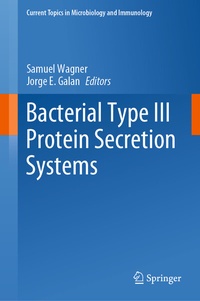
Bacterial Type III Protein Secretion Systems
Description

One of the most exciting developments in the field of bacterial pathogenesis in recent years is the discovery that many pathogens utilize complex nanomachines to deliver bacterially encoded effector proteins into eukaryotic and prokaryotic target cells to modulate a variety of cellular functions for the pathogen's benefit. These protein-delivery machines include the type III secretion system (T3SS), which is widespread in nature and encoded not only by bacteria pathogenic to vertebrates or plants, but also by bacteria that are symbiotic to plants or insects. Because they are essential virulence factors for many important human pathogens, these systems are emerging as a prime target for the development of new-generation, anti-infective drugs.
This book reviews our current understanding of these intriguing injection machines as well as of the closely related T3SS that serves in flagella assembly.
Individual chapters focus on regulation, assembly, structure, and function of the type III secretion machine and on the evolution of the secreted effector proteins. Given its scope, this book will appeal to a broad readership, including researchers and teachers in the fields of infectious diseases, host pathogen interactions, plant and animal pathogenesis, and symbiosis.More details
Other editions
Additional editions
Persons
Samuel Wagner is a Professor of Infection Biology and Head of the Section of Cellular and Molecular Microbiology at the Interfaculty Institute of Microbiology and Infection Medicine at the Eberhard Karls University Tübingen, Germany. He is also Principal Investigator of the excellence cluster 'Controlling microbes to fight infections' (CMFI) and of the German Center for Infection Research (DZIF) at the partner-site Tübingen.
His laboratory is mainly interested in the assembly, structure, and function of bacterial virulence-associated secretion systems, in particular of the type III secretion systems of Salmonella typhimurium and the type IV secretion system of Legionella pneumophila. His laboratory also develops novel anti-infective compounds targeting type III secretion systems.
Jorge E. Galán is the Lucille P. Markey Professor of Microbial Pathogenesis, Professor of Cell Biology, and Chair of the Department of Microbial Pathogenesis at Yale University's School of Medicine. His research interests include the study of host-pathogen interactions, particularly the bacterial pathogens Salmonella and Campylobacter jejuni. His research has contributed to our understanding of the structure and function of type III protein secretion machines, bacterial effectors proteins and bacterial toxins.
