

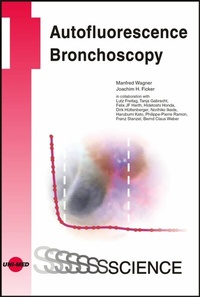
Autofluorescence Bronchoscopy
1st Edition
Published on 30. January 2007
97 pages
978-3-8374-4956-3 (ISBN)
Description

At present lung cancer is the most common cancer in the world and responsible for over 1 million deaths worldwide. Advances in bronchoscopy have helped to increase detection rates of central type early lung cancer. These lesions are invisible on the basis of radiological methods. They usually show only subtle changes of the bronchial mucosa and are therefore sometimes difficult to identify by conventional bronchoscopy.
The data showing the ability to increase the diagnostic rate for early lung cancer in the central airways by autofluorescence bronchoscopy are convincing. Video-chip-autofluorescence bronchoscopy seems to be one of the technologies with the largest impact on diagnostic bronchoscopy in the last decades.
More details
Other editions
Additional editions
Manfred Wagner | Joachim H. Ficker
Autofluorescence Bronchoscopy
Book
01/2007
1st Edition
UNI-MED
€44.80
Article exhausted; check different version
Content
- Intro
- Authors
- Contents
- 1. Principles of autofluorescence bronchoscopy
- 1.1. Introduction need for autofluorescence diagnosis
- 1.2. Central type early stage lung cancer and dysplasia
- 1.3. Development of fluorescence imaging
- 1.4. Procedure and safety of autofluorescence examination
- 1.5. Evaluation of the performance of autofluorescence bronchoscopy
- 1.6. Recent studies of autofluorescence bronchoscopy advantage of autofluorescence examination
- 1.7. Future directions
- 1.8. References
- 2. Video-Autofluorescence SAFE-3000 (Pentax Corporation)
- 2.1. Introduction
- 2.2. Principle of autofluorescence
- 2.2.1. Generation of the excitation light
- 2.2.2. How is autofluorescence light generated?
- 2.2.3. Reasons for diminished autofluorescence light
- 2.2.4. Effect of tumour cell metabolism
- 2.3. Technical equipment
- 2.3.1. Fibreoptical Autofluorescence System SAFE-1000
- 2.3.2. Autofluorescence System SAFE-2000
- 2.3.3. Video Autofluorescence System SAFE-3000
- 2.4. Course of the examination
- 2.4.1. Patient preparation
- 2.4.2. The examination
- 2.4.3. Documentation
- 2.4.4. Time requirement
- 2.4.5. Aftercare
- 2.4.6. Equipment cleaning and maintenance
- 2.5. Practical tips
- 2.5.1. Sequence of measures
- 2.5.2. Evaluation of suspicious mucosal areas
- 2.5.3. Problem situation: the restless patient
- 2.5.4. Problem situation: COPD
- 2.6. Pitfalls
- 2.6.1. Tumour despite normal autofluorescence image
- 2.6.2. Cicatricial changes
- 2.6.3. Mucosal deposits and inclusions
- 2.6.4. Inflammatory lesions
- 2.6.5. Technical problems
- 2.7. Results
- 2.7.1. Initial data from a comparison of fibre bronchoscopy and the SAFE-1000 system
- 2.7.2. White light bronchoscopy versus SAFE-1000
- 2.7.3. Screening in uranium mining
- 2.7.4. Impact on treatment
- 2.7.5. Typical findings and pitfalls
- 2.7.6. Correlations with histopathological findings
- 2.7.7. Justification for an additional autofluorescence bronchoscopy
- 2.7.8. Initial data obtained with the SAFE-3000 system
- 2.7.9. Evaluation of the results
- 2.7.10. Differentiation between primary lung cancer and metastasis
- 2.8. Aspects of quality assurance and economics
- 2.9. Conclusion
- 2.10. References
- 3. Autofluorescence Video-chip Bronchoscope (AFI, Olympus)
- 3.1. Introduction
- 3.2. Finding new excitation/reflection wavelengths for fluorescence observation
- 3.3. Autofluorescence imaging videoscope system
- 3.4. Results of clinical trials
- 3.5. Summary
- 3.6. References
- 4. The Storz D-Light Autofluorescence
- 4.1. Introduction
- 4.2. Systems and procedures
- 4.3. Results
- 4.3.1. Drug-induced fluorescence
- 4.3.2. Autofluorescence bronchoscopy
- 4.4. Discussion
- 4.5. Conclusions
- 4.6. References
- 5. Autofluorescence bronchoscopy using the Hemer optical catheter and the Wolf DAFE system
- 5.1. Drug induced fluorescence
- 5.2. Spectroscopy with an optical catheter
- 5.3. Early fluorescence imaging techniques
- 5.4. DAFE
- 5.5. DAFE second generation
- 5.6. DAFE video-chip bronchoscope
- 5.7. References
- 6. Trends and outlook
- 6.1. Trends
- 6.2. Views against autofluorescence bronchoscopy and comments
- 6.3. Outlook
- 6.4. References
- Index
