

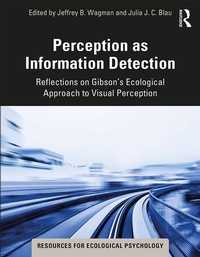
Perception as Information Detection
Reflections on Gibson's Ecological Approach to Visual Perception
1st Edition
Published on 31. July 2019
354 pages
978-1-000-05403-3 (ISBN)
Description

This book provides a chapter-by-chapter update to and reflection on of the landmark volume by J.J. Gibson on the Ecological Approach to Visual Perception (1979).
Gibson's book was presented a pioneering approach in experimental psychology; it was his most complete and mature description of the ecological approach to visual perception. Perception as Information Detection commemorates, develops, and updates each of the sixteen chapters from Gibson's volume. The book brings together some of the foremost perceptual scientists in the field, from the United States, Europe, and Asia, to reflect on Gibson's original chapters, expand on the key concepts discussed and relate this to their own cutting-edge research. This connects Gibson's classic with the current state of the field, as well as providing a new generation of students with a contemporary overview of the ecological approach to visual perception.
Perception as Information Detection is an important resource for perceptual scientists as well as both undergraduates and graduates studying sensation and perception, vision, cognitive science, ecological psychology, and philosophy of mind.
Gibson's book was presented a pioneering approach in experimental psychology; it was his most complete and mature description of the ecological approach to visual perception. Perception as Information Detection commemorates, develops, and updates each of the sixteen chapters from Gibson's volume. The book brings together some of the foremost perceptual scientists in the field, from the United States, Europe, and Asia, to reflect on Gibson's original chapters, expand on the key concepts discussed and relate this to their own cutting-edge research. This connects Gibson's classic with the current state of the field, as well as providing a new generation of students with a contemporary overview of the ecological approach to visual perception.
Perception as Information Detection is an important resource for perceptual scientists as well as both undergraduates and graduates studying sensation and perception, vision, cognitive science, ecological psychology, and philosophy of mind.
More details
Series
Edition
1. Auflage
Language
English
Place of publication
London
United Kingdom
Publishing group
Taylor & Francis Ltd
Target group
College/higher education
Illustrations
1 Tables, black and white; 36 Line drawings, black and white; 18 Halftones, black and white; 60 Illustrations, black and white
ISBN-13
978-1-000-05403-3 (9781000054033)
Copyright in bibliographic data and cover images is held by Nielsen Book Services Limited or by the publishers or by their respective licensors: all rights reserved.
Schweitzer Classification
Other editions
Additional editions
Jeffrey B. Wagman | Julia J. C. Blau
Perception as Information Detection
Reflections on Gibson's Ecological Approach to Visual Perception
Book
08/2019
1st Edition
Routledge
€207.20
Shipment within 15-20 days
Jeffrey B. Wagman | Julia J. C. Blau
Perception as Information Detection
Reflections on Gibson's Ecological Approach to Visual Perception
Book
08/2019
1st Edition
Routledge
€75.20
Shipment within 15-20 days
Persons
Jeffrey B. Wagman, Ph.D. is Professor of Psychology at Illinois State University. His research focuses on perception of affordances. He is a recipient of the Illinois State University Outstanding University Researcher Award and a Japan Society for the Promotion of Science Invitation Fellowship for Research in Japan. He is an Associate Editor of the journal Ecological Psychology.
Julia J. C. Blau, Ph. D. is an Assistant Professor of Psychology at Central Connecticut State University. She earned her doctorate in ecological psychology from the University of Connecticut. Her research focuses on the fractality of event perception, as well as the ecological approach to film perception.
Julia J. C. Blau, Ph. D. is an Assistant Professor of Psychology at Central Connecticut State University. She earned her doctorate in ecological psychology from the University of Connecticut. Her research focuses on the fractality of event perception, as well as the ecological approach to film perception.
Content
Table of Contents
List of Contributors
Foreword
Preface
Introduction
Part One The Environment to Be Perceived
Chapter 1. The Third Sense of Environment
Edward Baggs and Anthony Chemero
Chapter 2. The Triad of Medium, Substance, And Surfaces for The Theory of Further Scrutiny
Tetsushi Nonaka
Chapter 3. Ecological Interface Design Inspired By 'The Meaningful Environment'
Christopher C. Pagano & Brian Day
Chapter 4. Challenging the Axioms of Perception: The Retinal Image and The Visibility Of Light
Claudia Carello & Michael T. Turvey
Part Two. The Information for Visual Perception.
Chapter 5. Getting into The Ambient Optic Array and What We Might Get Out of It
William M. Mace
Chapter 6. The Challenge of An Ecological Approach to Event Perception: How to Obtain Forceful Control From Forceless Information
Robert Shaw & Jeffrey Kinsella-Shaw
Chapter 7. The Optical Information for Self-Perception in Development
Audrey L. H. van der Meer & F. R. (Ruud) van der Weel
Chapter 8. A Guided Tour of Gibson's Theory of Affordances
Jeffrey B. Wagman
Part Three. Visual Perception
Chapter 9. Perceiving Surface Layout: Ground Theory, Affordances, and the Objects of Perception
William H. Warren
Chapter 10. Acting in Perceiving: Experiments on Perception of Motion in The World and Movements of The Self, An Update
L. James Smart Jr., Justin A. Hassebrock, & Max A. Teaford
Chapter 11. Revisiting "The Discovery of The Occluding Edge and Its Implications For
Perception" 40 Years On
Harry Heft
Chapter 12. Looking with The Head and Eyes
John M. Franchak
Chapter 13. James Gibson's Ecological Approach to Locomotion and Manipulation: Development and Changing Affordances
Karen E. Adolph, Justine E. Hoch, and Ori Ossmy
Chapter 14. Information and Its Detection: The Consequences of Gibson's Theory of Information Pickup
Brandon J. Thomas, Michael A. Riley, & Jeffrey B. Wagman
Part Four. Depiction.
Chapter 15. The Use, And Uses of Depiction
Thomas A. Stoffregen
Chapter 16. Revisiting Ecological Film Theory
Julia J. C. Blau
List of Contributors
Foreword
Preface
Introduction
Part One The Environment to Be Perceived
Chapter 1. The Third Sense of Environment
Edward Baggs and Anthony Chemero
Chapter 2. The Triad of Medium, Substance, And Surfaces for The Theory of Further Scrutiny
Tetsushi Nonaka
Chapter 3. Ecological Interface Design Inspired By 'The Meaningful Environment'
Christopher C. Pagano & Brian Day
Chapter 4. Challenging the Axioms of Perception: The Retinal Image and The Visibility Of Light
Claudia Carello & Michael T. Turvey
Part Two. The Information for Visual Perception.
Chapter 5. Getting into The Ambient Optic Array and What We Might Get Out of It
William M. Mace
Chapter 6. The Challenge of An Ecological Approach to Event Perception: How to Obtain Forceful Control From Forceless Information
Robert Shaw & Jeffrey Kinsella-Shaw
Chapter 7. The Optical Information for Self-Perception in Development
Audrey L. H. van der Meer & F. R. (Ruud) van der Weel
Chapter 8. A Guided Tour of Gibson's Theory of Affordances
Jeffrey B. Wagman
Part Three. Visual Perception
Chapter 9. Perceiving Surface Layout: Ground Theory, Affordances, and the Objects of Perception
William H. Warren
Chapter 10. Acting in Perceiving: Experiments on Perception of Motion in The World and Movements of The Self, An Update
L. James Smart Jr., Justin A. Hassebrock, & Max A. Teaford
Chapter 11. Revisiting "The Discovery of The Occluding Edge and Its Implications For
Perception" 40 Years On
Harry Heft
Chapter 12. Looking with The Head and Eyes
John M. Franchak
Chapter 13. James Gibson's Ecological Approach to Locomotion and Manipulation: Development and Changing Affordances
Karen E. Adolph, Justine E. Hoch, and Ori Ossmy
Chapter 14. Information and Its Detection: The Consequences of Gibson's Theory of Information Pickup
Brandon J. Thomas, Michael A. Riley, & Jeffrey B. Wagman
Part Four. Depiction.
Chapter 15. The Use, And Uses of Depiction
Thomas A. Stoffregen
Chapter 16. Revisiting Ecological Film Theory
Julia J. C. Blau
