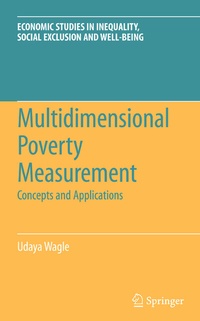
Multidimensional Poverty Measurement
Description

Conceptualization and measurement of poverty have traditionally relied on purely economic approaches, with income or consumption as the only indicator. Multidimensional approaches have increasingly been used to understand poverty, but have yet to be fully operationalized.
This book uses factor analysis and structural equations modelling to develop a multidimensional framework that integrates capability and social inclusion as additional poverty indicators.
The empirical relevance of this methodological contribution is demonstrated through its application in the United States and Nepal.
The proposed approach not only helps to identify different categories of the poor, but also to more accurately target resources and policies of poverty alleviation.
The book will therefore be an important reference for professionals in development agencies as well as for poverty and policy researchers.
Reviews / Votes
From the reviews:
"'Multidimensional Poverty Measures', offers an unconventional look at this topic and presents an interesting application to Nepal and the United States. . the book represents a nice contribution to the growing debate on the need to move away from the traditional one-dimensional approach to well-being and deprivation. . I found the review of the approaches to be extremely enlightening and to be an excellent resource for those interested in the field of multidimensional poverty." (Maria Ana Lugo, The Journal of Economic Inequality, Vol. 10, 2012)
"Udaya Wagle offers an empirical framework to measure multidimensional poverty based on latent variable models, and thus contributes to this growing literature. . this book will positively stimulate the discussion and reflections surrounding the quantitative measurement of multidimensional poverty. . the work provided in this book is without doubt one of the most accurate. . Multidimensional Poverty Measurement: Concepts and Applications will thus become more and more relevant, and its methodology should naturally be applied more often by poverty researchers." (Sylvain Weber, Eastern Economic Journal, Vol. 37 (20), 2011)More details
Other editions
Additional editions