

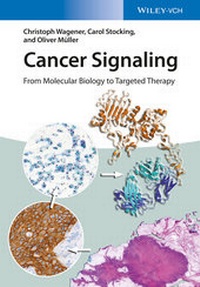
Cancer Signaling
Description

The first part of the book gives an introduction into the cell and molecular biology of cancer, focusing on the key mechanisms of cancer formation. The second part of the book introduces the main signaling transduction mechanisms responsible for carcinogenesis and compares their function in healthy versus cancer cells. In contrast to the complexity of its topic, the text is easy to read. 32 specially prepared teaching videos on key concepts and pathways in cancer signaling are available online for users of the print edition and have been integrated into the text in the enhanced e-book edition.
More details
Other editions
Additional editions
Persons
Carol Stocking is Head of the Research Group Retroviral Pathogenesis at the Heinrich-Pette-Institute, Leibniz Institute for Experimental Virology in Hamburg, Germany. She is a highly regarded expert in the field of leukemogenesis and hematology. Her areas of research are gene regulation, molecular control of differentiation, and hematopoietic stem cells. Dr. Stocking has authored more than 120 original publications in top international journals and 20 book chapters.
Oliver Müller is Professor for Applied Life Sciences at the University for Applied Sciences Kaiserslautern, Germany. He holds academic degrees in both biochemistry and medicine. His areas of research are the intracellular signal transduction and the genes and proteins involved in carcinogenesis. Professor Müller is author of more than 80 original articles, 11 patents, 15 scientific reviews and 4 book chapters. His work was honoured by several science awards.
Content
Tumor Cell Heterogeneity and Resistance to Targeted Therapy
Cell Cycle of Tumor Cells
Cell Aging and Cell Death
Growth Factors and Receptor Tyrosine Kinases
The Philadelphia Chromosome and BCR-ABL1
MAPK Signaling
PI3K-AKT-mTOR Signaling
Hypoxia-Inducible Factor (HIF)
NF-kappaB Pathways
Wnt Signaling
Notch Signaling
Hedgehog Signaling
TGFbeta Signaling
Preface
1 History of Cancer Signaling Research
Of all the various fields of biomedical science, research on intracellular signaling provides some of the best examples for the successful transfer of basic science discoveries into the clinic. Findings from signaling research, together with new techniques of prevention, diagnosis, radiation, and surgery, have helped to increase the cure rates of all cancer patients from below 10% in the 1930s to over 60% today. It has been a long road from the discovery at the beginning of the twentieth century of chromosomal aberrations in tumor genomes, providing the first molecular insight into tumorigenesis, to the modern-day targeted and personalized anticancer therapy based on over 100 years of molecular and biochemical advances.
The first successful steps in the fight against cancer were observed using broad and unspecific cytostatic drugs. In 1947, the first partial remission of pediatric leukemia in a 4-year-old girl was achieved by using the drug aminopterin. Until this time, children with acute leukemia usually died within weeks of being diagnosed. Aminopterin is a competitive analog of the vitamin folic acid that is a necessary cofactor in the synthesis of nucleobases, the building stones of DNA and RNA.
In 1949, the US Food and Drug Administration (FDA) approved nitrogen mustard, the first chemotherapeutical drug, for the treatment of Hodgkin's lymphoma. Originally developed as a weapon gas, nitrogen mustard kills (cancer) cells by modifying their DNA by alkylation. Nitrogen mustard and its derivatives paved the way for many other alkylating and nonalkylating cytostatic and cytocidal anticancer drugs.
In 1958, the first therapeutic use of a combination of different cytostatic drugs was found to prolong the survival times of leukemia patients. In 1965, it was reported that a specific combination of chemotherapeutics could cure 50% of all patients with Hodgkin's lymphoma. Combination therapy is still used today to lower the risk of side effects and resistance.
During the 1960s, scientists in a hospital in Philadelphia identified a chromosomal aberration linked to certain forms of myeloid and lymphoid leukemia. Thirty years later, a fusion protein generated by the so-called Philadelphia chromosome became the target of one of the first specific and targeted cancer treatments with the kinase inhibitor imatinib (Gleevec).
The 1970s ushered in the era of oncogenes. Researchers found that tumor-causing viruses carry mutated forms of mammalian genes. This finding led to the identification of the first proto-oncogene KRAS in 1979. The Ras protein was characterized as an intracellular protein that sends signals from the inner cell membrane into the nucleus. As the first protein with specific signaling activity involved in tumorigenesis, Ras opened a new chapter of cancer research, namely cancer signaling research. Over the following years, the identification of other signaling proteins led to the finding that intracellular signaling pathways control all biological processes and all cellular functions, such as proliferation, differentiation, and migration.
In the 1980s, the first tumor suppressor gene TP53 was discovered. The corresponding protein is a paradigm for a tumor suppressing protein, acting as a regulator and an inhibitor of several important pathways of intracellular signaling that control proliferation, cell death, and DNA repair. Also during the 1980s, scientists could show that tamoxifen lowers the risk of breast cancer relapse after surgery. Tamoxifen is a steroid hormone analog that functions as a signaling molecule at important knots of the intracellular signaling network.
The 1990s can be regarded as the key decade of cancer signaling research. Many more tumor suppressor genes were discovered. Mutations in such genes, e.g., APC and BRAC1, were shown to play important roles in the development of inherited and sporadic forms of the two most common cancer types, carcinomas of the colon and breast, respectively. The function of these tumor suppressors could be linked to important intracellular signaling pathways. Also during the 1990s, many new anticancer drugs of the second generation were approved. These drugs do not inhibit tumor growth by specific killing of the cell or by attacking DNA or RNA, but rather by interfering with biological processes that are the outputs of intracellular signaling. A good example is the family of taxanes, which inhibit dynamics of microtubule and thereby block the mitotic process, and are still in use today against ovarian and breast cancer. In 1997, the FDA approved the first anticancer drug of the third generation, rituximab (Rituxan). Rituximab was not only the first drug of molecularly targeted therapy, it was also the first monoclonal antibody used in medical therapy. Rituximab targets a B-cell surface receptor that initiates important signaling cascades regulating proliferation.
During the early 2000s, Trastuzumab was introduced into the therapy of metastatic breast cancer. Trastuzumab binds to HER2/Neu, a homolog of the receptor for the epidermal growth factor (EGF), and inhibits the transfer of growth-activating signals from the cell membrane into the cell. In 2001, the FDA approved imatinib (Gleevec) after just three months of review - the fastest approval in FDA history. Imatinib is the first drug proven to counteract a molecular defect on the so-called Philadelphia chromosome. It has since become the standard care for patients with chronic myeloid leukemia (CML). Its high efficacy and easily administered pill form enables most patients to live with CML as a chronic but manageable disease. Imatinib inhibits BCR-ABL, which is a constitutively activated kinase positioned in a central node of intracellular signaling. Other targeted drugs were also approved after the turn of the millennium, including gefitinib (Iressa), which blocks the intracellular enzymatic activity of the EGF receptor involved in driving lung cancer growth and spread.
During the late 2000s, tumor-genome sequencing projects started answering questions of how many and which genes are involved in the development of common cancers. Hundreds of the 25 000 protein-coding genes in the human genome show somatic mutations in human tumors. Today, there is strong evidence that mutations in close to 400 genes can be classified as driver mutations, that is, they causally contribute to cancer development. Nearly all cancer genes encode proteins with important functions in signaling pathways. The most prominent group is that of protein kinases, composed of both cytosolic and receptor protein kinases. Furthermore, most of the cancer genes functionally cluster within specific signaling pathways, such as the MAPK pathway, the Wnt pathway, and the PI3K/AKT pathway.
2 Outlook
Molecularly targeted tumor therapy is a rational approach based on the aberrant intracellular signaling implicated in tumorigenesis and tumor progression. However, although great successes have been reported, resistance to therapy remains a sobering phenomenon. After initial spectacular effects, tumors often recur within a year. Interconnecting and parallel signaling pathways coupled to tumor cell heterogeneity are the major reasons for therapy resistance. In order to overcome resistance to targeted therapies, the underlying molecular mechanisms need to be completely and rigorously understood. Since the spectrum of gene mutations and activated pathways can vary between tumor cells at the same location or with the same histological type, predictive diagnostic tests are essential to choose the adequate drug(s) for each individual patient. Comparable to the successful shift to combinatorial application of cytostatic and cytocidal drugs observed in the late 1950s, choosing drug combinations that target different signaling pathways is likely to be more successful than single drugs.
Resistance and ineffective response to targeted therapies have led to some disappointment in the public eye. However, one should consider that it took nearly a century from the first reports of the minor effects of chemotherapeutic drugs to the effective combination therapies applied today. Novel analytical tools, such as deep and whole-genome sequencing, allow for the first time an in-depth analysis of molecular aberrations in tumors. Using these tools, potential therapeutic targets for the rational design of clinical trials can be identified. Although we are still waiting for the results of more recent clinical trials, it is safe to assume that it will probably not take another century until significant progress has been achieved. Combinatorial therapy has successfully been used to combat AIDS; nevertheless, cancer is much more complex than HIV.
In addition to therapy resistance, the costs of targeted therapies are a great concern to all. In order to deliver effective therapies to all patients, costs must correlate to the budgets available.
3 Intention of this Book
We wrote this book in the hope that it will serve as a useful introduction to a fascinating research field for students, physicians, and researchers. We do hope that the information provided in the book will help facilitate the transfer of results from basic research into the clinic.
4 Selection of Topics and Readers' Comments
In this book, we summarize the current knowledge of cancer signaling research. We are aware that we have not comprehensively enumerated all important findings, and we apologize for failing to cite each and every colleague who has made significant contributions to this field. Our intention was to give a short and concise overview of the important but...
