

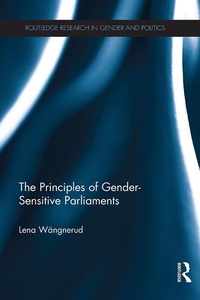
The Principles of Gender-Sensitive Parliaments
Published on 10. April 2015
174 pages
978-1-317-62304-5 (ISBN)
Description

Gender serves as a lens that makes visible important issues in the field of representation: Whom do elected politicians represent? What is at stake in the parliamentary process? What do we know about the interplay between parliaments and the everyday lives of citizens? It is widely understood that women's presence in government matters but we need to understand the conditions under which it matters more clearly.
Using Sweden as a case study, a country where the number of women elected to the national parliament has steadily risen since the 1970s, Lena Waengnerud presents a novel approach on which characteristics inside a parliament help translate physical representation into substantive representation for women. Using three guiding principles: (i) the implementation of equal opportunities for women and men to influence internal parliamentary working procedures; (ii) the creation of room for women's interests and concerns on the political agenda; and (iii) the production of gender-sensitive legislation, Waengnerud shows what are the necessary conditions for women's needs, interests, and concerns to be adequately integrated into parliamentary processes.
The Principles of Gender-Sensitive Parliaments book adds fuel to all these classical debates within the field of political representation and will bring attention to a wider audience on why electing women matters.
Using Sweden as a case study, a country where the number of women elected to the national parliament has steadily risen since the 1970s, Lena Waengnerud presents a novel approach on which characteristics inside a parliament help translate physical representation into substantive representation for women. Using three guiding principles: (i) the implementation of equal opportunities for women and men to influence internal parliamentary working procedures; (ii) the creation of room for women's interests and concerns on the political agenda; and (iii) the production of gender-sensitive legislation, Waengnerud shows what are the necessary conditions for women's needs, interests, and concerns to be adequately integrated into parliamentary processes.
The Principles of Gender-Sensitive Parliaments book adds fuel to all these classical debates within the field of political representation and will bring attention to a wider audience on why electing women matters.
Reviews / Votes
"Not just a book about sex, gender and the Swedish Parliament, Lena Waengnerud confronts the contemporaneous challenges of political representation, women's interests, masculinized political parties, and feminist institutionalism. A simple but nonetheless elegant argument is made: gender sensitive parliaments are constituted by gender sensitive parties, themselves made up of gender sensitive individuals. Marshalling extensive and persuasive data, Waengnerud identifies the individuals (male and female), institutions (especially parties), and wider contexts conducive to a gender sensitive politics. Any gender equality effect of the presence of women in parliaments, including the Swedish one, is never simply about numbers. A politics of presence is not enough. Changes, she writes, 'do not just happen'. Politics and gender scholars would do well, then, to apply her politics of feminist awareness approach so as to better understand the complicated relationship between women's descriptive and substantive representation." -Sarah Childs, University of Bristol"This excellent book turns the usual, unanswerable question, "Do women make a difference in politics", into empirically answerable questions of the conditions for gender-sensitive parliaments."-Drude Dahlerup, Stockholm University Sweden. "Not just a book about sex, gender and the Swedish Parliament, Lena Waengnerud confronts the contemporaneous challenges of political representation, women's interests, masculinized political parties, and feminist institutionalism. A simple but nonetheless elegant argument is made: gender sensitive parliaments are constituted by gender sensitive parties, themselves made up of gender sensitive individuals. Marshalling extensive and persuasive data, Waengnerud identifies the individuals (male and female), institutions (especially parties), and wider contexts conducive to a gender sensitive politics. Any gender equality effect of the presence of women in parliaments, including the Swedish one, is never simply about numbers. A politics of presence is not enough. Changes, she writes, 'do not just happen'. Politics and gender scholars would do well, then, to apply her politics of feminist awareness approach so as to better understand the complicated relationship between women's descriptive and substantive representation." -Sarah Childs, University of Bristol
"This excellent book turns the usual, unanswerable question, "Do women make a difference in politics", into empirically answerable questions of the conditions for gender-sensitive parliaments."-Drude Dahlerup, Stockholm University Sweden.
More details
Series
Language
English
Place of publication
London
United Kingdom
Publishing group
Taylor & Francis Ltd
Target group
College/higher education
Product notice
Reflowable
Illustrations
21 s/w Tabellen, 20 s/w Zeichnungen
21 Tables, black and white; 20 Line drawings, black and white
File size
0,88 MB
ISBN-13
978-1-317-62304-5 (9781317623045)
Copyright in bibliographic data and cover images is held by Nielsen Book Services Limited or by the publishers or by their respective licensors: all rights reserved.
Schweitzer Classification
Other editions
Additional editions
Lena Waengnerud
The Principles of Gender-Sensitive Parliaments
Book
03/2017
1st Edition
Routledge
€71.30
Shipment within 10-20 days
Lena Waengnerud
The Principles of Gender-Sensitive Parliaments
Book
04/2015
1st Edition
Routledge
€231.20
Shipment within 10-20 days
Person
Lena Waengnerud is Professor at the University of Gothenburg. Her research focuses representative democracy, gender and corruption, gender and anxiety. She has published in Annual Review of Political Science, European Political Science Review, Gender & Politics, Governance, Party Politics, and Scandinavian Political Studies.
Content
1. Introduction 2. Gender-Sensitive Political Parties 3. Gender-Sensitive Political Representatives 4. Internal Parliamentary Working Conditions 5. Room for Women's Interests and Concerns 6. The Production of Gender-Sensitive Legislation 7. The Politics of Feminist Awareness
