

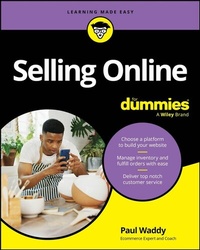
Selling Online For Dummies
Description

Transform your ecommerce ideas into profitable reality with this page-turning new handbook
Online shopping is more popular than ever, and ecommerce is now a multi-billion-dollar industry. Isn't it time for you to claim your share? If you've been wondering how to start an online business, or get your current business thriving online, this comprehensive guide shares everything you need to know.
In Selling Online For Dummies, ecommerce advisor and online shopping guru Paul Waddy shows you exactly how to get started in setting up your online shop. With an expert's eye for business, and an easy-to-understand take on the technical stuff, Waddy takes you from digital start to finish as he discusses topics like:
- Finding hot products to sell, working with suppliers and managing your inventory
- Building a website from scratch by choosing the right developer and platform
- Marketing your site with smart SEO, paid ads, and organic marketing strategies on Google, Instagram, Facebook and TikTok
- Understanding the user experience and creating happy, loyal customers
- Dealing with payments, currencies, taxes and duties
It's time to take advantage of the commercial opportunities waiting for you online. Selling Online For Dummies is a must-read that will help you turn your great idea from virtual to reality.
More details
Other editions
Additional editions
Person
Paul Waddy is an ecommerce advisor with over 15 years of experience and the author of Shopify For Dummies. Paul is the founder of Paul Waddy Advisory and www.learnecommerce.com.au, and the co-founder of Ecom Nation. Paul's expertise is in helping online retailers scale profitably.
Content
Introduction 1
Part 1: Getting Started with Selling Online 5
Chapter 1: Introducing the Business of Selling Online 7
Chapter 2: Selling Online in a Nutshell 11
Chapter 3: You're onto Something: Assessing Your Idea 31
Chapter 4: The Secret Sauce: Sourcing Products and Buying Stock 43
Chapter 5: Taking Stock: Inventory Management 57
Part 2: Full Steam Ahead: Building Your Online Store 75
Chapter 6: The Starting Line: Legal Matters and Registering Your Online Business 77
Chapter 7: Choosing a Platform for Building Your Website 93
Chapter 8: Navigating an Ecommerce Website 111
Chapter 9: The Blueprints: Designing Your Online Store 133
Chapter 10: The Reward: Receiving Payments 169
Part 3: All About the Customer: Providing a Positive Customer Experience 187
Chapter 11: Understanding the User Experience 189
Chapter 12: Customer Service: Happy Customers Are Loyal Customers 205
Chapter 13: From Here to There: Order Fulfilment 223
Chapter 14: Closing the Loop: Returns 237
Part 4: The Next Big Thing: Marketing Your Ecommerce Business 251
Chapter 15: Digital Marketing: A Beginner's Guide 253
Chapter 16: The Search Party: Finding New Customers 265
Chapter 17: Sticky Customers: Customer Retention 285
Chapter 18: Getting Social: Social Media and Influencer Marketing 299
Part 5: The Part of Tens 319
Chapter 19: Ten Things to Understand About Selling Online 321
Chapter 20: Ten Useful Online Tools 329
Chapter 21: Ten Things to Check Before Going Live 337
Appendix: List of Abbreviations 345
Index 349
Chapter 2
Selling Online in a Nutshell
IN THIS CHAPTER
Understanding why ecommerce is worth your time and energy
Getting to grips with ecommerce abbreviations
Considering some useful tips before you get started
Making sense of online sales channels
Exploring the scope of ecommerce, from physical to digital products
The practice of selling online, commonly known as ecommerce, is simply the electronic sale of goods and sometimes services, both physical and digital. In hindsight, electronic commerce may not be the best title for the industry - it has very little to do with electricity - however, there you have it.
Put even more simply, I'm talking about selling goods and services via an online store or marketplace. What's a marketplace, I hear you ask? Good question! I'll get to that later in this chapter as I take you through what selling online involves - from the boring stuff (like understanding the lingo of ecommerce) though to the fun stuff (such as exploring the different sales channels you can use).
It's Never Too Late To Get Started
It's never too late to begin your ecommerce journey. In fact, there's never been a better time to start! It's easy to believe that it's all been done before, but it hasn't, and there's always room for healthy competition.
Online retail is adapting and changing so quickly right now that savvy online retailers have plenty of great opportunities to get ahead of the game. For example, one of the criticisms of online retail has been the lack of personal touch. Time and time again, you'll hear traditional retailers (I won't call them dinosaurs), who typically haven't taken ecommerce seriously enough, say that consumers want a face-to-face service - which is something online stores can't compete with, right? Wrong! Nowadays, a smart new online retailer can gain a competitive edge by switching their live chat customer support service to face-to-face video support (for a more personal service), or adding a slick bit of intuitive AI-driven (artificial intelligence) search capability so that visitors can find what they're looking for - sometimes before they even know they need it!
For a relatively low cost, a whole range of technological advances are out there and ready for online retailers willing to give them a go.
One of my favourite things about being an online retailer is hearing the continuous stories of new online entrepreneurs: people who have bootstrapped, or growth hacked, their way to success. You don't need to have millions of dollars in the bank or a chain of 50 retail stores to succeed; the barriers to entry are low enough for a shrewd operator to make a successful living in ecommerce.
The average cost of fitting out a nice retail store in a good location may reach thousands of dollars before you've even bought your stock or hired your staff, whereas an online retailer can very cheaply open an online store on a platform such as Shopify or BigCommerce - sometimes even getting started for free, and only paying a monthly fee if they decide to continue past the free trial. The opportunities are there for the taking!
Online retail has grown rapidly, with the tailwind of COVID-19 behind it - and even though that growth has steadied, it's still on the rise. Online retail is no flash in the pan - the way consumers behave is changing forever rather than temporarily, and you can be a part of it.
A brief history of ecommerce
Although it could be claimed that ecommerce in its earliest forms (such as the introduction of electronic funds transfers) dates back to the late 1960s and 1970s, in this book I'm focusing more on products that are sold online (rather than the transmission of data, such as through electronic lodgements of tax and other information).
In the 1980s and early 1990s, companies such as the Boston Computer Exchange created online marketplaces for people to sell their old computers. Fast forward a few years to 1995, and you saw the launch of the online marketplace Amazon (which you've probably heard of - and if you haven't, I suggest you put this book down and google it!). In 1999, another giant was founded: the enormous Chinese online marketplace, Alibaba. The two founders of these companies, Jeff Bezos and Jack Ma, sit high in the rankings of the wealthiest people in the world. So, you're in good company.
Today, many of the largest companies in the world either operate or power ecommerce businesses. Take for instance Shopify, which powers online stores all over the world. Or consider the story of Afterpay, the Australian 'buy now pay later' start-up, which was listed on the Australian Securities Exchange in 2018 at less than $3 (AUD). By early 2021, it had reached $156! These companies are dominating their fields on the back of strong ecommerce growth.
When you're weighing up business opportunities to invest in or start yourself, I liken it to property investing: if you follow the railway lines being built, or the major shopping centres or malls being built (in other words, if you follow the investment in infrastructure), there's a fair chance those areas are on the up.
The kinds of products you can sell online these days also hints at the limitless opportunities of online retail. For example, here is a list of Shopify's 'Trending Products To Sell' from early in 2021:
- Peel-off face masks
- Nail polish
- Exercise bands
- Water bottles
- Blankets
- Yoga and Pilates mats
- Kayak accessories
- Jigsaw puzzles
- Kitchen and dining room furniture
- Rugs
- Board games
- Laptop skins
WHO ARE THE BIG PLAYERS IN THE ECOMMERCE SPACE?
Although Amazon, eBay, and Alibaba are the big three in many people's eyes, it may surprise you to hear that Alibaba isn't even the biggest ecommerce player in China anymore - that award goes to JD.com, another online marketplace. You may also be surprised to discover that eBay and Alibaba aren't higher placed, but it just goes to show how many enormous ecommerce businesses are out there today, and that's testament to how many smart companies have pivoted into selling online and tapped into the huge growth that has been occurring.
As it stands today, here are the 10 largest ecommerce businesses in the world, according to Forbes:
- Amazon
- JD.com
- Suning Commerce Group
- Apple
- Walmart
- Dell Technologies
- Vipshop Holdings
- Otto Group
- Gome Electrical Appliances
- Macy's
The list contains something for almost everyone, from the sublime to the ridiculous. Almost anything can be sold online, and there is sure to be a demand for it.
Although no one has a crystal ball, it is conceivable to predict that, within 10 years, ecommerce will overtake traditional retail in terms of its share of consumer spending.
What's all the fuss about: Why start an online store?
Hopefully by now you have whetted your appetite for ecommerce, or at least further fuelled your fire - and with good reason. Ecommerce equals opportunity for all, and what you are faced with is a fairly level playing field, or free market. Whether you're a multinational or global business, an experienced retailer with multiple stores, a Ma and Pa-style business with a local store, or a first-timer selling bohemian crystals, heated dog mats, shoes or all of the above, there has never been a better time to start an online store.
The COVID-19 pandemic of 2020 brought about a seismic shift in how consumers spend their money. In case you were living off the grid during the pandemic, you've been living under a rock, or you're simply too young to remember the pandemic by the time you pick up this book (because it's been labelled a classic and kept in circulation for eternity), COVID-19 is a virus that ravaged the world in 2020 and continues to present problems at the time of writing. It forced the closure of international borders and localised lockdowns of people around the world due to its contagious nature and the lack of a widely accessible vaccine. With border closures, lockdowns and the ongoing risk of contamination came the closure of retail stores in waves.
So, what did people do when they couldn't leave their homes to go to the shops? They picked up their smartphones and tablets, or logged on to their desktop computers, and they shopped - online - in a massive way.
The shift from physical retail (also known as bricks and mortar retail) to online retail was already in progress in most parts of the world, but it accelerated quickly during COVID-19, bringing years of growth from this sudden disruption to retail in six short months. The result has rapidly generated huge wealth for some online retailers. The United States Department of Commerce reported considerable growth in ecommerce sales when comparing 2019 to 2020, and the chances are that this growth will prove to have nudged ecommerce sales (as a proportion of all retail sales) far ahead of its projected longer-term growth pre-COVID.
Some industries boomed more than others. In somewhat of a strange lottery, homewares, DIY and books grew at unprecedented levels, while businesses that...
