

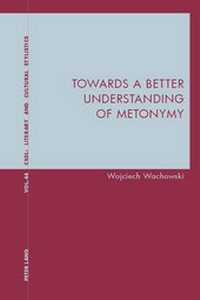
Towards a Better Understanding of Metonymy
Description

The general aim of this book is to contribute to a better understanding of metonymy, a phenomenon which still, despite the current upsurge in scholarly attention, remains puzzling in some respects. The theoretical framework of this book is provided by the school of thought commonly known as Cognitive Linguistics. The first part of the book analyses and develops various hypotheses concerning the nature of metonymy advanced in the literature to date. It presents numerous arguments in favour of the conceptual rather than purely linguistic basis of metonymy and shows that metonymy is a ubiquitous phenomenon not only in language but above all in thought. The second part contains a thorough analysis of the constraints to the scope of metonymy and discusses the differences between metonymy and other forms of so-called figurative language. The third part is devoted to the role and importance of metonymy in communication and focuses on the creative functions of metonymy, which have received surprisingly little scholarly attention to date, such as euphemism, vague language, and humour. The fourth part of this book is centred on some problematic issues concerning the distinction between metonymy, metaphor, and synecdoche.
More details
Other editions
Additional editions
Person
Wojciech Wachowski is Assistant Professor in the Institute of Modern Languages and Applied Linguistics at Kazimierz Wielki University in Bydgoszcz, Poland. He is also an Endeavour Research Fellow at the University of Queensland, Australia, and has lectured as a visiting professor at several European universities. He has published on various topics in linguistics, especially cognitive linguistics and sociolinguistics. His main research interests include metonymy and metaphor, and teacher and translator training.
Content
CONTENTS: Metonymy: The name and definition - Metonymy: The scope - Metonymy: The functions - Metaphor, metonymy, and synecdoche: Problematic issues.
