

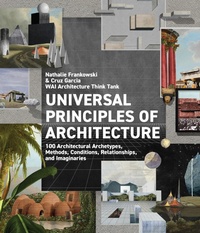
Universal Principles of Architecture: Volume 7
100 Architectural Archetypes, Methods, Conditions, Relationships, and Imaginaries
Published on 10. October 2023
224 pages
978-0-7603-8062-8 (ISBN)
Description

Take an expansive and provocative tour of architectural theory and practice, exploring everything from basic concepts to speculative design and subversive interventions.
Universal Principles of Architecture illustrates in 100 concepts the importance, possibilities, challenges, and roles that architecture plays in shaping the world. This radical and perhaps surprising survey is divided into five sections: Archetypes, Methods, Conditions, Relationships, and Imaginaries. And, each of the five sections in the book introduces in 20 principles architecture at different scales and stages of the design process.
Through an inclusive and holistic approach, the book refers to initial design ideas, creative design approaches, reflections on the effects of the built and destroyed environments, and architectural desires and aspirations to transform the world and engage with the cosmos.
Because architecture is the converging point where many fields of knowledge, ideas, forms, approaches, methods, sensibilities, and materials meet, the book provides a flexible and dynamic space where the material, conceptual, and social take shape.
Written, illustrated, and designed by critically acclaimed architects, educators, and authors Cruz Garcia and Nathalie Frankowski of WAI Architecture Think Tank, Universal Principles of Architecture combines accessible writing with otherworldly images like the ones they have displayed in exhibitions at the Centre Pompidou Metz, Museum of Modern Art New York, Neues Museum Nuremberg, and Museum of Art, Architecture, and Technology Lisbon.
The principles include:
Figurative Archetypes
Parasitic Architecture
Diagramming
Modelling
Three-Dimensional Printing
Carbon Neutral
Biomimicry
Inclusive Design
Participatory Design
AI Cities
Queer Cartographies
Intergalactic Architecture
Intended as an intergenerational and transdisciplinary reference volume, the book presents an ambitious overview of what architecture has been and can be in a world full of urgent challenges and abundant opportunities for social and ecological responsibility, and design creativity.
This book will challenge your preconceived notions of what architecture is and how it can be used.
The titles in the Rockport Universal series offer comprehensive and authoritative information and edifying and inspiring visual examples on multidisciplinary subjects for designers, architects, engineers, students, and anyone who is interested in expanding and enriching their design knowledge.
Universal Principles of Architecture illustrates in 100 concepts the importance, possibilities, challenges, and roles that architecture plays in shaping the world. This radical and perhaps surprising survey is divided into five sections: Archetypes, Methods, Conditions, Relationships, and Imaginaries. And, each of the five sections in the book introduces in 20 principles architecture at different scales and stages of the design process.
Through an inclusive and holistic approach, the book refers to initial design ideas, creative design approaches, reflections on the effects of the built and destroyed environments, and architectural desires and aspirations to transform the world and engage with the cosmos.
Because architecture is the converging point where many fields of knowledge, ideas, forms, approaches, methods, sensibilities, and materials meet, the book provides a flexible and dynamic space where the material, conceptual, and social take shape.
Written, illustrated, and designed by critically acclaimed architects, educators, and authors Cruz Garcia and Nathalie Frankowski of WAI Architecture Think Tank, Universal Principles of Architecture combines accessible writing with otherworldly images like the ones they have displayed in exhibitions at the Centre Pompidou Metz, Museum of Modern Art New York, Neues Museum Nuremberg, and Museum of Art, Architecture, and Technology Lisbon.
The principles include:
Figurative Archetypes
Parasitic Architecture
Diagramming
Modelling
Three-Dimensional Printing
Carbon Neutral
Biomimicry
Inclusive Design
Participatory Design
AI Cities
Queer Cartographies
Intergalactic Architecture
Intended as an intergenerational and transdisciplinary reference volume, the book presents an ambitious overview of what architecture has been and can be in a world full of urgent challenges and abundant opportunities for social and ecological responsibility, and design creativity.
This book will challenge your preconceived notions of what architecture is and how it can be used.
The titles in the Rockport Universal series offer comprehensive and authoritative information and edifying and inspiring visual examples on multidisciplinary subjects for designers, architects, engineers, students, and anyone who is interested in expanding and enriching their design knowledge.
Reviews / Votes
"Beautifully illustrated...especially and unreservedly recommended." * Midwest Book Review *More details
Series
Language
English
Place of publication
Beverly
United States
Publishing group
Quarto Publishing Group USA Inc
Illustrations
color photos
File size
19,39 MB
ISBN-13
978-0-7603-8062-8 (9780760380628)
Copyright in bibliographic data and cover images is held by Nielsen Book Services Limited or by the publishers or by their respective licensors: all rights reserved.
Schweitzer Classification
Other editions
Additional editions
WAI Architecture Think Tank | Cruz Garcia | Nathalie Frankowski
Universal Principles of Architecture: Volume 7
100 Architectural Archetypes, Methods, Conditions, Relationships, and Imaginaries
Book
10/2023
Rockport Publishers
€37.50
Article exhausted; check different version
Persons
Founded by Puerto Rican architect, artist, curator, educator, author, and theorist Cruz Garcia and French architect, artist, curator, educator, author, and poet Nathalie Frankowski, WAI Architecture Think Tank is an internationally recognized studio invested in the development of new curricula and experiments that support public engagement with architecture. They are particularly interested in decolonization and anti-racist reconstruction of the role of architecture in the construction of new worlds. Garcia and Frankowski are Associate Professors at Iowa State University, where they are Design for Critical Futures Fellows in Activism and Emancipatory practice respectively, as well as faculty at the Advanced Architectural Design program at Columbia University. Their work has been part of the inaugural Chicago Architecture Biennial and exhibitions at the Centre Pompidou Metz, Neues Museum Nuremberg, Museum of Modern Art New York, and the Museum of Art, Architecture, and Technology Lisbon. They are authors of Universal Principles of Architecture.
waithinktank.com
Cruz Garcia is a Puerto Rican architect, artist, curator, educator, author, theorist, and co-founder of WAI Architecture Think Tank together with Nathalie Frankowski.
Nathalie Frankowski is a French architect, artist, curator, educator, author, poet, and co-founder of WAI Architecture Think Tank together with Cruz Garcia.
waithinktank.com
Cruz Garcia is a Puerto Rican architect, artist, curator, educator, author, theorist, and co-founder of WAI Architecture Think Tank together with Nathalie Frankowski.
Nathalie Frankowski is a French architect, artist, curator, educator, author, poet, and co-founder of WAI Architecture Think Tank together with Cruz Garcia.
Content
- Intro
- Cover
- Title
- Contents
- Introduction: How to read Universal Principles of Architecture
- Archetypes
- 1 Volumetric Archetypes: Architectures of pure geometric forms and their combinations
- 2 Spatial Archetypes: Design by addition, subtraction, and other strategies of space
- 3 Organizational Archetypes: Architectures of centrality, axiality, networks, layering, and stacking
- 4 Square Archetypes: Closed, nuclear, dominated, grouped, and amorphous open spaces
- 5 Megalithic Archetypes: Dolmens, menhirs, inukshuks, and other structures in stone
- 6 Vitruvian Archetypes: Ordering, composition, proportion, symmetry, decorum, and economy
- 7 Figurative Archetypes: Forms and shapes that are representative of something else
- 8 Hardcorist Archetypes: Architecture designed as pure formal exploration
- 9 Five Points: Designing free plan, free structure, garden roof, pilotis, and free facades
- 10 Nonsolid Architectures: Architectures that are not made of conventionally solid materials
- 11 Void: Carved, dug, buried, and other forms of architectures of subtraction
- 12 Ornament: Decoration in the facades, structures, and interiors of architecture
- 13 Megastructure: Very big terrestrial, aquatic, flying, cosmic, extraplanetary structures
- 14 Super Tall: Structures, buildings, and spaces reaching extraordinary heights
- 15 Stealth: Architectures of disappearance, disguise, and camouflage
- 16 Blob: Amorphous, shapeless, and irregularly shaped architectures
- 17 Topo Architecture: Buildings, structures, and spaces that are also landscape
- 18 Parasitic Architectures: Structures attached to or protruding from other buildings
- 19 Infrastructural Architecture: Buildings that are also bridges, tunnels, and other forms of utilities
- 20 Big Box: Very large buildings contained inside a single-facade envelope
- Methods
- 21 Manifestos: Compelling declaration of a vision, intent, goal, or mission
- 22 Diagramming: Highlighting architecture's basic functions, layout, and programs
- 23 Sketching: Drawing the basic outline, main ideas, or concepts of a project
- 24 Modelling: Constructing the three-dimensional representation of a design
- 25 Massing: Three-dimensional volumetric explorations of a project
- 26 Collage: Image produced by the combination of other images
- 27 Narrative Architecture: Storytelling of architectural situations, conditions, and critiques
- 28 Kit-of-Parts: Design with predetermined components and elements
- 29 Tactical Urbanism: Punctual and specific urban interventions that are part of a larger plan
- 30 Psychogeographic Cartographies: Assembling urban experiences with unexpected spatial combinations
- 31 Mapping: Outlining the conditions and characteristics behind a design project
- 32 Investigative Architecture: Identifying and researching various aspects of the built environment
- 33 Urban Patchwork: Designing smaller interactive spatial components (patches)
- 34 Figure-Ground: Contrasting spatial differences of open and enclosed spaces
- 35 Cadavre Exquis: Collective design where members don't know one another's input
- 36 Mash-Up: Combining disparate elements into a new design
- 37 Parametric: Designing via the input of parameters and variables
- 38 Three-Dimensional Printing: Producing three-dimensional objects by means of machines
- 39 Robot Fabrication: Constructing, assembling, and manufacturing projects with robots
- 40 Living Architecture: Using living organisms as construction and spatial materials
- Conditions
- 41 Ecological Architecture: Buildings, spaces, and structures in balance with nature
- 42 Spiritual Architecture: Structures and spaces for spiritual practices, rituals, and customs
- 43 Multisensorial Architecture: Spaces for engaging with many senses and sensibilities
- 44 Critical Spatial Practice: Spatial interventions that change or challenge social conventions
- 45 Social Justice Design: Designing for social equity and fair conditions for people
- 46 Domesticity: Engaging with the spatial politics of home and dwelling
- 47 Carbon Neutral: Designing for the eradication of greenhouse gas emissions
- 48 Reuse: Making use of already existing structures
- 49 Building Life Cycle: Accounting for all the stages of a structure's life span
- 50 Post-Occupancy: Considering architecture after a project has been inhabited
- 51 Historical Preservation: Sustaining historical artifacts, edifices, spaces, and infrastructures
- 52 Biomimicry: Emulating nature's solutions to problems
- 53 Mobile Architecture: Flexible designs for continuous physical and social motion
- 54 Kinetic Architecture: Buildings and structures in motion
- 55 Agritecture: Connecting agriculture and architecture
- 56 Free Space: Designing for maximum flexibility and continuous transformation
- 57 Peripatetic Architecture: Structures for continuous relocation
- 58 Non-Extractivist Architecture: Rejecting resource extraction for architecture
- 59 Weather Architecture: Spatial interventions incorporating atmospheric phenomena
- 60 Recovery Architecture: Design for the aftermath of natural, human, and ecological crises
- Relationships
- 61 Universalist Design (anti-ableist): Designing accessibility for the many ways of existing in the world
- 62 Transcalarity: Considering multiple scales and sizes of functions and programs
- 63 Inclusive Design: Designing for everyone, regardless of age, circumstance, and ability
- 64 Silver/Children's Architecture: Architecture for people at different stages of their life
- 65 Animal-Centered Design: Design for behaviors, conditions, and characteristics of animal species
- 66 Commoning: Spatial design for the sharing of resources and experiences
- 67 Social Condenser: Projects designed for large social gatherings
- 68 Participatory Design: Designing by the exchange of ideas and collective deliberation
- 69 Grid: Determining spatial paraments by networks of lines
- 70 Post-Domestic Architecture: Spaces that facilitate life without labor related to the home
- 71 Ephemeral Architecture: Design that is transient and leaves no physical mark
- 72 Phenomenology: Design approach that considers and centers on experience
- 73 Architecture of Isolation: Spatial design that avoids collective human interactions
- 74 Defensive Architecture: Spaces and structures that protect against attacks
- 75 Simulation Design: Models reproducing architectural and contextual conditions
- 76 AI Cities: Machines or computers performing urban tasks and decision-making
- 77 Self-Generating Architecture: Structures producing building components and elements on-site
- 78 Authorless Architecture: Collective design processes against singular authorship
- 79 Design-Build: Performing every part of the process, from design to construction
- 80 Building Construction Moratorium: Imposed or voluntary restriction of the construction of architecture
- Imaginaries
- 81 Utopia: Architectures of ideal or cautionary societies, cities, and states
- 82 Futurisms: Projections of futures formed by particular characteristics
- 83 Organic Architecture: Designing a close relationship between architecture and the land
- 84 Queer Cartographies: Spatial interventions challenging the role of heteronormative design
- 85 Space Magicians: Designing spaces, situations, and experiences through fantasy
- 86 Metabolism: Architectures that grow and adapt like a body
- 87 Brutalism: Raw honesty of materials, programs, labor, and extraction
- 88 Avant-Garde: Experimental approach to design with the aim of changing the world
- 89 Modernities: Plans that implement social conditions and improve living conditions
- 90 Post-Colonial Architecture: Mitigating the impact of colonization and reimagining life without it
- 91 Panopticon: Spatial conditions of continuous surveillance
- 92 Abolitionist Architecture: Design for the end slavery, prisons, and other oppressive institutions
- 93 Anti-Racist Architecture: Design that exposes and subverts racist practices and processes
- 94 Feminist City: Design addressing the needs of women and nonbinary and trans people
- 95 Self-Sustaining Architecture: Addressing all aspects of maintenance and sustenance of architecture
- 96 Virtual City: Design of urban conditions that exist solely on computers
- 97 Playground City: Conceiving spaces for play, where humans are players
- 98 Relationality: Design for relations between species, the living, and the nonliving
- 99 Planetary Design: Design philosophy that tackles challenges at the scale of the planet
- 100 Intergalactic Architecture: Speculative and scientific design of structures in space
- Glossary
- Acknowledgments
- About the Authors
- Index
- Dedication
- Copyright
