

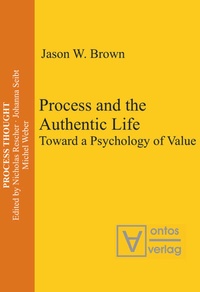
Process and the Authentic Life
Description

The thesis advanced in this book is that feeling and cognition actualize through a process that originates in older brain formations and develops outward through limbic and cortical fields through the self-concept and private space into (as) the world. An iteration of this transition deposits acts, objects, feelings and utterances. Value is a mode of conceptual feeling that depends on the dominant phase in this transition: from desire through interest to object worth. Among the topics covered are subjective time and change, the epochal nature of objects and their temporal extensibility and the evolution of value from inorganic matter into organic form.
The theory of microgenesis informs this work. According to this theory, acts and objects evolve in milliseconds through phases that replicate patterns in forebrain evolution. The progression in the actualization of the mind/brain state is from archaic to recent in brain formation, from unity to diversity, from past to present and from mind to world. An account is given of the diversity of felt experience avoiding the reductionist moves characteristic of biological materialism and the inherent dualism of psychoanalytic and related theories. This book is intended for any reader interested in the psychology of the inner life and philosophy of mind, including philosophers, psychologists, psychiatrists and others with an interest in problems of value and moral feeling.
More details
Other editions
Additional editions
Content
2 - Foreword [Seite 15]
3 - Author's Preface [Seite 21]
4 - Introduction [Seite 23]
5 - Chapter 1. What is an object? [Seite 47]
6 - Chapter 2. Self, Subject and Subjectivity [Seite 73]
7 - Chapter 3. Affect and idea [Seite 101]
8 - Chapter 4. Value in Mind and Nature [Seite 127]
9 - Chapter 5. A World of Value [Seite 147]
10 - Chapter 6. From Drive to Desire [Seite 173]
11 - Chapter 7. Custom and EvolutionaryNaturalism [Seite 195]
12 - Chapter 8. Actualization and Causality [Seite 219]
13 - Chapter 9. Autonomy and Compassion [Seite 243]
14 - Chapter 10. The Grounds of RationalDecision [Seite 275]
15 - Chapter 11. What is a Good Act? [Seite 301]
16 - Chapter 12. The Ideal [Seite 335]
17 - Chapter 13. From Intention to Obligation [Seite 359]
18 - Chapter 14. Taste and Manners [Seite 383]
19 - Chapter 15. Moral Conflict [Seite 407]
20 - Chapter 16. Morality and Suicide [Seite 431]
21 - Chapter 17. Luck and the Pursuit ofHappiness [Seite 457]
22 - Chapter 18. Efficacy and Illusions [Seite 485]
23 - Chapter 19. Thought and Action [Seite 509]
24 - Chapter 20. Thought and Memory [Seite 531]
25 - Chapter 21. The Moral Dimensions ofAesthetic Experience [Seite 553]
26 - Chapter 22. The Illusory and the Real [Seite 579]
27 - Chapter 23. Wholeness and the CreativeLife [Seite 603]
28 - Chapter 24. The Nature of Existence [Seite 635]
29 - Chapter 25. Reflections on Immortality [Seite 663]
30 - References [Seite 691]
