

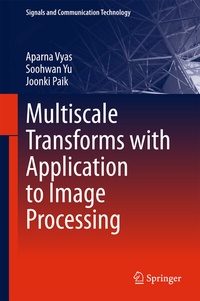
Multiscale Transforms with Application to Image Processing
Description

This book provides an introduction to image processing, an overview of the transforms which are most widely used in the field of image processing, and an introduction to the application of multiscale transforms in image processing.
The book is divided into three parts, with the first part offering the reader a basic introduction to image processing. The second part of the book starts with a chapter on Fourier analysis and Fourier transforms, wavelet analysis, and ends with a chapter on new multiscale transforms. The final part of the book deals with all of the most important applications of multiscale transforms in image processing.
The chapters consist of both tutorial and highly advanced material, and as such the book is intended to be a reference text for graduate students and researchers to obtain state-of-the-art knowledge on specific applications. The technique of solving problems in the transform domain is common in applied mathematics and widely used in research and industry, but is a somewhat neglected subject within the undergraduate curriculum. It is hoped that faculty can use this book to create a course that can be offered early in the curriculum and fill this void. Also, the book is intended to be used as a reference manual for scientists who are engaged in image processing research, developers of image processing hardware and software systems, and practising engineers and scientists who use image processing as a tool in their applications.
More details
Other editions
Additional editions
Persons
Soohwan Yu was born in Incheon, Korea, in 1988. He received the B.S. degree in information and communication engineering from Suwon University, Korea, in 2013. He received the M.S degree in image engineering from Chung-Ang University, Korea, in 2016, where he is currently pursuing the Ph.D. degree in image engineering. His research interests include image enhancement, super-resolution, and image restoration.
Joonki Paik was born in Seoul, Korea in 1960. He received a B.S. degree in control and instrumentation engineering from Seoul National University in 1984. He received an M.S. and a Ph.D. degrees in electrical engineering and computer science from Northwestern University in 1987 and 1990, respectively. From 1990 to 1993, he worked at Samsung Electronics, where he designed image stabilization chip sets for consumer camcorders. Since 1993, he has been a faculty member at Chung-Ang University, Seoul, South Korea. Currently, he is a professor in the Graduate School of Advanced Imaging Science, Multimedia and Film. From 1999 to 2002, he was a visiting professor in the Department of Electrical and Computer Engineering at the University of Tennessee, Knoxville. Dr. Paik was a recipient of the Chester-Sall Award from the IEEE Consumer Electronics Society, the Academic Award from the Institute of Electronic Engineers of Korea, and the Best Research Professor Award from Chung-Ang University. He has served the Consumer Electronics Society of IEEE as a member of the editorial board. Since 2005 he has been the head of the National Research Laboratory in the eld of image processing and intelligent systems. In 2008 he worked as a full time technical consultant for the System LSI Division at Samsung Electronics, where he developed various computational photographic techniques including an extended depth-of- eld (EDoF) system. From 2005 to 2007, he served as Dean of the Graduate School of Advanced Imaging Science, Multimedia, and Film. From 2005 to 2007, he wasDirector of the Seoul Future Contents Convergence (SFCC) Cluster established by the Seoul Research and Business Development (R&BD) Program. Dr. Paik is currently serving as a member of the Presidential Advisory Board for Scienti c/Technical Policy for the Korean government and as a technical consultant for the Korean Supreme Prosecutors Office for computational forensics.
Content
I Introduction to Image Processing.- 1 Fundamentals of Digital Image Processing.- II Multiscale Transform.- 2 Fourier Analysis and Fourier Transform.- 3 Wavelets and Wavelet Transform.- 4 New Multiscale Constructions.- III Application of Multiscale transforms to Image Processing.- 5 Image Restoration.- 6 Image Enhancement.- Appendix A.- Appendix B.- Appendix C.- Appendix D.- Appendix E.- Index.
