

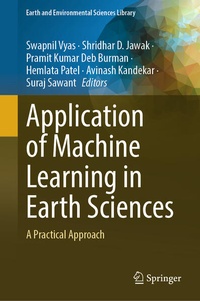
Application of Machine Learning in Earth Sciences
Description

This book introduces the reader to applications of machine learning (ML) in Earth Sciences. In detail, it describes the basic application of machine learning algorithms and models and their potential in Earth Sciences. It discusses the use of several tools and software and the typical workflow for ML applications in Earth Sciences. This book provides a comparative analysis of how standard processes and ML algorithms work in several Earth Sciences applications. Case studies from the various fields of Earth Sciences are presented to illustrate how to apply ML and Deep Learning, these include regression, forecasting, time series analysis in Climate studies, classification methods using multi-spectral data clustering, and dimensionality reduction in classification. This book reviews ML/AI models, algorithms, and methods, analyse case studies, and examine methods of application of ML/AI techniques to specific areas of Earth Sciences. It aims to serve all professionals, and researchers, scientists alike in academics, industries, government, and beyond.
More details
Other editions
Additional editions
Content
A ConvGRU Deep Learning Algorithm to Forecast global Ionospheric TEC Maps.- Estimation of Daily Air Relative Humidity Using a Novel Outlier-Robust Extreme Learning Machine Model: A Case Study of Two Algerian Locations.- Significance of Machine Learning in Understanding Earth's Magnetosphere and Solar Activity.- Harnessing artificial intelligence for the detection and analysis of microplastics and associated chemicals in the atmosphere.- Application of Machine Learning in Bioremediation and Detection of Pollutants.- Machine Learning for Analysis of Water flow in the Reservoirs and Monitoring of Air quality.- Leveraging AI/ML for the Identification of Ma-rine Organisms.- Application of Machine Learning in River Water Quality Monitoring.- Application of AI/ML in river water quality monitoring.- Deep Neural Network for Water Mapping during Flood from SAR images using Matlab.
