

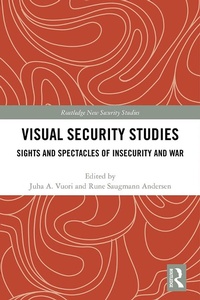
Visual Security Studies
Sights and Spectacles of Insecurity and War
1st Edition
Published on 6. August 2018
220 pages
978-1-315-38756-7 (ISBN)
Description

The present volume engages visuality in security from a variety of angles and explores what the subfield of Visual Security Studies might be.
To structure this experimentation, and to encourage a more careful and multifaceted approach to visuality and security, the main conceptual move in this volume is to envision three different transversal meeting points between security and visuality: visuality as a modality (active in representations and signs of security), visuality as practice (active in enacting security), and visuality as a method (active in investigating security). These three approaches structure the book together with three areas in which we see visuality as especially pertinent in relation to security: in security technologies that (en)vision security and are themselves the objects of visions of security; in spectacles of security and security spectatorship; and in ways of making security visible.
In this way, the volume works to sensitize International Relations research to visual forms of knowledge and practice by examining visual aspects of security. At the same time, it allows for debate on how this particular modality of the sensible not only affects what is visible and what is not, but also how authority and truth-claims come about, and how they are compared and evaluated. Through engagement with security via the 'language' or 'code' of the visual, it is possible to interrogate how scholars in the field understand visuality as well as the economy, grammar, and performativity of visual articulation and the production of knowledge. The volume also examines how visuality can be used as a method in doing research, and as a way of presenting research results.
Visual Security Studies is not a new theory of security or its study; instead, the present volume suggests that visuality should be envisioned as an aspect of security studies that can be incorporated into pre-existing approaches. The aim is to highlight how much of contemporary practice is visual and to foster an increased attentiveness to visuality in security politics, security practice, and to the possibilities of employing visual research methods in security scholarship.
This book will be of much interest to students of critical security, media studies, surveillance studies, visual sociology, and IR in general.
To structure this experimentation, and to encourage a more careful and multifaceted approach to visuality and security, the main conceptual move in this volume is to envision three different transversal meeting points between security and visuality: visuality as a modality (active in representations and signs of security), visuality as practice (active in enacting security), and visuality as a method (active in investigating security). These three approaches structure the book together with three areas in which we see visuality as especially pertinent in relation to security: in security technologies that (en)vision security and are themselves the objects of visions of security; in spectacles of security and security spectatorship; and in ways of making security visible.
In this way, the volume works to sensitize International Relations research to visual forms of knowledge and practice by examining visual aspects of security. At the same time, it allows for debate on how this particular modality of the sensible not only affects what is visible and what is not, but also how authority and truth-claims come about, and how they are compared and evaluated. Through engagement with security via the 'language' or 'code' of the visual, it is possible to interrogate how scholars in the field understand visuality as well as the economy, grammar, and performativity of visual articulation and the production of knowledge. The volume also examines how visuality can be used as a method in doing research, and as a way of presenting research results.
Visual Security Studies is not a new theory of security or its study; instead, the present volume suggests that visuality should be envisioned as an aspect of security studies that can be incorporated into pre-existing approaches. The aim is to highlight how much of contemporary practice is visual and to foster an increased attentiveness to visuality in security politics, security practice, and to the possibilities of employing visual research methods in security scholarship.
This book will be of much interest to students of critical security, media studies, surveillance studies, visual sociology, and IR in general.
More details
Series
Edition
1. Auflage
Language
English
Place of publication
London
United Kingdom
Publishing group
Taylor & Francis Ltd
Target group
College/higher education
Professional and scholarly
Product notice
Reflowable
Illustrations
1 Tables, black and white; 1 Line drawings, black and white; 18 Halftones, black and white; 19 Illustrations, black and white
ISBN-13
978-1-315-38756-7 (9781315387567)
Copyright in bibliographic data and cover images is held by Nielsen Book Services Limited or by the publishers or by their respective licensors: all rights reserved.
Schweitzer Classification
Other editions
Additional editions
Book
12/2019
1st Edition
Routledge
€64.90
Shipment within 15-20 days
Book
06/2018
1st Edition
Routledge
€215.41
Shipment within 10-20 days
Persons
Juha A. Vuori is acting Professor of International Politics at the University of Turku, and an Adjunct Professor of International Politics at the University of Tampere. He is the author of Critical Security and Chinese Politics (Routledge, 2014) and co-author of A History of the People's Republic of China (in Finnish, 2012).
Rune Saugmann Andersen is a post-doctoral fellow at University of Tampere and holds a PhD from the Center for Advanced Security Theory (CAST), University of Copenhagen.
Rune Saugmann Andersen is a post-doctoral fellow at University of Tampere and holds a PhD from the Center for Advanced Security Theory (CAST), University of Copenhagen.
Content
Chapter 1: Introduction, Chapter 2: Scalia.warhead1, Chapter 3: The gaze, the drone dispositif, and necro-biographies, Chapter 4: CCTV oddity, Chapter 5: The humanity of war, Chapter 6: World Drug Day and visual rituals of security in West Africa, Chapter 7: Collaging Iranian missiles, Chapter 8: Leonardo's security, Chapter 9: Making norms visible, Chapter 10: Auto-photographing (in)securities, Chapter 11: Visual security
