

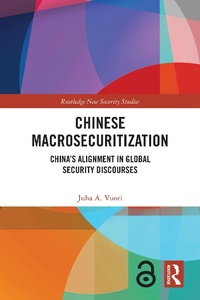
Chinese Macrosecuritization
China's Alignment in Global Security Discourses
1st Edition
Published on 10. November 2023
262 pages
978-1-003-80704-9 (ISBN)
Description

This book provides a holistic picture of Chinese global security discourses, with a focus on macrosecuritizations.
The work examines how the People's Republic of China (PRC) has aligned itself within global security discourses. This is approached through the theory of securitization, specifically by using the notion of macrosecuritization as the lens for its analysis. The book offers the first full account of Chinese macrosecuritization discourses and alignments, and it aims to discern what security speech with referent objects such as humanity, civilization, or nature has done in the domestic and international politics of China. Specifically, the work focuses on the discourses of the Cold War, anti-nuclear weapons, climate change, and the Global War on Terror, which have all been postulated in the literature as macrosecuritizations. In addition, it examines discourses with global referent objects that have been put forth by the PRC so that we can see whether its proposals for global security governance take the form of, or are legitimated through, macrosecuritization. The overall argument in the book is that the way contemporary China uses macrosecuritization discourses provides for ontological security as its position in relation to other major powers is undergoing transformation, by allowing it to maintain a consistent narrative of its international self that abides by its own set of moral values and sense of worth.
This book will be of interest to students of critical security studies, Chinese politics and International Relations.
The Open Access version of this book, available at www.taylorfrancis.com, has been made available under a Creative Commons Attribution-NonCommercial-ShareAlike (CC-BY-NC-SA) 4.0 International.
The work examines how the People's Republic of China (PRC) has aligned itself within global security discourses. This is approached through the theory of securitization, specifically by using the notion of macrosecuritization as the lens for its analysis. The book offers the first full account of Chinese macrosecuritization discourses and alignments, and it aims to discern what security speech with referent objects such as humanity, civilization, or nature has done in the domestic and international politics of China. Specifically, the work focuses on the discourses of the Cold War, anti-nuclear weapons, climate change, and the Global War on Terror, which have all been postulated in the literature as macrosecuritizations. In addition, it examines discourses with global referent objects that have been put forth by the PRC so that we can see whether its proposals for global security governance take the form of, or are legitimated through, macrosecuritization. The overall argument in the book is that the way contemporary China uses macrosecuritization discourses provides for ontological security as its position in relation to other major powers is undergoing transformation, by allowing it to maintain a consistent narrative of its international self that abides by its own set of moral values and sense of worth.
This book will be of interest to students of critical security studies, Chinese politics and International Relations.
The Open Access version of this book, available at www.taylorfrancis.com, has been made available under a Creative Commons Attribution-NonCommercial-ShareAlike (CC-BY-NC-SA) 4.0 International.
More details
Series
Edition
1. Auflage
Language
English
Place of publication
London
United Kingdom
Publishing group
Taylor & Francis Ebooks
Target group
College/higher education
Professional and scholarly
Illustrations
9 Tables, black and white; 2 Line drawings, black and white; 2 Illustrations, black and white
File size
20,50 MB
ISBN-13
978-1-003-80704-9 (9781003807049)
Copyright in bibliographic data and cover images is held by Nielsen Book Services Limited or by the publishers or by their respective licensors: all rights reserved.
Schweitzer Classification
Other editions
Additional editions
Book
04/2025
1st Edition
Routledge
€67.50
Shipment within 10-20 days

Book
12/2023
Taylor & Francis
Unfortunately, price unknown
Available (delivery time upon request)
Book
11/2023
1st Edition
Routledge
€206.50
Shipment within 10-20 days
Person
Juha A. Vuori is Professor of International Politics at Tampere University in Finland. His recent publications include Visual Security Studies: Sights and Spectacles of Insecurity and War (co-ed. with Rune Andersen, 2018) and Critical Security and Chinese Politics: The Anti-Falungong Campaign (2014).
Content
Introduction: Securitizing Global Concerns 1. From Securitization to Macrosecuritization 2. Security in China 3. The Cold War Then and Now 4. Anti-Nuclear Discourse in China 5. Climate Security with Chinese Characteristics 6. China's War on Terror 7. Potential Chinese Macrosecuritization Issues 8. Making Sense of China's Alignment in Security Discourses with Global Referents
