

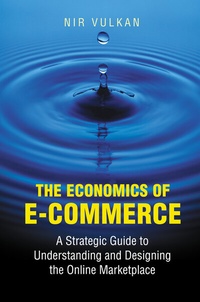
The Economics of E-Commerce
A Strategic Guide to Understanding and Designing the Online Marketplace
1st Edition
Published on 24. August 2020
240 pages
978-0-691-21454-2 (ISBN)
Description

Despite the recent misfortunes of many dotcoms, e-commerce will have major and lasting effects on economic activity. But the rise and fall in the valuations of the first wave of e-commerce companies show that vague promises of distant profits are insufficient. Only business models based on sound economic propositions will survive. This book provides professionals, investors, and MBA students the tools they need to evaluate the wide range of actual and potential e-commerce businesses at the microeconomic level. It demonstrates how these tools can be used to assess a variety of existing applications.
Advances in web-based technology--particularly automation and delegation technologies such as smart agents, shopping bots, and bidding elves--support the further growth of e-commerce. In addition to enabling consumers to conduct automated comparisons and sellers to access visitors' background information in real time, such software programs can make decisions for individuals, negotiate with other programs, and participate in online markets. Much of e-commerce's economic value arises from this kind of automation, which not only reduces operating costs but adds value by generating new market interactions.
This text teaches how to analyze the added value of such applications, considering consumer behavior, pricing strategies, incentives, and other critical factors. It discusses added value in several e-commerce arenas: online shopping, business-to-business e-commerce, application design, online negotiation (one-to-one trading), online auctions (one-to-many trading), and many-to-many electronic exchanges. Combining insights from several years of microeconomic research as well as from game theory and computer science, it stresses the importance of economic engineering in application design as well as the need for business models to take into account the "total game."
As the only serious treatment of the microeconomics of e-commerce, this book should be read by anyone seeking e-commerce solutions or planning to work in the field.
Advances in web-based technology--particularly automation and delegation technologies such as smart agents, shopping bots, and bidding elves--support the further growth of e-commerce. In addition to enabling consumers to conduct automated comparisons and sellers to access visitors' background information in real time, such software programs can make decisions for individuals, negotiate with other programs, and participate in online markets. Much of e-commerce's economic value arises from this kind of automation, which not only reduces operating costs but adds value by generating new market interactions.
This text teaches how to analyze the added value of such applications, considering consumer behavior, pricing strategies, incentives, and other critical factors. It discusses added value in several e-commerce arenas: online shopping, business-to-business e-commerce, application design, online negotiation (one-to-one trading), online auctions (one-to-many trading), and many-to-many electronic exchanges. Combining insights from several years of microeconomic research as well as from game theory and computer science, it stresses the importance of economic engineering in application design as well as the need for business models to take into account the "total game."
As the only serious treatment of the microeconomics of e-commerce, this book should be read by anyone seeking e-commerce solutions or planning to work in the field.
More details
Other editions
Additional editions
Nir Vulkan
The Economics of E-Commerce
A Strategic Guide to Understanding and Designing the Online Marketplace
Book
03/2003
Princeton University Press
€111.50
Shipment within 10-20 days
Person
Nir Vulkan is University Lecturer in Management at the Saïd Business School and a Fellow of Worcester College, University of Oxford.
Content
- Cover Page
- Half-title Page
- Title Page
- Copyright Page
- Dedication Page
- Contents
- Preface
- Acknowledgments
- Chapter 1: Introduction And Overview
- Part I. Evaluating E-Commerce Applications
- Chapter 2: E-Commerce and the Tools of Economic Analysis
- The Phenomenal Growth of E-Commerce
- Why Use Economics to Analyze E-Commerce?
- Key Issues
- Chapter 3: E-Commerce For Consumers
- The Impact of E-Commerce on Prices And Product offerings
- Consumer Research and Comparison Shopping: The Economics of Search Costs
- Individually Tailored Products and Prices: The Economics of Personalization
- Consumer E-Commerce In Practice: The Waldo Experiment
- Key Issues In Consumer E-Commerce
- Chapter 4: Business-to-Business E-Commerce
- Types of B2b E-Commerce
- Why Trade Online?
- How Firms Choose the Most Profitable Way to Trade
- B2b E-Commerce in Practice: Exostar
- Key Issues For B2b E-Commerce
- Part II. Designing E-Commerce Applications
- Chapter 5: E-Commerce And The Principles of Economic Engineering
- The Motivation For Economic Engineering
- Economic Design in Practice
- Designing Incentives to Participate in The Market
- Encouraging the "Right" Behavior
- Putting the Design Into Practice
- Lessons for Designers of Market Mechanisms
- Chapter 6: One-to-One Trading: Direct Negotiations in E-Commerce
- One-to-One Negotiations off- and Online
- Designing Technologies For One-to-One Negotiations
- The Importance of Context-Specific Design For E-Commerce
- The Limits of Protocol Design For One-to-One Negotiations
- Negotiations: E-Commerce in Practice
- Key Considerations For E-Commerce Negotiations
- Chapter 7: One-to-Many Trading: Online Auctions
- Types of Auction
- Why Use Auctions?
- General Principles of Auction Design
- Designing Online Auctions: The Problem of Late Bidding
- Additional Issues For Online Auction Designers
- Key Considerations For Online Auctions
- Chapter 8: Many-To-Many Electronic Exchanges
- Introduction
- What Can Be Traded Through an Exchange?
- How Do Exchanges Work?
- What Is Liquidity And Who Provides It?
- Automation
- Case Study
- Key Consideration For E-Commerce Exchanges
- Bibliography
- Index
