

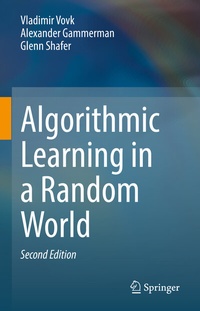
Algorithmic Learning in a Random World
Description

This book is about conformal prediction, an approach to prediction that originated in machine learning in the late 1990s. The main feature of conformal prediction is the principled treatment of the reliability of predictions. The prediction algorithms described - conformal predictors - are provably valid in the sense that they evaluate the reliability of their own predictions in a way that is neither over-pessimistic nor over-optimistic (the latter being especially dangerous). The approach is still flexible enough to incorporate most of the existing powerful methods of machine learning. The book covers both key conformal predictors and the mathematical analysis of their properties.
Algorithmic Learning in a Random World contains, in addition to proofs of validity, results about the efficiency of conformal predictors. The only assumption required for validity is that of "randomness" (the prediction algorithm is presented with independent and identically distributed examples); in later chapters, even the assumption of randomness is significantly relaxed. Interesting results about efficiency are established both under randomness and under stronger assumptions.
Since publication of the First Edition in 2005 conformal prediction has found numerous applications in medicine and industry, and is becoming a popular machine-learning technique. This Second Edition contains three new chapters. One is about conformal predictive distributions, which are more informative than the set predictions produced by standard conformal predictors. Another is about the efficiency of ways of testing the assumption of randomness based on conformal prediction. The third new chapter harnesses conformal testing procedures for protecting machine-learning algorithms against changes in the distribution of the data. In addition, the existing chapters have been revised, updated, and expanded.
More details
Other editions
Additional editions
Persons
Alexander Gammerman is Professor of Computer Science and co-Director of the Centre for Reliable Machine Learning at Royal Holloway, University of London. His research interests lie in machine learning and pattern recognition, where the majority of his research books, papers, and grants can be found. He is a Fellow of the Royal Statistical Society and has held visiting and honorary professorships from several universities in Europe and the USA.
Glenn Shafer is Professor and formerDean of the Rutgers Business School - Newark and New Brunswick. He is best known for his work in the 1970s and 1980s on the Dempster-Shafer theory, an alternative theory of probability that has been applied widely in engineering and artificial intelligence. Glenn is also known for his initiation, with Vladimir Vovk, of the game-theoretic framework for probability. Their first book on the topic was Probability and Finance: It's Only a Game! A new book on the topic, Game-Theoretic Foundations for Probability and Finance , published in 2019 (Wiley).
