

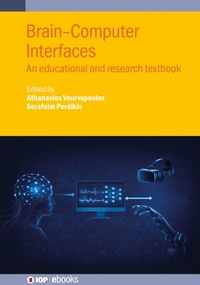
Brain-Computer Interfaces
Description

This book provides a comprehensive and accessible introduction to the science and practice of brain-computer interfaces (BCIs), a rapidly evolving field at the intersection of neuroscience, engineering, computer science, and human-computer interaction. Its primary purpose is to equip readers with the conceptual foundations and methodological tools needed to understand how BCIs work, how they are designed, and how they are applied in research, clinical, and emerging real-world contexts. The scope of the book spans the full BCI pipeline, with equal emphasis on technical rigor and practical relevance. This volume is both an educational gateway and a lasting reference for understanding contemporary brain-computer interfaces.
Key Features:
- Pedagogical features include exercises and end-of-chapter summaries
- Accompanied by MATLAB and Python code
- How to use EEGs to develop more intuitive BCIs in real-time scenarios
- Introductory approach accessible to advanced students and ECRs in academia and industry
More details
Other editions
Additional editions

Persons
Athanasios Vourvopoulos is an Assistant Professor in the Department of Bioengineering at Instituto Superior Técnico (IST), University of Lisbon, and Principal Researcher at the Institute for Systems and Robotics (ISR-Lisboa)/LaSEEB, his research is at the intersection of biomedical and computer engineering, with a focus on closed-loop neurotechnologies, including non-invasive brain-computer interfaces (BCIs), neurofeedback, and neuromodulation. His work integrates these technologies with virtual environments and robotic platforms to support the treatment of neurological disorders and to promote long-term improvements in health outcomes, autonomy, and quality of life. This research has been recognized with several grants and awards, including the "Best Early Career Award" from the International Society for Virtual Rehabilitation (ISVR).
Serafeim Perdikis is Associate Professor of the Neural Engineering and Brain-Computer Interface (BCI) Laboratory at the University of Essex, School of Computer Science and Electronic Engineering, UK. His main areas of research interest include BCI, theoretical and applied machine learning, artificial intelligence, bio-signal and especially electroencephalography (EEG) and electromyography (EMG) signal processing, mutual learning and co-adaptation in BCI, translational and rehabilitation applications of BCI. His work has been disseminated in the most important journals, conferences and magazines in this field, and funded by various agencies. He has led the winning team in the BCI race discipline of the first Cybathlon competition for assistive technologies. His rehabilitation work has received the Best Paper Award for the Neural Engineering pillar in IEEE MetroXRAINE 2023.
Content
Preface
Editor biographies
List of contributors
List of abbreviations
1 Introduction
2 Experimental apparatus and design
3 Brain-computer interface paradigms
4 Methods for brain-computer interfacing
5 Principles and techniques of brain-computer interaction
6 Applications of brain-computer interface
7 The human in the loop
8 Outlook
