

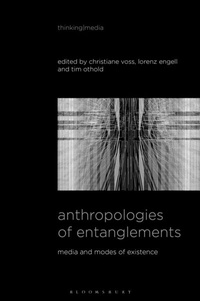
Anthropologies of Entanglements
Media and Modes of Existence
1st Edition
Published on 24. August 2023
326 pages
978-1-5013-7513-2 (ISBN)
Description

Media and human modes of existence are always already intertwined and interdependent. The notion of the anthropocene has further stimulated a new examination of ideas about human agency and responsibility. Various approaches all emphasize relational concepts and the situatedness and embodiment of human-and also non-human-existences and experiences. Their common interest has shifted from any so-called 'human nature' to the multitude of cultural, topographical, technical, historical, social, discursive, and media formats with which human existences are entangled.
This volume brings together a range of thinkers from international backgrounds and puts these important reflections and ideas in the spotlight. More specifically, the volume explores the concept of "anthropomedial entanglements." It fosters an understanding of human bodies, experiences, and media as being immanently entangled and mutually constituting, prior to any possible distinction between them. The different contributions thus open up a dialogue between empirical case studies and media-historical research on the one hand and the conceptual work of media and cultural philosophies and aesthetics on the other hand.
This volume brings together a range of thinkers from international backgrounds and puts these important reflections and ideas in the spotlight. More specifically, the volume explores the concept of "anthropomedial entanglements." It fosters an understanding of human bodies, experiences, and media as being immanently entangled and mutually constituting, prior to any possible distinction between them. The different contributions thus open up a dialogue between empirical case studies and media-historical research on the one hand and the conceptual work of media and cultural philosophies and aesthetics on the other hand.
Reviews / Votes
Anthropologies of Entanglement develops a new and inspiring approach to understanding our contemporary condition of the "Mediocene", in which the human and natural spheres are indissolubly intertwined with and permeated by media. Its key word, "Anthropomediality," convincingly suggests to conceive the human existence as mediatic; the relation comes before the related. The 16 contributions by international authors from a broad variety of fields brilliantly discuss the entanglements that precede all forms of reification and anthropogenesis. * Christoph Menke, Professor, Goethe-Universitaet Frankfurt am Main, Germany * This splendid collection includes essays tackling examples from the multiple histories of our co-evolution with technologies (from the prostheses of World War I to today's surveillance devices of the train station) and others offering ways to conceptualize the status of human-media interrelations, and their inseparability, that entanglement carried in Voss' term, "anthropomediality." The writing is consistently lucid and engaging, as well as helpful in unfolding dense theories into usable form and in applying them to a diversity of films (from Rocky to Claire Denis). The book will be particularly valuable for students wanting to think more deeply about the consequences of a traffic that courses among media and existence. * Antonia Lant, Professor of Cinema Studies, Tisch School of the Arts, New York University, USA *More details
Series
Edition
1. Auflage
Language
English
Place of publication
New York
United States
Publishing group
Bloomsbury Publishing PLC (Digital)
Target group
College/higher education
Illustrations
57 colour images
ISBN-13
978-1-5013-7513-2 (9781501375132)
Copyright in bibliographic data and cover images is held by Nielsen Book Services Limited or by the publishers or by their respective licensors: all rights reserved.
Schweitzer Classification
Other editions
Additional editions
Christiane Voss | Lorenz Engell | Tim Othold
Anthropologies of Entanglements
Media and Modes of Existence
Book
03/2025
Bloomsbury Academic USA
€55.89
Shipment within 15-20 days
Persons
Christiane Voss is Professor of Philosophy of Audiovisual Media at the Bauhaus-University Weimar, Germany. Important publications include Die Relevanz der Irrelevanz (2021), together with Lorenz Engell, Der Leihkoerper (2013), and Narrative Emotions (2003).
Lorenz Engell is Professor of Media Philosophy at Bauhaus-Universitaet Weimar, Germany, where he was the founding dean of the Faculty of Media from 1996-2000 and co-director of the International Research Center for Cultural Techniques and Media Philosophy (IKKM) from 2008-2020.
Tim Othold is a research associate at the postgraduate program for Media Anthropology at Bauhaus-University Weimar, Germany.
Lorenz Engell is Professor of Media Philosophy at Bauhaus-Universitaet Weimar, Germany, where he was the founding dean of the Faculty of Media from 1996-2000 and co-director of the International Research Center for Cultural Techniques and Media Philosophy (IKKM) from 2008-2020.
Tim Othold is a research associate at the postgraduate program for Media Anthropology at Bauhaus-University Weimar, Germany.
Content
Acknowledgements
Anthropologies of Entanglements: An Introduction
Christiane Voss, Lorenz Engell, Tim Othold (Bauhaus-University Weimar, Germany)
I. Milieus
1. Existing in Motion: Foundations for a Philosophical Media-Anthropology
Christiane Voss (Bauhaus-University Weimar, Germany)
2. Tangled Efforts and Middle-Voiced Verbs
Jane Bennett (Johns Hopkins University, USA)
3. The Experience-Image and Collaborative Filmmaking - From Visual Anthropology to Media-Anthropological Practices
Julia Bee (University of Siegen, Germany)
4. A Life in the Interstices: Micropolitics and Aesthetics in Everyday Life
Christoph Carsten (Independent Scholar, Germany)
II. Practice and Process
5. Prosthesis for Feeling: Intensifying Potentiality through Media
Mark B.N. Hansen (Duke University, USA)
6. Chemaera
Jason Pine (Independent Scholar, USA)
7. In Control of Algorithms: Video Analytics and Human-machine Relations at the Train Station
Gabriele Schabacher (Johannes Gutenberg University Mainz, Germany)
8. On the Anthropology of the mode double click
Lorenz Engell (Bauhaus-Universitaet Weimar, Germany)
9. Neutral Time
Philip Gries (Bauhaus-University Weimar, Germany)
III. Bodies in Media
10. Unfolding Bodies. Art and Ontology of the American Northwest Coast
Bernhard Siegert (Bauhaus-University Weimar, Germany)
11. Corporeal Literacy: Alphabetic Bodies and the Logic of the Cut
Maaike Bleeker (Utrecht University, the Netherlands)
12.Torn, Crushed, Shredded. The Reconstruction of Wounded Bodies in World War I
Johanna Seifert (FernUniversitaet, Germany)
13. Material Dialectics of the Hard Body
Ivo Ritzer (University of Bayreuth, Germany)
14. She is Inseminating: On the Secret of Life in Claire Denis's Science Fiction Film High Life (2018)
Astrid Deuber-Mankowsky (Ruhr-University Bochum, Germany)
Contributors
Index
Anthropologies of Entanglements: An Introduction
Christiane Voss, Lorenz Engell, Tim Othold (Bauhaus-University Weimar, Germany)
I. Milieus
1. Existing in Motion: Foundations for a Philosophical Media-Anthropology
Christiane Voss (Bauhaus-University Weimar, Germany)
2. Tangled Efforts and Middle-Voiced Verbs
Jane Bennett (Johns Hopkins University, USA)
3. The Experience-Image and Collaborative Filmmaking - From Visual Anthropology to Media-Anthropological Practices
Julia Bee (University of Siegen, Germany)
4. A Life in the Interstices: Micropolitics and Aesthetics in Everyday Life
Christoph Carsten (Independent Scholar, Germany)
II. Practice and Process
5. Prosthesis for Feeling: Intensifying Potentiality through Media
Mark B.N. Hansen (Duke University, USA)
6. Chemaera
Jason Pine (Independent Scholar, USA)
7. In Control of Algorithms: Video Analytics and Human-machine Relations at the Train Station
Gabriele Schabacher (Johannes Gutenberg University Mainz, Germany)
8. On the Anthropology of the mode double click
Lorenz Engell (Bauhaus-Universitaet Weimar, Germany)
9. Neutral Time
Philip Gries (Bauhaus-University Weimar, Germany)
III. Bodies in Media
10. Unfolding Bodies. Art and Ontology of the American Northwest Coast
Bernhard Siegert (Bauhaus-University Weimar, Germany)
11. Corporeal Literacy: Alphabetic Bodies and the Logic of the Cut
Maaike Bleeker (Utrecht University, the Netherlands)
12.Torn, Crushed, Shredded. The Reconstruction of Wounded Bodies in World War I
Johanna Seifert (FernUniversitaet, Germany)
13. Material Dialectics of the Hard Body
Ivo Ritzer (University of Bayreuth, Germany)
14. She is Inseminating: On the Secret of Life in Claire Denis's Science Fiction Film High Life (2018)
Astrid Deuber-Mankowsky (Ruhr-University Bochum, Germany)
Contributors
Index
