

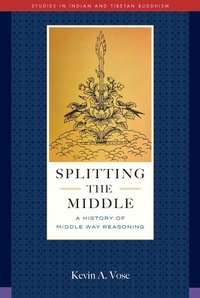
Splitting the Middle
A History of Middle Way Reasoning
Published on 28. April 2026
552 pages
979-8-89070-013-1 (ISBN)
Description

Discover how Patsab Nyima Drak created the foremost form of Buddhist philosophy, the Prasangika interpretation of the Middle Way, from the works of the famed Indian philosopher Candrakirti.
This book traces how Buddhist philosophers Bhaviveka and Candrakirti (ca. sixth?seventh centuries) understood key Buddhist epistemological questions: how to prove the central Middle Way claim that all things are empty of intrinsic nature, the correct use of svatantra inference, and the role of arguments by "consequence" (prasanga). These arguments saw further refinement in the works of eighth-century thinkers Santaraksita and Kamalasila, who were instrumental in transmitting the Middle Way from India to Tibet. Together, these figures inspired the twelfth-century renaissance of the Middle Way in Tibet, where the differences between their viewpoints became the basis for two philosophical schools?Prasangika and Svatantrika?named for their chosen forms of argumentation.
Patsab Nyima Drak (ca. 1070?1145), the Tibetan translator of Candrakirti's major works, and his disciples Shang Thangsakpa, Khuton Dode Bar, and Maja Jangchup Tsondru, together with the Kashmiri Jayananda, forged a systematic interpretation of the Middle Way and the Mahayana Buddhist path to awakening. They saw Candrakirti's arguments by consequence to be central in overcoming the twin delusions of holding philosophical positions and seeing things as having intrinsic natures. Championing Candrakirti's austere vision of transformation, these creators of Prasangika argued that proper reasoning and contemplation induce a radical break with consciousness that enables the practitioner to become a buddha.
This examination of the first Prasangikas casts this reading of the Middle Way in new light, challenging contemporary interpretations that present it as a form of skepticism. Splitting the Middle argues that Prasangika constitutes a thoroughgoing challenge to the validity of mental states and ways of knowing.
This book traces how Buddhist philosophers Bhaviveka and Candrakirti (ca. sixth?seventh centuries) understood key Buddhist epistemological questions: how to prove the central Middle Way claim that all things are empty of intrinsic nature, the correct use of svatantra inference, and the role of arguments by "consequence" (prasanga). These arguments saw further refinement in the works of eighth-century thinkers Santaraksita and Kamalasila, who were instrumental in transmitting the Middle Way from India to Tibet. Together, these figures inspired the twelfth-century renaissance of the Middle Way in Tibet, where the differences between their viewpoints became the basis for two philosophical schools?Prasangika and Svatantrika?named for their chosen forms of argumentation.
Patsab Nyima Drak (ca. 1070?1145), the Tibetan translator of Candrakirti's major works, and his disciples Shang Thangsakpa, Khuton Dode Bar, and Maja Jangchup Tsondru, together with the Kashmiri Jayananda, forged a systematic interpretation of the Middle Way and the Mahayana Buddhist path to awakening. They saw Candrakirti's arguments by consequence to be central in overcoming the twin delusions of holding philosophical positions and seeing things as having intrinsic natures. Championing Candrakirti's austere vision of transformation, these creators of Prasangika argued that proper reasoning and contemplation induce a radical break with consciousness that enables the practitioner to become a buddha.
This examination of the first Prasangikas casts this reading of the Middle Way in new light, challenging contemporary interpretations that present it as a form of skepticism. Splitting the Middle argues that Prasangika constitutes a thoroughgoing challenge to the validity of mental states and ways of knowing.
More details
Other editions
Additional editions
Book
05/2026
Wisdom Publications,U.S.
€56.00
Shipment within 10-20 days
Person
Kevin A. Vose is the author of the Studies in Indian and Tibetan Buddhism series volume Resurrecting Candrakirti. He is a Professor of Religious Studies at William & Mary and the author of several research articles on the transmission of Sanskrit Buddhist philosophical traditions from India to Tibet and the formation of Tibetan Buddhist scholastic traditions. His articles have appeared in the Journal of the International Association of Buddhist Studies, Journal of Buddhist Philosophy, Journal of Indian Philosophy, and Journal of South Asian Intellectual History, among others. His work focuses in particular on a collection of eleventh- and twelfth-century Tibetan manuscripts discovered in one of the few libraries to survive the Cultural Revolution in Tibet and that provide a wealth of information on the formative period of Tibetan Buddhism. From this collection, he and Pascale Hugon are preparing an edition and translation of Gyamarwa's Essence of the Middle Way, available as a work-in-progress on the website of the Austrian Academy of Sciences.
