

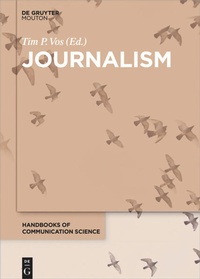
Journalism
1st Edition
Published on 22. May 2018
XIII, 601 pages
978-1-5015-0008-4 (ISBN)
Description

This volume sets out the state-of-the-art in the discipline of journalism at a time in which the practice and profession of journalism is in serious flux.
While journalism is still anchored to its history, change is infecting the field. The profession, and the scholars who study it, are reconceptualizing what journalism is in a time when journalists no longer monopolize the means for spreading the news. Here, journalism is explored as a social practice, as an institution, and as memory. The roles, epistemologies, and ethics of the field are evolving. With this in mind, the volume revisits classic theories of journalism, such as gatekeeping and agenda-setting, but also opens up new avenues of theorizing by broadening the scope of inquiry into an expanded journalism ecology, which now includes citizen journalism, documentaries, and lifestyle journalism, and by tapping the insights of other disciplines, such as geography, economics, and psychology.
The volume is a go-to map of the field for students and scholars-highlighting emerging issues, enduring themes, revitalized theories, and fresh conceptualizations of journalism.
While journalism is still anchored to its history, change is infecting the field. The profession, and the scholars who study it, are reconceptualizing what journalism is in a time when journalists no longer monopolize the means for spreading the news. Here, journalism is explored as a social practice, as an institution, and as memory. The roles, epistemologies, and ethics of the field are evolving. With this in mind, the volume revisits classic theories of journalism, such as gatekeeping and agenda-setting, but also opens up new avenues of theorizing by broadening the scope of inquiry into an expanded journalism ecology, which now includes citizen journalism, documentaries, and lifestyle journalism, and by tapping the insights of other disciplines, such as geography, economics, and psychology.
The volume is a go-to map of the field for students and scholars-highlighting emerging issues, enduring themes, revitalized theories, and fresh conceptualizations of journalism.
More details
Other editions
Additional editions
Tim P. Vos
Journalism
Book
05/2018
1st Edition
De Gruyter Mouton
€310.00
Article not available at the moment
Tim P. Vos
Journalism
Book
05/2018
1st Edition
De Gruyter Mouton
€299.00
The article will not be published
Person
Tim P. Vos, University of Missouri, Columbia, MO, USA.
Content
- Intro
- Preface to Handbooks of Communication Science series
- Acknowledgements
- Contents
- 1. Journalism
- 2. Journalism history
- I Foundations of the Field
- 3. Roles of Journalists
- 4. Epistemologies of Journalism
- 5. Journalism Ethics
- II. Conceptualizing the Field
- 6. Journalism as Practice
- 7. Journalism as Institution
- 8. Journalism as Public Sphere
- 9. Journalism as Memory
- III. Theorizing the Field
- 10. Journalism as Agenda Setting
- 11. Journalism as Framing
- 12. Journalism as Gatekeeping
- IV. Journalism via the Disciplines
- 13. The Sociology of Journalism
- 14. The Economics of Journalism and News Provision
- 15 Politics and Policies of Journalism and Free Press
- 16. The Technology of Journalism
- 17. Journalism and Geography
- V. The Journalism Ecology
- 18. Entrepreneurial Journalism
- 19. Mapping the Citizen News Landscape: Blurring Boundaries, Promises, Perils, and Beyond
- 20. Advocacy Journalism
- 21. Documentary Journalism
- 22. Lifestyle Journalism
- VI. The Issues of Journalism
- 23. Journalism, War, and Peace
- 24. Journalism, Censorship, and Press Freedom
- 25. Journalism, Pluralism, and Diversity
- 26. Journalism, Gender, and Race
- 27. Journalism, Audiences and Community Engagement
- VII. Conclusion
- 28. Journalism and Change
- 29. The Future of Journalism Scholarship
- Biographical sketches
- Index
