

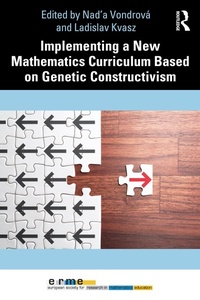
Implementing a New Mathematics Curriculum Based on Genetic Constructivism
Published on 29. May 2026
280 pages
978-1-040-67656-1 (ISBN)
Description

This book shows the transformative power of genetic constructivism in mathematics education, exploring how research, practice, and policy converged to drive educational innovations in the Czech Republic can offer valuable insights into the evolution of mathematics teaching on an international scale.
Drawing on a seventy-year legacy of advancements, the book highlights the pioneering ideas that emerged during the communist regime and were further developed after the Velvet Revolution, influenced by both East-European and global perspectives. Each chapter sees leading international experts reflect on the development and large-scale implementation of genetic constructivism, examining its impact on learners and providing forward-looking recommendations for the future of mathematics education. The book also delves into key themes, including the origins and defining characteristics of genetic constructivism, practical applications in schools, and an evaluation of its influence on student learning, all while maintaining a consistent focus on joyful, autonomous discovery supported by thoughtful teaching.
Encouraging readers to critically assess their own teaching methods, this is the ideal resource for researchers, educators, and policymakers seeking innovative strategies to enhance mathematics education.
Drawing on a seventy-year legacy of advancements, the book highlights the pioneering ideas that emerged during the communist regime and were further developed after the Velvet Revolution, influenced by both East-European and global perspectives. Each chapter sees leading international experts reflect on the development and large-scale implementation of genetic constructivism, examining its impact on learners and providing forward-looking recommendations for the future of mathematics education. The book also delves into key themes, including the origins and defining characteristics of genetic constructivism, practical applications in schools, and an evaluation of its influence on student learning, all while maintaining a consistent focus on joyful, autonomous discovery supported by thoughtful teaching.
Encouraging readers to critically assess their own teaching methods, this is the ideal resource for researchers, educators, and policymakers seeking innovative strategies to enhance mathematics education.
More details
Series
Language
English
Place of publication
London
United Kingdom
Publishing group
Taylor & Francis Ltd
Target group
Professional and scholarly
College/higher education
Product notice
Reflowable
Illustrations
13 Tables, black and white; 14 Line drawings, color; 77 Line drawings, black and white; 3 Halftones, color; 33 Halftones, black and white; 17 Illustrations, color; 110 Illustrations, black and white
File size
16,97 MB
ISBN-13
978-1-040-67656-1 (9781040676561)
Copyright in bibliographic data and cover images is held by Nielsen Book Services Limited or by the publishers or by their respective licensors: all rights reserved.
Schweitzer Classification
Other editions
Additional editions

Nad'a Vondrova | Ladislav Kvasz
Implementing a New Mathematics Curriculum Based on Genetic Constructivism
Book
05/2026
1st Edition
Routledge
€52.50
Shipment within 10-20 days
Nad'a Vondrova | Ladislav Kvasz
Implementing a New Mathematics Curriculum Based on Genetic Constructivism
Book
05/2026
1st Edition
Routledge
€191.50
Shipment within 10-20 days
Persons
Nada Vondrova is Professor of Mathematics Education, the Head of the Department of Mathematics and Mathematical Education and Board for Doctoral Studies in Mathematics Education at the Faculty of Education, Charles University, Prague.
Ladislav Kvasz is Professor of Mathematics Education at the Faculty of Education, Charles University, Prague. His book Patterns of Change, Linguistic Innovations in the Development of Classical Mathematics won the prestigious Fernando Gil International Prize for the Philosophy of Science for 2010.
Ladislav Kvasz is Professor of Mathematics Education at the Faculty of Education, Charles University, Prague. His book Patterns of Change, Linguistic Innovations in the Development of Classical Mathematics won the prestigious Fernando Gil International Prize for the Philosophy of Science for 2010.
Content
1. Introduction 2. Genetic constructivism in teaching 3. Theory of generic models as a concept development theory 4. Genetic constructivism in schools 5. Genetic constructivism: Development of concepts in the textbooks 6. Genetic constructivism in the classroom 7. The relationship between pedagogical approaches and pupils' outcomes in classes with and without GCT 8. Moving from research to teaching geometric rotation according to genetic constructivism 9. Final remarks 10. Some reflections on Genetic Constructivism in Teaching viewed as a 'woven' curriculum 11. Personal feedback
