

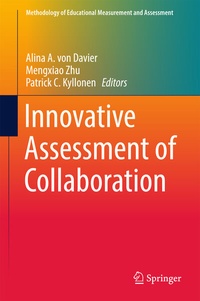
Innovative Assessment of Collaboration
Description

This edited volume provides a platform for experts from various fields to introduce and discuss their different perspectives on the topic of teamwork and collaborative problem solving. It brings together researchers in organizational teaming, educational collaboration, tutoring, simulation, and gaming as well as those involved in statistical and psychometric process modelling. This book seeks to channel this expertise towards advances in the measurement and assessment of cognitive and non-cognitive skills of individuals and teams.
Reviews / Votes
"The value of this volume is in the cross-disciplinary snapshot of the research on assessment of collaboration. The editors should be applauded for culling ideas from a variety of disciplines that would otherwise not be cross-referenced. . the references inside this volume would be an ideal starting point for anyone working in either education or IO psychology, but who is new to the assessment of collaboration." (Tyler H. Matta, Psychometrika, Vol. 83, 2018)More details
Other editions
Additional editions
Content
Prologue: Building the Foundation for Innovations in Assessment: Interdisciplinary Measurement of Collaboration and Teamwork.- 1. Introduction: Innovative Assessment of Collaboration.- PART 1: Framework and Methods.- 2. The Assessment of Team Performance: Observation and Needs.- 3. Assessing Collaboration Within and Between Teams: A Multiteam Systems Perspective.- 4. Innovation in Team Interaction: New Methods for Assessing Collaboration between Brains and Bodies Using a Multi-Level Framework.- 5. Assessing Collaborative Problem Solving Through Conversational Agents.- 6. Assessment of Discussion in Learning Contexts.- 7. Collaborative Problem Solving Measures in the Programme for International Students Assessment (PISA).- 8. Assessing and Teaching 21 st Century Skills: Collaborative Problem Solving as a Case Study.- 9. Initial Steps towards a Standardized Assessment for Collaborative Problem Solving (CPS): Practical Challenges and Strategies.- 10. Exploring Dual Eye Tracking as a Tool to Assess Collaboration.- 11. Multimodal Behavioral Analytics in Intelligent Learning and Assessment Systems.- 12. Measuring Collaboration in Cross-Cultural Contexts.- 13. Inclusive Design of Collaborative Problem-Solving Tasks.- PART 2: Modeling and Analysis.- 14. Understanding and Assessing Collaborative Processes through Relational Events.- 15. Modeling Collaboration Using Point Processes.- 16. Dynamic Bayesian Network Models for Peer Tutoring Interactions.- 17. Representing Self-Organization and Nonstationarities in Dyadic Interaction Processes Using Dynamic Systems Modeling Techniques.- 18. Modeling Collaboration with Social Network Models.- 19. Network Models for Teams with Overlapping Membership.- 20. Linking Team Neurodynamic Organizations with Observational Rating of Team Performance.
