

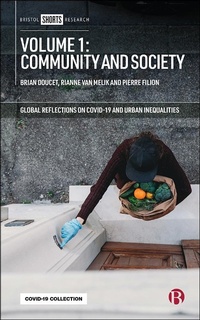
Volume 1: Community and Society
Bristol University Press
1st Edition
Published on 22. July 2021
284 pages
978-1-5292-1888-6 (ISBN)
Description

Our experiences of the city are dependent on our gender, race, class, age, ability, and sexual orientation. It was already clear before the pandemic that cities around the world were divided and becoming increasingly unequal. The pandemic has torn back the curtain on many of these pre-existing inequalities.
Contributions to this volume engage directly with different urban communities around the world. They give voice to those who experience poverty, discrimination and marginalisation in order to put them in the front and center of planning, policy, and political debates that make and shape cities.
Offering crucial insights for reforming cities to be more resilient to future crises, this is an invaluable resource for scholars and policy makers alike.
Contributions to this volume engage directly with different urban communities around the world. They give voice to those who experience poverty, discrimination and marginalisation in order to put them in the front and center of planning, policy, and political debates that make and shape cities.
Offering crucial insights for reforming cities to be more resilient to future crises, this is an invaluable resource for scholars and policy makers alike.
More details
Series
Edition
First Edition
Language
English
Place of publication
Bristol
United Kingdom
Target group
Professional and scholarly
College/higher education
Product notice
Reflowable
Illustrations
11 s/w Abbildungen, 3 s/w Tabellen
3 Tables, black and white; 11 Illustrations, black and white
File size
2,40 MB
ISBN-13
978-1-5292-1888-6 (9781529218886)
Copyright in bibliographic data and cover images is held by Nielsen Book Services Limited or by the publishers or by their respective licensors: all rights reserved.
Schweitzer Classification
Other editions
Additional editions
Volume 1: Community and Society
Community and Society
Book
07/2021
1st Edition
Bristol University Press
€60.70
Shipment within 3-4 weeks
Persons
Brian Doucet is Associate Professor and Canada Research Chair in Urban Change and Social Inclusion at the School of Planning, University of Waterloo, Canada.
Rianne van Melik is Assistant Professor in Urban Geography at the Institute for Management Research (IMR), Radboud University, Nijmegen, the Netherlands.
Pierre Filion is Professor at the School of Planning, University of Waterloo, Canada.
Rianne van Melik is Assistant Professor in Urban Geography at the Institute for Management Research (IMR), Radboud University, Nijmegen, the Netherlands.
Pierre Filion is Professor at the School of Planning, University of Waterloo, Canada.
Contributions
McGill University
McGill University
American University in Dubai
DePaul University
College of Agriculture, Science and Education
Istanbul Technical University
Istanbul Technical University
Utrecht University; Institute for Social and Economic Change
Utrecht University
Institute for Social and Economic Change
Content
Introduction ~ Brian Doucet, Rianne Van Melik and Pierre Filion
Part 1: Working Practices
Street Vendor Struggles: Maintaining a Livelihood Through the COVID-19 Lockdown in Hanoi, Vietnam ~ Sarah Turner and Nguyen N. Binh
The Man and the Scooter: How the Low-Income Worker Helps Save a Locked-Down City ~ Abdellatif Qamhaieh
The Hidden Inequities and Divisions Among Workers in the US: The Domestic Workers Workforce As Non-Essential Workers ~ Carolina Sternberg
Reflections of Living 'Hand-to-Mouth' Among 'Hustlers' During COVID-19: Insights on the Realities of Poverty in Jamaica ~ Sheere Brooks
Looking at Urban Inequalities Regarding Different Jobs in the Age of COVID-19: Who Stayed at Home, Who Did Not? ~ Ferhan Gezici and Cansu Ilhan
Part 2: Life During Lockdown
Ageist Transport Infrastructures: Rethinking Public Transport Amidst COVID-19 Lockdowns in India ~
Prajwal Nagesh, Ajay Bailey, Sobin George and Lekha Subaiya
The Pandemic and Food Insecurity in Small Cities of the Global South: A Case Study of Noapara in Bangladesh ~ M. Feisal Rahman and Hanna A. Ruszczyk
How Governments' Response to the Pandemic Exacerbate Gender Inequalities in Belarus and Ukraine: Comparative Analysis of Minsk and Kyiv Cases ~ Olga Matveieva and Vasil Navumau
Infrastructure Inequality and Privileged Capacity To Transform Everyday Life in COVID-19 South Africa ~ Charlotte Lemanski and Jiska De Groot
Under Quarantine in a City Project: Stories of Food, Family, Fear and Community ~ Jeremy Auerbach, Jordin Clark and Solange Munoz
The Impacts of Socio-Spatial Inequity: COVID-19 in Sao Paulo ~ Roberto Rocco, Beatriz Kara Jose, Higor Carvalho and Luciana Royer
Part 3: Migration, Migrants and Refugees
Liminality, Gender and Ethnic Dynamics in Urban Space: COVID-19 and Its Consequences for Young Female Migrants (YFM) in Dhaka ~ Ellen Bal, Lorraine Nencel, Hosna J. Shewly and Sanjeeb Drong
Spatial Inequality and Colonial Palimpsest in Kuala Lumpur ~ Nurul Azreen Azlan
The COVID-19 Pandemic and the Travails of Rohingya Refugees in the Largest Bangladeshi Refugee Camp ~ Diotima Chattoraj, AKM Ahsan Ullah and Mallik Akram Hossain
Singapore's Pandemic Governance and Deepening Marginalisation of Migrant Workmen ~ Sallie Yea
Part 4: Age, Race, Gender and Ability
Experiential Equity: An Environmental Neuroscientific Lens for Disparities in Urban Stress ~ Robin Mazumder
What Is the Relationship Between COVID-19 and the Movement To "Defund the Police"? ~ Richardson Dilworth and Timothy PR Weaver
Following the Voices of Older Adults During the COVID-19 Crisis: Perspectives From the Netherlands ~ Jolanda Lindenberg, Paul Van De Vijver, Lieke De Kock, David Van Bodegom and Niels Bartels
The Role of Social Infrastructures for Trans* People During the COVID-19 Pandemic ~ Magdalena Rodekirchen and Sawyer Phinney
COVID-19 and Blind Spaces: Responding to Digital (In)accessibility and Social Isolation During Lockdown for Blind, Deafblind, Low Vision, and Vision Impaired Persons in Aotearoa New Zealand ~ Rebekah Graham, Bridgette Masters-Awatere, Chrissie Cowan,
Conclusion ~ Brian Doucet, Rianne Van Melik and Pierre Filion
Part 1: Working Practices
Street Vendor Struggles: Maintaining a Livelihood Through the COVID-19 Lockdown in Hanoi, Vietnam ~ Sarah Turner and Nguyen N. Binh
The Man and the Scooter: How the Low-Income Worker Helps Save a Locked-Down City ~ Abdellatif Qamhaieh
The Hidden Inequities and Divisions Among Workers in the US: The Domestic Workers Workforce As Non-Essential Workers ~ Carolina Sternberg
Reflections of Living 'Hand-to-Mouth' Among 'Hustlers' During COVID-19: Insights on the Realities of Poverty in Jamaica ~ Sheere Brooks
Looking at Urban Inequalities Regarding Different Jobs in the Age of COVID-19: Who Stayed at Home, Who Did Not? ~ Ferhan Gezici and Cansu Ilhan
Part 2: Life During Lockdown
Ageist Transport Infrastructures: Rethinking Public Transport Amidst COVID-19 Lockdowns in India ~
Prajwal Nagesh, Ajay Bailey, Sobin George and Lekha Subaiya
The Pandemic and Food Insecurity in Small Cities of the Global South: A Case Study of Noapara in Bangladesh ~ M. Feisal Rahman and Hanna A. Ruszczyk
How Governments' Response to the Pandemic Exacerbate Gender Inequalities in Belarus and Ukraine: Comparative Analysis of Minsk and Kyiv Cases ~ Olga Matveieva and Vasil Navumau
Infrastructure Inequality and Privileged Capacity To Transform Everyday Life in COVID-19 South Africa ~ Charlotte Lemanski and Jiska De Groot
Under Quarantine in a City Project: Stories of Food, Family, Fear and Community ~ Jeremy Auerbach, Jordin Clark and Solange Munoz
The Impacts of Socio-Spatial Inequity: COVID-19 in Sao Paulo ~ Roberto Rocco, Beatriz Kara Jose, Higor Carvalho and Luciana Royer
Part 3: Migration, Migrants and Refugees
Liminality, Gender and Ethnic Dynamics in Urban Space: COVID-19 and Its Consequences for Young Female Migrants (YFM) in Dhaka ~ Ellen Bal, Lorraine Nencel, Hosna J. Shewly and Sanjeeb Drong
Spatial Inequality and Colonial Palimpsest in Kuala Lumpur ~ Nurul Azreen Azlan
The COVID-19 Pandemic and the Travails of Rohingya Refugees in the Largest Bangladeshi Refugee Camp ~ Diotima Chattoraj, AKM Ahsan Ullah and Mallik Akram Hossain
Singapore's Pandemic Governance and Deepening Marginalisation of Migrant Workmen ~ Sallie Yea
Part 4: Age, Race, Gender and Ability
Experiential Equity: An Environmental Neuroscientific Lens for Disparities in Urban Stress ~ Robin Mazumder
What Is the Relationship Between COVID-19 and the Movement To "Defund the Police"? ~ Richardson Dilworth and Timothy PR Weaver
Following the Voices of Older Adults During the COVID-19 Crisis: Perspectives From the Netherlands ~ Jolanda Lindenberg, Paul Van De Vijver, Lieke De Kock, David Van Bodegom and Niels Bartels
The Role of Social Infrastructures for Trans* People During the COVID-19 Pandemic ~ Magdalena Rodekirchen and Sawyer Phinney
COVID-19 and Blind Spaces: Responding to Digital (In)accessibility and Social Isolation During Lockdown for Blind, Deafblind, Low Vision, and Vision Impaired Persons in Aotearoa New Zealand ~ Rebekah Graham, Bridgette Masters-Awatere, Chrissie Cowan,
Conclusion ~ Brian Doucet, Rianne Van Melik and Pierre Filion
