

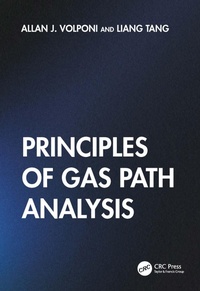
Principles of Gas Path Analysis
1st Edition
Published on 11. December 2025
448 pages
978-1-040-44394-1 (ISBN)
Description

Principles of Gas Path Analysis offers a self-contained reference of the concept and theory of gas path analysis (GPA), as both a diagnostic and prognostic methodology for gas turbine engines. It provides a chronological account of the methodology as it evolved over the past 50 years.
Before expanding into specific GPA concepts, the book begins by covering the basics that are generic to diagnostics and prognostics as well as a discussion of engine health management (EHM) and how GPA can contribute to this strategy. The text further introduces essential parameter corrections important for understanding the foundational principles of GPA. Additionally, advanced topics such as information fusion and ambiguity resolution are explored to highlight potential future advancements in the field. Examples are provided using simulated data generated from a fictional high bypass turbofan engine model. The book contains a comprehensive set of appendices with detailed treatment of the mathematical derivations and statistics behind GPA as well as specialized constructs for relevant methods such as neural networks and fuzzy logic.
The book is intended for professional engineers engaged in the gas turbine industry and EHM, including aircraft operators and maintainers. It will also benefit researchers studying gas turbine engine diagnostics and prognostics.
Before expanding into specific GPA concepts, the book begins by covering the basics that are generic to diagnostics and prognostics as well as a discussion of engine health management (EHM) and how GPA can contribute to this strategy. The text further introduces essential parameter corrections important for understanding the foundational principles of GPA. Additionally, advanced topics such as information fusion and ambiguity resolution are explored to highlight potential future advancements in the field. Examples are provided using simulated data generated from a fictional high bypass turbofan engine model. The book contains a comprehensive set of appendices with detailed treatment of the mathematical derivations and statistics behind GPA as well as specialized constructs for relevant methods such as neural networks and fuzzy logic.
The book is intended for professional engineers engaged in the gas turbine industry and EHM, including aircraft operators and maintainers. It will also benefit researchers studying gas turbine engine diagnostics and prognostics.
More details
Edition
1. Auflage
Language
English
Place of publication
London
United Kingdom
Publishing group
Taylor & Francis Ltd
Target group
College/higher education
Professional and scholarly
Illustrations
58 Tables, black and white; 66 Line drawings, color; 112 Line drawings, black and white; 1 Halftones, color; 1 Halftones, black and white; 67 Illustrations, color; 113 Illustrations, black and white
File size
37,69 MB
ISBN-13
978-1-040-44394-1 (9781040443941)
Copyright in bibliographic data and cover images is held by Nielsen Book Services Limited or by the publishers or by their respective licensors: all rights reserved.
Schweitzer Classification
Other editions
Additional editions
Allan J. Volponi | Liang Tang
Principles of Gas Path Analysis
Book
approx. 12/2025
1st Edition
CRC Press
€267.70
Not yet published
Persons
Dr. Allan J Volponi is a retired Senior Fellow from the Controls & Diagnostic Systems organization at Pratt & Whitney in East Hartford, CT. He received his B.S. and M.S. degrees from Pratt Institute (1971-2), and Ph.D. from the Adelphi University (1977), all in mathematics. He spent 40 years with United Technologies, initially with the Hamilton Sundstrand Division as a Senior Principal Engineer in the engine controls group before transferring to P&W in 2000. His interests are in propulsion health management where he has been active in the development of engine performance diagnostic systems. Dr. Volponi has been the recipient of numerous awards including the 1992 Manly Memorial Medal by the SAE, the 2006 Aircraft Engine Technology Award by ASME, the Silver Specialist and Sir Roy Fedden Awards from the Royal Aeronautical Society, and the 2013 Scholar Award from ASME/IGTI. Dr. Volponi has been an active member of the International Gas Turbine Institute (IGTI) and a past Chairman of its Controls, Diagnostics and Instrumentation Committee and is an ASME Fellow. He holds 17 patents, has 2 pending, and he is the author of numerous technical papers on gas turbine diagnostics and prognostics health management.
Dr. Liang Tang is an expert in jet engine health management, controls, and the application of artificial intelligence (AI) and machine learning (ML) in aerospace. Since 2012, he has served in several technical leadership positions with two major engine OEMs, focusing on engine health management, diagnostics and prognostics, and the application of AI/ML to inspection and process improvements. Dr. Tang is recognized for extending gas path analysis from snapshot-based approaches to the full-flight domain and for applying ML techniques to resolve diagnostic ambiguity. Since 2005, he has also led multiple government-funded research programs as Principal Investigator for agencies including NASA and the DoD, spanning health management, controls, navigation, and autonomy. Dr. Tang earned his Ph.D. from Shanghai Jiao Tong University in 1999 and was a postdoctoral research fellow at the Georgia Institute of Technology from 2003 to 2004. He has published more than 60 papers and holds multiple patents related to diagnostics, prognostics and health management for aerospace systems. He remains actively engaged in technical committees and standards organizations such as the SAE and ASME, where he has held several leadership positions, including chairing technical committees over the past decade.
Dr. Liang Tang is an expert in jet engine health management, controls, and the application of artificial intelligence (AI) and machine learning (ML) in aerospace. Since 2012, he has served in several technical leadership positions with two major engine OEMs, focusing on engine health management, diagnostics and prognostics, and the application of AI/ML to inspection and process improvements. Dr. Tang is recognized for extending gas path analysis from snapshot-based approaches to the full-flight domain and for applying ML techniques to resolve diagnostic ambiguity. Since 2005, he has also led multiple government-funded research programs as Principal Investigator for agencies including NASA and the DoD, spanning health management, controls, navigation, and autonomy. Dr. Tang earned his Ph.D. from Shanghai Jiao Tong University in 1999 and was a postdoctoral research fellow at the Georgia Institute of Technology from 2003 to 2004. He has published more than 60 papers and holds multiple patents related to diagnostics, prognostics and health management for aerospace systems. He remains actively engaged in technical committees and standards organizations such as the SAE and ASME, where he has held several leadership positions, including chairing technical committees over the past decade.
Content
1. Engine Health Management. 2. Diagnostics and Prognostics. 3. Parameter Corrections. 4. Gas Path Analysis Fundamentals. 5. Discrete Time Gas Path Analysis. 6. Transient Modeling. 7. Extending Beyond Steady-State Gas Path Analysis. 8. Information Fusion. 9. Ambiguity Resolution. 10. Prognostics and Future Trends. Addendum to Introduction. Chapter 2 Addendums. Chapter 3 Addendums. Chapter 4 Addendums. Chapter 5 Addendums. Chapter 6 Addendums. Chapter 7 Addendums. Chapter 8 Addendums. Chapter 9 Addendums.
