

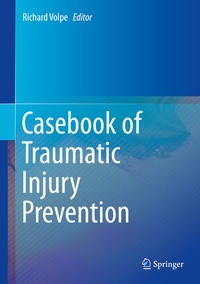
Casebook of Traumatic Injury Prevention
Description

This casebook profiles exceptional traumatic injury prevention programs from all over the globe. Its detailed description and analysis employ a multi-stage process of identifying, evaluating, and casing effective prevention practices. The case studies reflect how legislative and regulatory information impact prevention efforts and provide insight into how national centers for injury prevention and control inform prevention practices on countrywide levels. The authors work with outcome-based research criteria to select and develop their comprehensive and contextually aware profiles of the programs. All included case studies follow the BRIO approach (Background, Resources, Implementation, and Outcome) - a model designed to provide a consistent way of describing programs that have been evaluated and found to be exceptional practices.
The scope of the Casebook ranges across:
- The challenge of traumatic injury prevention
- Sports and recreation-related traumatic injury prevention
- Fall-related traumatic injury prevention
- Road traffic-related traumatic injury prevention
- Traumatic injury prevention within complex systems
In its recognition of traumatic injury prevention across the lifespan as a critical and complex public health challenge, the Casebook of Traumatic Injury Prevention promises to be an influential and authoritative resource for professionals and students in public health, safety, injury prevention, medicine, psychology, sociology, nursing, and engineering. Government agencies and institutions such as the Centers for Disease Control and Prevention (CDC), public health departments, and safety associations also would find the Casebook relevant to their work.
More details
Other editions
Additional editions
Person
Richard Volpe is Projects Director of Life Span Adaptation Projects at the Laidlaw Research Centre of the Dr. Eric Jackman Institute of Child Study, and Professor in the Department of Applied Psychology and Human Development of the Ontario Institute for Studies in Education (OISE) at the University of Toronto in Ontario, Canada.
